Core services
Enterprise Data Extraction

Scalable web, app and AI-powered collection across 40+ countries.

All 58 services →
New 2026
AI Training Data

Corpus building with provenance and opt-out compliance.

Learn more →
Free pilot
24-hour sample

We run collection on your own sources before you commit.

Get a sample →
58Services
40+Countries
DEVELOPER

Ready-Made Scrapers

Pre-built for top platforms. Self-serve, no setup.

View All →
TRY FREE

API Playground

Test endpoints instantly. No credit card.

Start Free →
28Tools
2SDKs
icons Delivery & SDKs
Streaming Crawl API Scheduler Realtime Alerts Webhook Delivery 🐍 Python SDK 💚 Node.js SDK

Need it managed instead?

Fixed monthly retainer, named engineer, no per-request metering.

Managed Data API →
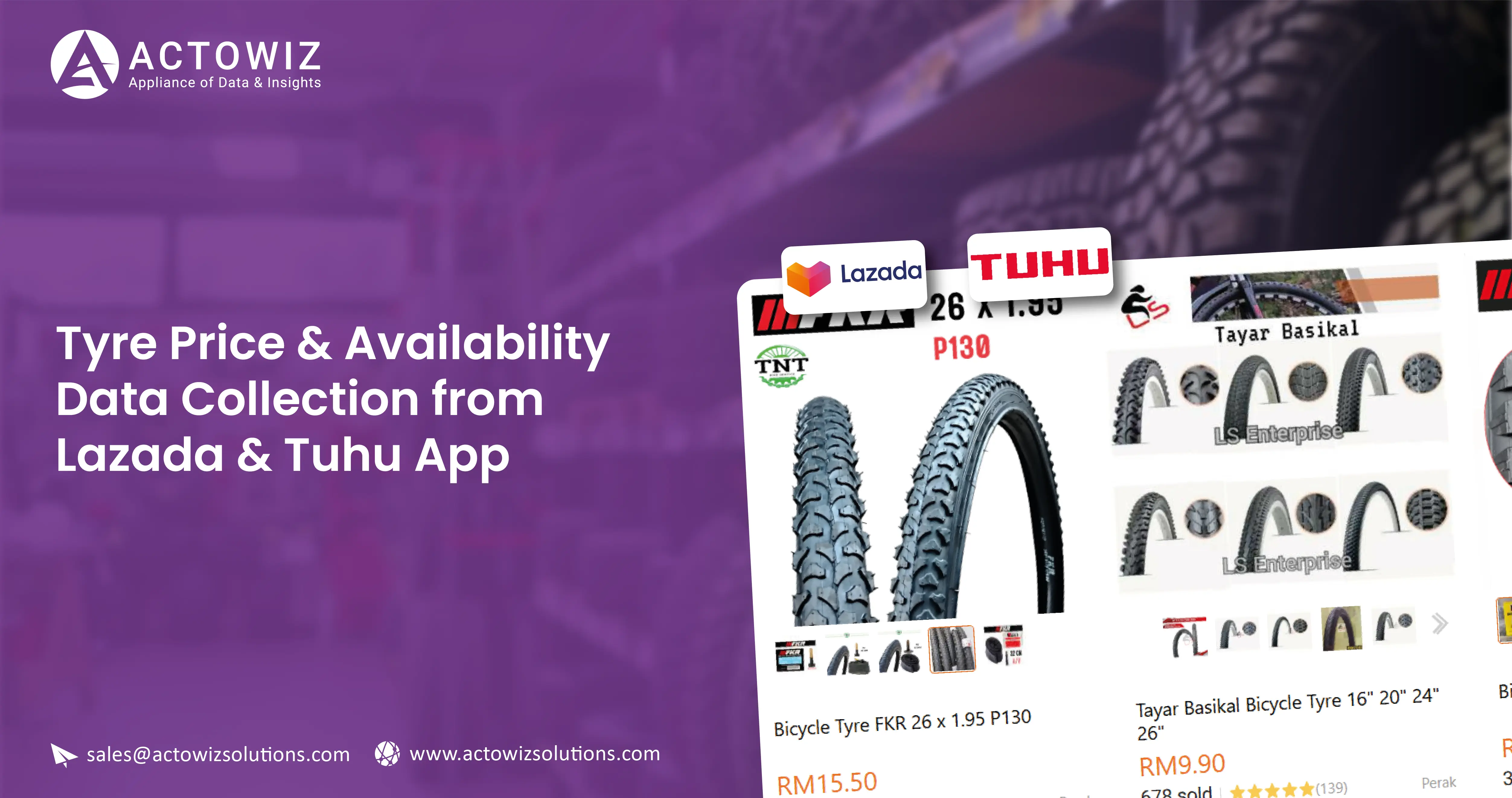
How to Overcome Competitor Price and Availability Gaps with Tyres Categories Data Collection from Lazada and Tuhu App

Introduction

Businesses can overcome competitor price and availability gaps by continuously collecting, standardizing, and comparing tyre product information across online marketplaces and apps. Tyres Categories data collection from Lazada and Tuhu App can help automotive brands, tyre retailers, distributors, and market researchers monitor product prices, tyre sizes, specifications, discounts, ratings, and availability in a structured format.

The core challenge is not simply finding tyre products online. The challenge is understanding how competing products change over time. A tyre may have a different price because of a temporary promotion, a different size, a different load index, or a different availability status. Without historical and normalized data, these differences can easily lead to incorrect competitive conclusions.

Automotive Data Scraping Services can automate the collection of relevant product attributes and convert changing marketplace information into datasets suitable for analysis. Businesses can then identify pricing gaps, compare assortment depth, monitor product availability, and evaluate competitive positioning.

For automotive eCommerce teams, the most useful workflow connects product, price, specification, and availability information. This allows decision-makers to answer practical questions quickly: Which tyre brands are gaining assortment visibility? Which sizes are most competitive? Where are price differences increasing? Which products frequently become unavailable? Which promotions affect the market most?

The following sections explain how structured data collection can help solve these challenges.

How Can Marketplace Product Extraction Improve Competitive Pricing?

Lazada Tyre Product Data Extraction gives automotive businesses a structured way to analyze tyre listings across a large digital marketplace. Instead of manually checking individual products, analysts can capture product titles, brands, tyre sizes, prices, discounts, seller information, ratings, reviews, and availability where publicly accessible.

For pricing teams, the biggest advantage is historical comparison. A single price observation provides limited intelligence. Repeated observations reveal whether a price change is temporary or persistent. This helps businesses distinguish promotional pricing from longer-term competitive movement.

The extracted data can also be standardized by brand, model, size, and specification. This is important because two products with similar names may have completely different specifications. Comparing equivalent products improves the reliability of price-gap calculations.

A structured dataset can support several practical decisions. Pricing teams can identify products priced substantially above or below comparable listings. Category managers can detect fast-changing tyre segments. Marketing teams can observe discount activity. Retailers can identify products that require closer monitoring.

Illustrative Competitive Pricing Data Maturity, 2020–2026
Year Illustrative Index* Primary Capability
2020 100 Manual product research
2021 109 SKU-level comparison
2022 121 Automated price collection
2023 134 Competitor benchmarking
2024 148 Promotion monitoring
2025 163 Alert-driven pricing
2026 180 AI-ready pricing intelligence

*Illustrative industry maturity index, not actual Lazada historical data.

The key point is that extraction should be designed around comparable products. Businesses should normalize brand, model, size, unit, price, and promotional fields before calculating competitive gaps. This creates a more reliable foundation for pricing decisions.

How Can App-Level Data Improve Tyre Product Monitoring?

Tuhu App Tyre Product Data Scraping can help businesses understand tyre products presented through a mobile-first automotive retail environment. App-based product information may contain valuable attributes such as product names, brands, specifications, prices, promotional offers, and availability indicators, depending on what is publicly accessible.

Mobile commerce creates an additional data challenge because product information may be presented differently from conventional websites. Data collection therefore needs to account for structured application content and changing product interfaces.

For automotive brands and retailers, app-level monitoring can provide another competitive reference point. Comparing app observations with marketplace data can reveal differences in pricing, assortment, promotions, and product availability.

Historical snapshots are particularly useful. If a tyre appears at a promotional price on one day and returns to a standard price later, the dataset can preserve that change. Analysts can then distinguish temporary campaigns from sustained pricing strategies.

Illustrative Mobile Commerce Monitoring Trend, 2020–2026
Year Illustrative Data Coverage Index* Analytical Focus
2020 100 Basic digital monitoring
2021 112 Product-level tracking
2022 126 Price and promotion analysis
2023 139 App assortment monitoring
2024 153 Cross-channel comparison
2025 169 Automated monitoring
2026 186 Real-time intelligence workflows

*Illustrative trend for explaining data maturity; not actual Tuhu App statistics.

Businesses should focus on collecting only the fields required for their commercial objectives. Useful fields may include product identifier, brand, model, tyre size, price, discount, availability, rating, timestamp, and category. Proper validation is essential when product information changes frequently.

Illustrative Cross-Platform Intelligence Growth, 2020–2026
Year Illustrative Comparison Index* Main Use
2020 100 Separate source monitoring
2021 108 Basic product comparison
2022 120 Price comparison
2023 133 Assortment benchmarking
2024 149 Cross-channel intelligence
2025 166 Automated gap detection
2026 185 Unified competitive analytics

*Illustrative index, not measured Lazada or Tuhu performance data.

The most actionable approach is to create a common schema across sources. Product identifiers, names, brands, sizes, prices, promotions, and availability should be normalized before comparison. This reduces false differences and improves the quality of competitive reporting.

For decision-makers, cross-platform analysis provides a clearer answer to an important question: Is a competitive gap caused by price, assortment, availability, or differences in product specifications?

Why Should Businesses Compare Both Digital Sources?

Lazada and Tuhu Tyre Product Data Scraping can create a broader competitive view by combining marketplace and app-based product observations. Looking at only one source may leave gaps in pricing, assortment, or availability intelligence.

Cross-source comparison can answer questions that individual datasets cannot. For example, a tyre may be listed on one platform but absent on another. Prices for an equivalent product may also differ because of promotions, seller strategies, fulfillment arrangements, or platform-specific offers.

Businesses can build a comparison layer that maps products according to brand, model, size, specification, and other identifying attributes. Once products are normalized, analysts can calculate price differences and identify assortment gaps.

This approach is particularly valuable for tyre retailers competing across multiple digital channels. Instead of monitoring each source independently, teams can create a unified view of the market.

How Can Catalog-Level Extraction Strengthen Assortment Decisions?

Tyre product catalog scraping from Lazada and Tuhu can help businesses understand the composition of online tyre assortments. Catalog-level data goes beyond price tracking by showing which brands, models, sizes, and product variants are represented.

For category managers, this information can identify assortment gaps. A business may discover that competitors offer multiple tyre sizes or models that are missing from its own digital catalog. It can also reveal whether certain brands have expanded their presence within a category.

Catalog data can be organized by manufacturer, tyre type, size, vehicle application, price segment, and product specification. This makes it easier to compare assortment breadth and identify areas requiring further research.

Illustrative Assortment Intelligence Trend, 2020–2026
Year Illustrative Catalog Intelligence Index* Business Application
2020 100 Basic catalog mapping
2021 111 Brand comparison
2022 123 Product range analysis
2023 137 Size-level benchmarking
2024 151 Assortment gap detection
2025 168 Automated catalog monitoring
2026 187 AI-supported assortment planning

*Illustrative industry index, not actual platform catalog statistics.

A good catalog dataset should preserve historical observations. This allows analysts to identify newly introduced products, removed listings, changing specifications, and assortment expansion.

The practical benefit is faster assortment planning. Instead of relying on periodic manual market research, category teams can use structured datasets to prioritize categories and products that show meaningful changes.

How Do Tyre Specifications Improve Product Comparisons?

Tyre size and specification data from Lazada and Tuhu can make competitive analysis substantially more accurate because tyre products cannot be compared reliably using brand and model names alone.

Relevant attributes may include tyre width, aspect ratio, rim diameter, load index, speed rating, tyre type, seasonality, vehicle compatibility, and other publicly available specifications. These fields allow analysts to separate genuinely comparable products from products that only appear similar.

Specification normalization is particularly important for pricing analysis. Comparing a premium tyre with a different size against a lower-cost tyre can produce a misleading price gap. A normalized dataset allows businesses to compare products within meaningful specification groups.

Illustrative Specification Intelligence Maturity, 2020–2026
Year Illustrative Specification Index* Primary Use
2020 100 Basic product descriptions
2021 110 Size normalization
2022 122 Specification mapping
2023 136 Comparable SKU grouping
2024 150 Detailed product benchmarking
2025 169 Automated specification matching
2026 188 AI-assisted product matching

*Illustrative index created for explanation; not actual Lazada or Tuhu statistics.

Businesses can use normalized specifications to build comparable product groups. These groups can then support price benchmarking, assortment analysis, product recommendations, and market research.

A strong specification dataset also helps prevent duplicate counting. The same tyre can appear under different titles, abbreviations, or seller descriptions. Matching products using multiple attributes can provide a more consistent view of the actual assortment.

How Can Automated Marketplace Monitoring Reduce Competitive Blind Spots?

A Lazada Product Data Scraper can help businesses automate the collection of publicly accessible tyre product information at defined intervals. Automation is useful when product prices, promotions, availability, and listings change too frequently for manual monitoring.

Combined with Tyres Categories data collection from Lazada and Tuhu App, automated workflows can support a broader competitive intelligence system. The objective is not simply to collect more records. It is to detect commercially meaningful changes quickly.

A business can establish monitoring rules for significant price changes, newly listed products, discontinued listings, availability changes, or assortment expansion. Historical records can then be used to determine whether an event is temporary or part of a broader trend.

Illustrative Automation Maturity, 2020–2026
Year Illustrative Automation Index* Monitoring Capability
2020 100 Manual checks
2021 108 Scheduled collection
2022 119 Automated product extraction
2023 133 Historical snapshots
2024 149 Change detection
2025 171 Automated alerts
2026 190 Near-real-time intelligence

*Illustrative automation maturity index, not actual scraper performance data.

The most useful output is a change-oriented dataset. Instead of asking analysts to review every product every day, the system can highlight what changed and when. This makes competitive intelligence more actionable.

Data pipelines should include validation, duplicate detection, timestamping, schema consistency, and monitoring for collection failures. These controls help maintain data quality as source structures evolve.

How Can Actowiz Solutions Help?

Actowiz Solutions can help automotive retailers, tyre manufacturers, distributors, market research firms, and eCommerce intelligence companies develop structured data pipelines for competitive monitoring.

Stock & Availability Data Services can help businesses track observable product availability and changes over time. When availability is combined with product, price, and timestamp information, teams can investigate whether competitive gaps are caused by pricing or assortment availability.

Actowiz Solutions can also structure data collection around specific business objectives. For pricing teams, the focus may be competitor price movements. For category managers, it may be assortment and specification coverage. For market researchers, the priority may be historical product datasets.

Tyres Categories data collection from Lazada and Tuhu App can be incorporated into workflows designed to capture relevant product information across marketplace and app environments, subject to technical accessibility, applicable platform rules, and legal requirements.

With Web Scraping, businesses can build structured collection workflows for accessible web-based product information. Mobile App Scraping can support appropriate app-based data collection where information is technically accessible and its use complies with applicable terms and requirements.

The resulting Real-time dataset can support dashboards, APIs, business intelligence systems, pricing engines, research platforms, and AI applications.

A practical implementation should begin with a defined schema. Product name, brand, model, tyre size, specifications, price, discount, seller, rating, availability, source, and timestamp are examples of fields that may be useful depending on the business requirement.

The next step is normalization. Product records from different sources should be mapped into consistent categories and comparable identifiers. Finally, businesses can add monitoring rules that identify important price, availability, and assortment changes.

Conclusion

Competitive gaps become easier to identify when businesses have consistent visibility into product prices, specifications, assortment, and availability. Tyres Categories data collection from Lazada and Tuhu App can provide the structured foundation needed to compare digital tyre markets and identify meaningful changes over time.

The most effective strategy is not simply to collect large volumes of marketplace information. It is to create a reliable, normalized, historical dataset that answers specific commercial questions. Automotive retailers can use this information to monitor competitor pricing, identify assortment gaps, compare equivalent tyre specifications, and track availability changes.

For brands and distributors, structured competitive intelligence can support better market research and channel strategy. For eCommerce teams, automated monitoring can reduce manual research and make important changes easier to detect.

Actowiz Solutions can help businesses design data collection workflows aligned with their pricing, assortment, availability, and market intelligence requirements.

Ready to close your competitive pricing and availability gaps? Contact Actowiz Solutions today to build a structured tyre data pipeline tailored to your business needs!

You can also reach us for all your mobile app scraping, data collection, web scraping , and instant data scraper service requirements!

Social Proof That Converts

Trusted by Global Leaders Across Q-Commerce, Travel, Retail, and FoodTech

Our web scraping expertise is relied on by 4,000+ global enterprises including Zomato, Tata Consumer, Subway, and Expedia — helping them turn web data into growth.

4,000+ Enterprises Worldwide
50+ Countries Served
20+ Industries
Join 4,000+ companies growing with Actowiz →
Real Results from Real Clients

Hear It Directly from Our Clients

Watch how businesses like yours are using Actowiz data to drive growth.

1 min
★★★★★
"Actowiz Solutions offered exceptional support with transparency and guidance throughout. Anna and Saga made the process easy for a non-technical user like me. Great service, fair pricing!"
TG
Thomas Galido
Co-Founder / Head of Product at Upright Data Inc.
2 min
★★★★★
"Actowiz delivered impeccable results for our company. Their team ensured data accuracy and on-time delivery. The competitive intelligence completely transformed our pricing strategy."
II
Iulen Ibanez
CEO / Datacy.es
1:30
★★★★★
"What impressed me most was the speed — we went from requirement to production data in under 48 hours. The API integration was seamless and the support team is always responsive."
FC
Febbin Chacko
-Fin, Small Business Owner
icons 4.8/5 Average Rating
icons 50+ Video Testimonials
icons 92% Client Retention
icons 50+ Countries Served

Join 4,000+ Companies Growing with Actowiz

From Zomato to Expedia — see why global leaders trust us with their data.

Why Global Leaders Trust Actowiz

Backed by automation, data volume, and enterprise-grade scale — we help businesses from startups to Fortune 500s extract competitive insights across the USA, UK, UAE, and beyond.

icons
7+
Years of Experience
Proven track record delivering enterprise-grade web scraping and data intelligence solutions.
icons
4,000+
Projects Delivered
Serving startups to Fortune 500 companies across 50+ countries worldwide.
icons
200+
In-House Experts
Dedicated engineers across scrapers, AI/ML models, APIs, and data quality assurance.
icons
9.2M
Automated Workflows
Running weekly across eCommerce, Quick Commerce, Travel, Real Estate, and Food industries.
icons
270+ TB
Data Transferred
Real-time and batch data scraping at massive scale, across industries globally.
icons
380M+
Pages Crawled Weekly
Scaled infrastructure for comprehensive global data coverage with 99% accuracy.

AI Solutions Engineered
for Your Needs

LLM-Powered Attribute Extraction: High-precision product matching using large language models for accurate data classification.
Advanced Computer Vision: Fine-grained object detection for precise product classification using text and image embeddings.
GPT-Based Analytics Layer: Natural language query-based reporting and visualization for business intelligence.
Human-in-the-Loop AI: Continuous feedback loop to improve AI model accuracy over time.
icons Product Matching icons Attribute Tagging icons Content Optimization icons Sentiment Analysis icons Prompt-Based Reporting

Connect the Dots Across
Your Retail Ecosystem

We partner with agencies, system integrators, and technology platforms to deliver end-to-end solutions across the retail and digital shelf ecosystem.

icons
Analytics Services
icons
Ad Tech
icons
Price Optimization
icons
Business Consulting
icons
System Integration
icons
Market Research
Become a Partner →

Popular Datasets — Ready to Download

Browse All Datasets →
icons
Amazon
eCommerce
Free 100 rows
icons
Zillow
Real Estate
Free 100 rows
icons
DoorDash
Food Delivery
Free 100 rows
icons
Walmart
Retail
Free 100 rows
icons
Booking.com
Travel
Free 100 rows
icons
Indeed
Jobs
Free 100 rows

Latest Insights & Resources

View All Resources →
thumb
Blog

How to Overcome Competitor Price and Availability Gaps with Tyres Categories Data Collection from Lazada and Tuhu App

Tyres Categories data collection from Lazada and Tuhu App helps businesses track tyre prices, brands, availability, and assortment for market insights.

thumb
Case Study

How We Empowered a Leading Food Brand Using Scrape Ready-to-Cook Cut Veg Product Data from Blinkit TN for Smarter Product & Pricing Decisions

Track Scrape Ready-to-Cook Cut Veg Product Data from Blinkit TN to monitor prices, availability, SKUs, and trends for smarter retail insights.

thumb
Report

Brazil Car Rental Pricing Intelligence Report 2026

Brazil Car Rental Pricing Intelligence Report 2026 reveals rental price trends, market shifts, competitor rates, and opportunities for smarter pricing.

Start Where It Makes Sense for You

Whether you're a startup or a Fortune 500 — we have the right plan for your data needs.

icons
Enterprise
Book a Strategy Call
Custom solutions, dedicated support, volume pricing for large-scale needs.
icons
Growing Brand
Get Free Sample Data
Try before you buy — 500 rows of real data, delivered in 2 hours. No strings.
icons
Just Exploring
View Plans & Pricing
Transparent plans from $500/mo. Find the right fit for your budget and scale.
Get in Touch
Let's Talk About
Your Data Needs
Tell us what data you need — we'll scope it for free and share a sample within hours.
  • icons
    Free Sample in 2 HoursShare your requirement, get 500 rows of real data — no commitment.
  • icons
    Plans from $500/monthFlexible pricing for startups, growing brands, and enterprises.
  • icons
    US-Based SupportOffices in New York & California. Aligned with your timezone.
  • icons
    ISO 9001 & 27001 CertifiedEnterprise-grade security and quality standards.
Request Free Sample Data
Fill the form below — our team will reach out within 2 hours.
+1
Free 500-row sample · No credit card · Response within 2 hours

Request Free Sample Data

Our team will reach out within 2 hours with 500 rows of real data — no credit card required.

+1
Free 500-row sample · No credit card · Response within 2 hours