🎃 HALLOWEEN OFF Spooky Savings Event! Get FLAT 30% OFF on all Web Scraping & Data Extraction Plans 30% OFF Web Scraping Plans!
Ends in: 00d : 00h : 00m : 00s
🦇
👻
🎃 Spooktacular Limited Offer

Don’t Let High Data Costs Haunt You! 🎃

Get FLAT 30% OFF

Scrape competitor prices, monitor MAP, and extract real-time datasets at a spooky discount this Halloween.

Offer Expires In:
00d : 00h : 00m : 00s
⚡ Claim 30% Discount Now
🎃
Promo Code Copied!
SPOOKY30 (30% OFF Applied)
Core services
Enterprise Data Extraction

Scalable web, app and AI-powered collection across 40+ countries.

All 58 services →
New 2026
AI Training Data

Corpus building with provenance and opt-out compliance.

Learn more →
Free pilot
24-hour sample

We run collection on your own sources before you commit.

Get a sample →
58Services
40+Countries
DEVELOPER

Ready-Made Scrapers

Pre-built for top platforms. Self-serve, no setup.

View All →
TRY FREE

API Playground

Test endpoints instantly. No credit card.

Start Free →
28Tools
2SDKs
icons Delivery & SDKs
Streaming Crawl API Scheduler Realtime Alerts Webhook Delivery 🐍 Python SDK 💚 Node.js SDK
Need it managed instead?

Fixed monthly retainer, named engineer, no per-request metering.

Managed Data API →
HOT

Case Studies

How brands use Actowiz, with named outcomes.

Read →
FREE

Sample Datasets

Real output, no signup.

Download →
NEW

ROI Calculator

Model the return on a data engagement.

Calculate →

Introduction

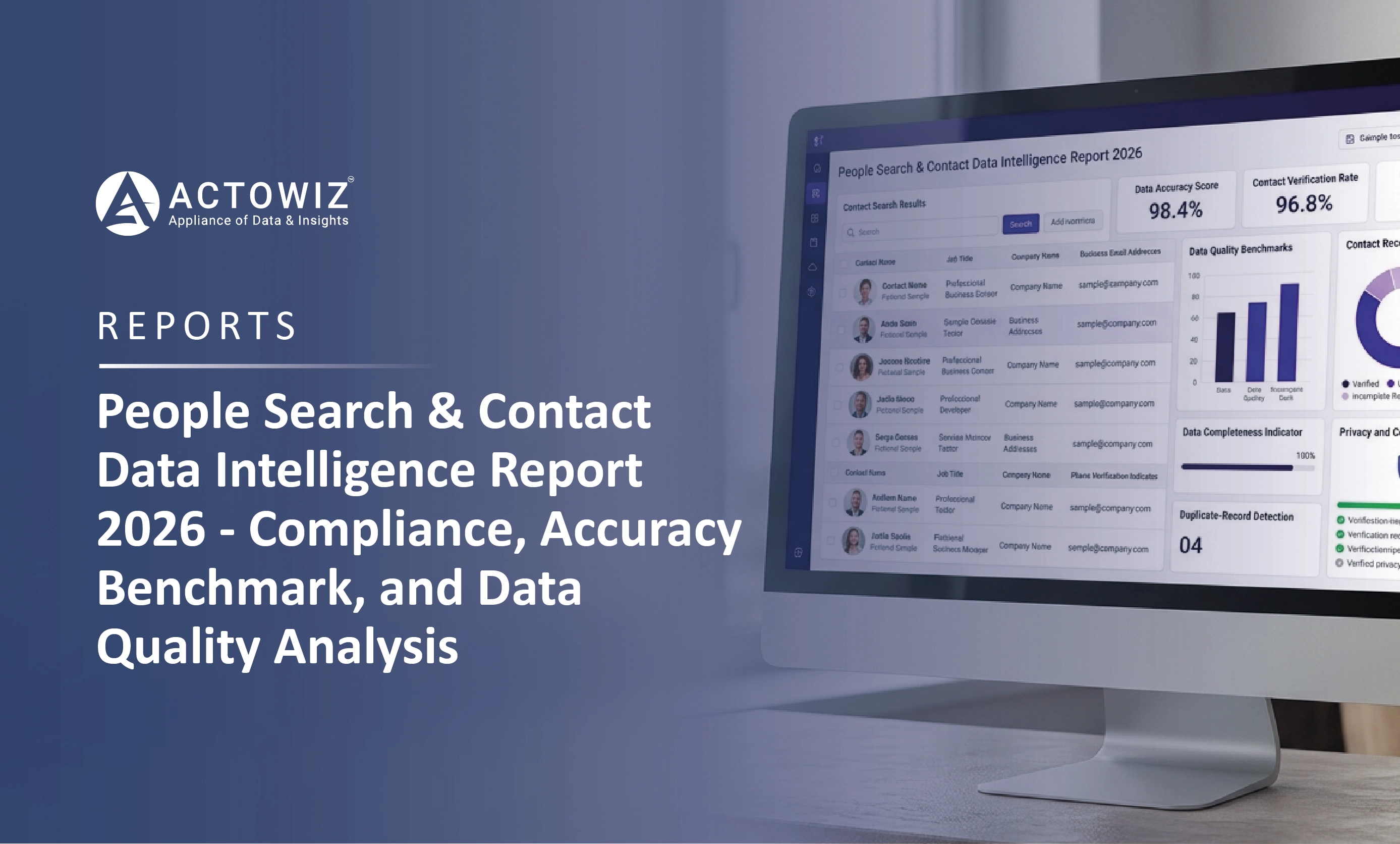
The People Search & Contact Data Intelligence Report 2026 examines the evolving requirements for collecting, validating, structuring, and responsibly using publicly available people and contact information in the United States. People-search platforms commonly aggregate information from data brokers, public records, and publicly accessible online sources, making data provenance, accuracy, privacy, and lawful use important considerations for businesses. The FTC specifically describes people-search sites as a type of data broker and notes that they can compile information from public records and other data sources. Consumer Advice

Custom Data Extraction Services can support structured research workflows by extracting permitted information into consistent fields for validation and analysis. However, extraction capability does not itself establish that information is accurate, current, permissible to use, or appropriate for a particular purpose. NIST's current digital identity guidance emphasizes reliable identity proofing and defined assurance levels, while U.S. privacy enforcement increasingly focuses on responsible collection, retention, disclosure, and deletion practices. NIST Computer Security Resource Center

U.S. Privacy and Data-Quality Indicators, 2020–2026
Year Verified indicator Significance
2020 79% of U.S. adults surveyed said they were at least somewhat concerned about how companies used their collected data. Demonstrates longstanding consumer concern about personal-data use. Pew Research Center
2021 FTC privacy enforcement continued to include cases involving consumer-information practices. Shows continuing federal oversight. Federal Trade Commission
2022 FTC brought action involving Twitter's use of account-security email addresses and phone numbers for targeted advertising. Illustrates the importance of purpose limitation and disclosure. Federal Trade Commission
2023 FTC reported 97 privacy cases and 89 data-security cases cumulatively since 1999. Provides a measurable indication of long-term enforcement activity. Federal Trade Commission
2024 FTC announced actions involving Avast, X-Mode Social, and InMarket concerning collection and handling of consumer information. Shows increased scrutiny of large-scale data collection and aggregation. Federal Trade Commission
2025 NIST published SP 800-63-4, including updated identity-proofing and assurance guidance. Strengthens the technical framework for identity verification. NIST
2026 California's Delete Act requires data brokers to use the accessible deletion mechanism at least every 45 days beginning August 1, 2026. Demonstrates the operational importance of deletion and consumer-control workflows. California Privacy Protection Agency

Mapping the Modern People-Data Collection Environment

The SearchPeopleFree.com data intelligence USA landscape illustrates why people-search research requires careful separation of discovery, extraction, validation, and permitted use. The FTC explains that people-search sites can collect information from other data brokers, publicly accessible social-media profiles, and federal, state, and local public records. Public-record categories can include property information, voter registration information, driving records, and court-related records. Consumer Advice

Web Data Mining can technically identify and structure information from websites, but responsible research requires more than simply locating a field. A useful dataset should preserve source context, collection timestamps, page-level provenance, and the distinction between directly observed information and information inferred from multiple records. This is particularly important when several people share names, when addresses change, or when records contain outdated contact information.

NIST's 2025 identity-proofing guidance provides a useful benchmark for thinking about verification. It defines identity-proofing requirements around establishing evidence that reliably identifies an applicant and establishes three identity-assurance levels. Although NIST's guidance is designed for digital authentication and government systems rather than commercial people-search websites, its emphasis on evidence and assurance provides a useful conceptual framework for evaluating identity-related datasets. NIST Computer Security Resource Center

Verified benchmark points
Indicator Verified information
U.S. adults surveyed concerned about company use of collected data 79%
U.S. adults surveyed saying they understood a great deal about what companies did with collected data in the cited 2019 survey 6%
NIST identity-assurance levels 3
California data-broker deletion-mechanism interval beginning August 2026 45 days

The figures above come directly from Pew, NIST, and CPPA sources rather than estimates. Pew Research Center

For businesses, the central lesson is that collection and intelligence should be treated as separate stages. A record being publicly accessible does not automatically establish that it is accurate or suitable for every downstream use. Data lineage and validation therefore become essential parts of a professional people-data workflow.

Establishing Responsible Controls for People-Search Information

SearchPeopleFree people search data compliance should be evaluated through the broader principles of lawful collection, transparency, accuracy, security, retention, and consumer rights. The FTC notes that people-search websites may aggregate personal information from numerous sources and sell reports to customers. The same guidance also provides consumers with information about requesting that people-search sites stop selling their information. Consumer Advice

The compliance environment has become more operationally demanding. California's Delete Act became effective January 1, 2026, and the California Privacy Protection Agency states that beginning August 1, 2026, data brokers must access the state's accessible deletion mechanism at least once every 45 days and process eligible deletion requests, subject to specified exceptions. California Privacy Protection Agency

Federal enforcement also demonstrates that privacy responsibilities can extend beyond initial collection. The FTC's enforcement record includes actions involving misleading data practices, inadequate security, improper use of personal information, and failures involving consumer deletion or consent. Federal Trade Commission

Compliance developments
Year Verified development
2020 Pew documented substantial U.S. concern over corporate use of personal information. Pew Research Center
2021 FTC privacy enforcement included litigation involving Public Data and other consumer-data matters. Federal Trade Commission
2022 FTC action against Twitter addressed deceptive use of account-security information. Federal Trade Commission
2023 FTC's cumulative privacy enforcement total reached 97 cases since 1999. Federal Trade Commission
2024 FTC pursued actions against data aggregators concerning consumer location information. Federal Trade Commission
2025 NIST released Revision 4 of its Digital Identity Guidelines. NIST
2026 California's Delete Act operationalized a centralized deletion mechanism for data brokers. California Privacy Protection Agency

A responsible data workflow should therefore maintain source attribution, collection dates, update schedules, deletion handling, access controls, and use-case restrictions. Compliance cannot be reduced to a single checkbox because requirements can depend on jurisdiction, source, data category, purpose, and downstream application.

Measuring Dataset Structure, Coverage, and Reliability

A SearchPeopleFree people search dataset should not be treated as inherently accurate simply because individual records originate from public or commercially accessible sources. Data intelligence depends on how records are collected, matched, normalized, refreshed, and validated. Names, telephone numbers, email addresses, addresses, professional information, and public-record attributes can change at different rates, creating different freshness requirements.

The People Search & Contact Data Intelligence Report 2026 therefore treats data quality as a multidimensional assessment rather than a single accuracy percentage. NIST's current identity-proofing guidance emphasizes evidence-based identity establishment and assurance levels, reinforcing the principle that identity confidence should be connected to the evidence supporting a record. NIST Computer Security Resource Center

Data-quality measurement framework
Quality dimension What should be measured Verification approach
Accuracy Whether a field correctly represents the underlying information Source comparison and validation
Completeness Whether required fields are populated Field-level completeness checks
Freshness How recently information was confirmed Timestamp and refresh tracking
Uniqueness Whether duplicate records exist Entity-resolution checks
Consistency Whether fields agree across sources Cross-source comparison
Provenance Whether the origin of each field is known Source and timestamp retention

There is no credible universal accuracy percentage that can be applied to every people-search dataset. Accuracy depends on the source population, geographic coverage, matching rules, update frequency, and definition of a correct record. Publishing an unsupported blanket accuracy rate would therefore be misleading.

A stronger benchmarking model evaluates each attribute separately. For example, an organization may validate a telephone number independently from an address and evaluate identity matching separately from contactability. This approach allows data teams to identify exactly where a dataset performs well and where additional verification is necessary.

The distinction is particularly important for business intelligence. A dataset can contain many records while still producing weak results if duplicate identities, stale addresses, disconnected numbers, or ambiguous name matches are not controlled. Structured quality scoring can make these limitations visible before data reaches downstream systems.

Building Reliable Data Interfaces for Business Intelligence

A People Search Data API for Business data Intelligence can provide a structured interface for delivering approved data fields to internal applications, research platforms, analytics environments, or verification workflows. APIs can improve consistency by standardizing field structures and reducing the need for repeated manual extraction. However, an API does not automatically guarantee that the underlying information is correct or legally appropriate.

For people-related information, the data contract should clearly identify fields, source provenance, timestamps, confidence indicators, permitted purposes, retention requirements, and deletion mechanisms. NIST's SP 800-63-4 framework emphasizes risk management, identity-proofing controls, and continuous evaluation considerations, making measurement an important component of identity-related systems. NIST Pages

Operational metrics
Metric Measurement purpose
Match rate Measures successful entity matching
Duplicate rate Identifies repeated records
Field completeness Measures populated attributes
Validation pass rate Measures records passing defined checks
Freshness age Measures elapsed time since confirmation
Error rate Tracks records failing quality rules
Deletion processing time Measures responsiveness to approved deletion requests

For business intelligence, APIs should ideally separate raw source values from normalized values. This makes it possible to audit transformations and understand how a final business record was created. Maintaining historical timestamps can also help analysts distinguish current information from previously observed values.

The California data-broker framework demonstrates why deletion capability should be considered at the architectural level. The CPPA states that eligible consumers can use the centralized DROP system to direct data brokers to delete personal information, subject to applicable exceptions. California Privacy Protection Agency

A well-designed data interface should therefore include lifecycle controls alongside technical delivery. Collection, validation, enrichment, distribution, correction, and deletion should be considered interconnected stages rather than independent processes.

Benchmarking U.S. Contact Data Against Verification Requirements

The US people data accuracy and verification dataset category requires especially careful benchmarking because accuracy is dependent on the evidence used to establish a person's identity and the characteristics being verified. A name match alone is generally insufficient to establish that two records represent the same individual. Address, telephone, email, professional, or public-record attributes may provide additional evidence, but each attribute should be independently assessed.

The People Search & Contact Data Intelligence Report 2026 uses NIST's identity-proofing framework as an important reference point for discussing verification quality. NIST SP 800-63A-4, published in 2025, establishes technical requirements for three identity-assurance levels and focuses on reliably identifying an applicant using evidence supplied during identity proofing. NIST Computer Security Resource Center

Verification benchmark
Benchmark area Evidence-based consideration
Identity match Multiple corroborating attributes
Contact validation Current status of the contact field
Source reliability Origin and authority of the information
Recency Time since last verification
Duplicate control Detection of potentially identical people
Confidence Documented evidence supporting the match
Auditability Ability to trace a record back to its source

The research should avoid presenting a single universal accuracy percentage because credible public sources do not establish one number applicable to all U.S. people-search datasets. Instead, businesses should report accuracy by attribute, source, geography, and validation method.

This distinction becomes increasingly important as data is used for higher-impact decisions. NIST's guidelines are specifically concerned with identity proofing for digital authentication and therefore should not be misrepresented as a certification for commercial people-search datasets. NIST Computer Security Resource Center

For practical benchmarking, organizations can create controlled samples, compare records against authoritative sources where legally available, measure false matches and missed matches, and document the methodology. Such an approach creates a defensible accuracy benchmark without inventing unsupported market-wide statistics.

Turning Structured Records Into Actionable Intelligence

Data Intelligence Services can help organizations move from fragmented information toward structured, auditable datasets. The value of a people-data workflow is not simply the number of records collected; it depends on whether the resulting information can be understood, validated, refreshed, governed, and used appropriately.

The FTC's enforcement activity illustrates why data stewardship is important. Its privacy and security enforcement program includes cases involving inaccurate or misleading practices, inadequate safeguards, improper use of personal information, and failures to meet privacy obligations. Federal Trade Commission

Key intelligence indicators
Indicator Business intelligence purpose
Source coverage Identifies where information originates
Record completeness Determines analytical usability
Freshness Identifies potentially outdated information
Entity resolution Reduces duplicate or incorrectly merged identities
Verification status Distinguishes confirmed from unconfirmed information
Provenance Supports audit and research reproducibility
Compliance status Tracks applicable handling requirements

Pew Research Center's research demonstrates that privacy remains a significant public concern. In its 2023 survey, 78% of U.S. adults said they trusted themselves to make the right decisions about their personal information, while 61% said they were skeptical that anything they could do would make a difference. Pew Research Center

This environment makes transparent data practices strategically important. Businesses should be able to determine where information originated, when it was obtained, what validation was performed, and whether subsequent correction or deletion requirements apply.

For Actowiz Solutions, the practical objective is to create research workflows in which extraction, normalization, validation, monitoring, and reporting operate as connected stages. That enables clients to evaluate datasets using measurable criteria rather than relying on unexplained record counts or unsupported accuracy claims.

Actowiz Solutions can support structured data-research programs through AI-Powered Scraping Services, combining automated extraction workflows with normalization, field mapping, validation, monitoring, and structured delivery. The emphasis should remain on permitted data collection and measurable data quality rather than indiscriminate collection.

The People Search & Contact Data Intelligence Report 2026 highlights why a professional workflow needs more than extraction technology. Data teams must account for source provenance, freshness, duplicate detection, field-level validation, privacy requirements, and lifecycle management. These requirements align with the broader direction of U.S. privacy enforcement and modern identity-proofing practices. NIST Computer Security Resource Center

Actowiz Solutions can focus on:

  • Structured extraction and field-level normalization
  • Source and timestamp preservation
  • Duplicate and entity-resolution workflows
  • Data-quality monitoring and validation
  • Automated refresh and change detection
  • Structured delivery through business-ready formats
  • Compliance-aware data lifecycle management
  • Research dashboards and analytical datasets

The objective is to make extracted information easier to audit and evaluate, while recognizing that technical extraction does not independently establish legal permission or data accuracy.

Conclusion

The Web Crawling service landscape has evolved alongside stronger expectations around privacy, identity verification, data quality, and consumer control. The FTC continues to enforce privacy and data-security requirements, NIST has updated its digital identity guidelines, and California's 2026 data-broker requirements introduce an operational deletion mechanism with a 45-day access cycle. Federal Trade Commission

The People Search & Contact Data Intelligence Report 2026 demonstrates that meaningful people-data intelligence should be evaluated through evidence rather than unsupported accuracy claims. Reliable workflows should distinguish extraction from verification, maintain provenance, monitor freshness, identify duplicates, and provide appropriate mechanisms for correction and deletion.

Talk to Actowiz Solutions to build a structured, quality-focused, and compliance-aware data intelligence workflow tailored to your business research requirements!

Social Proof That Converts

Trusted by Global Leaders Across Q-Commerce, Travel, Retail, and FoodTech

Our web scraping expertise is relied on by 4,000+ global enterprises including Zomato, Tata Consumer, Subway, and Expedia — helping them turn web data into growth.

4,000+ Enterprises Worldwide
50+ Countries Served
20+ Industries
Join 4,000+ companies growing with Actowiz →
Real Results from Real Clients

Hear It Directly from Our Clients

Watch how businesses like yours are using Actowiz data to drive growth.

▶
1 min
★★★★★
"Actowiz Solutions offered exceptional support with transparency and guidance throughout. Anna and Saga made the process easy for a non-technical user like me. Great service, fair pricing!"
TG
Thomas Galido
Co-Founder / Head of Product at Upright Data Inc.
▶
2 min
★★★★★
"Actowiz delivered impeccable results for our company. Their team ensured data accuracy and on-time delivery. The competitive intelligence completely transformed our pricing strategy."
II
Iulen Ibanez
CEO / Datacy.es
▶
1:30
★★★★★
"What impressed me most was the speed — we went from requirement to production data in under 48 hours. The API integration was seamless and the support team is always responsive."
FC
Febbin Chacko
-Fin, Small Business Owner
icons 4.8/5 Average Rating
icons 50+ Video Testimonials
icons 92% Client Retention
icons 50+ Countries Served

Join 4,000+ Companies Growing with Actowiz

From Zomato to Expedia — see why global leaders trust us with their data.

Why Global Leaders Trust Actowiz

Backed by automation, data volume, and enterprise-grade scale — we help businesses from startups to Fortune 500s extract competitive insights across the USA, UK, UAE, and beyond.

icons
7+
Years of Experience
Proven track record delivering enterprise-grade web scraping and data intelligence solutions.
icons
4,000+
Projects Delivered
Serving startups to Fortune 500 companies across 50+ countries worldwide.
icons
200+
In-House Experts
Dedicated engineers across scrapers, AI/ML models, APIs, and data quality assurance.
icons
9.2M
Automated Workflows
Running weekly across eCommerce, Quick Commerce, Travel, Real Estate, and Food industries.
icons
270+ TB
Data Transferred
Real-time and batch data scraping at massive scale, across industries globally.
icons
380M+
Pages Crawled Weekly
Scaled infrastructure for comprehensive global data coverage with 99% accuracy.

AI Solutions Engineered
for Your Needs

→
LLM-Powered Attribute Extraction: High-precision product matching using large language models for accurate data classification.
→
Advanced Computer Vision: Fine-grained object detection for precise product classification using text and image embeddings.
→
GPT-Based Analytics Layer: Natural language query-based reporting and visualization for business intelligence.
→
Human-in-the-Loop AI: Continuous feedback loop to improve AI model accuracy over time.
icons Product Matching icons Attribute Tagging icons Content Optimization icons Sentiment Analysis icons Prompt-Based Reporting

Connect the Dots Across
Your Retail Ecosystem

We partner with agencies, system integrators, and technology platforms to deliver end-to-end solutions across the retail and digital shelf ecosystem.

icons
Analytics Services
icons
Ad Tech
icons
Price Optimization
icons
Business Consulting
icons
System Integration
icons
Market Research
Become a Partner →

Popular Datasets — Ready to Download

Browse All Datasets →
icons
Amazon
eCommerce
Free 100 rows
icons
Zillow
Real Estate
Free 100 rows
icons
DoorDash
Food Delivery
Free 100 rows
icons
Walmart
Retail
Free 100 rows
icons
Booking.com
Travel
Free 100 rows
icons
Indeed
Jobs
Free 100 rows

Latest Insights & Resources

View All Resources →
thumb
Blog

How Businesses Use Jewellery E-Commerce Data Extraction 2026 for Products, Images, and Videos Intelligence

Jewellery E-Commerce Data Extraction 2026 helps brands track products, images, videos, prices, trends, and visual intelligence for smarter decisions.

thumb
Case Study

How CarDekho Data API 2026 Enables Automotive Brands to Monitor Images, Pricing, Specs, and Reviews

CarDekho Data API 2026 helps businesses track vehicle images, pricing, specs, and reviews for smarter automotive market and competitor analysis.

thumb
Report

People Search & Contact Data Intelligence Report 2026 - Compliance, Accuracy Benchmark, and Data Quality Analysis

People Search & Contact Data Intelligence Report 2026 explores compliance, data accuracy, contact intelligence, and benchmarks shaping modern people search.

Start Where It Makes Sense for You

Whether you're a startup or a Fortune 500 — we have the right plan for your data needs.

icons
Enterprise
Book a Strategy Call
Custom solutions, dedicated support, volume pricing for large-scale needs.
icons
Growing Brand
Get Free Sample Data
Try before you buy — 500 rows of real data, delivered in 2 hours. No strings.
icons
Just Exploring
View Plans & Pricing
Transparent plans from $500/mo. Find the right fit for your budget and scale.

Request Free Sample Data

Our team will reach out within 2 hours with 500 rows of real data — no credit card required.

+1 ▼
✓ Free 500-row sample · No credit card · Response within 2 hours