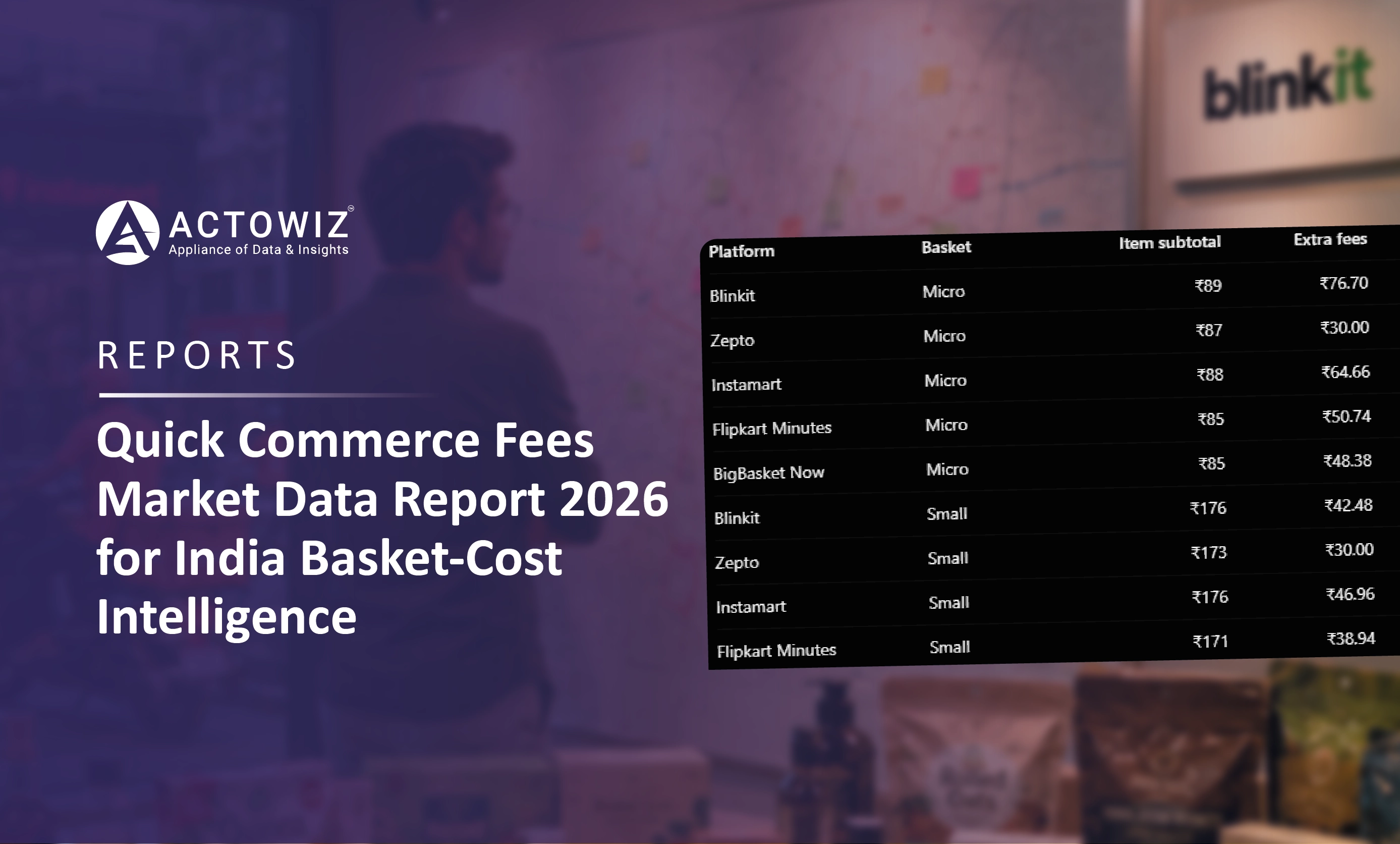
Track quick commerce fees in India: delivery, handling, small-cart and surge fees on Blinkit, Zepto and Instamart. See landed basket cost.
Quick commerce fees in India are the delivery, handling, small-cart, platform and surge or rain charges that Blinkit, Zepto, Swiggy Instamart, BB Now, Flipkart Minutes and JioMart add on top of shelf prices. Because these fees change by city, pincode, hour and cart value, FMCG brands need landed basket cost, not shelf price alone, to understand price perception.
A shopper does not compare MRP and selling price in isolation. They see a checkout total. A ₹45 pack that triggers a small-cart fee can feel more expensive than a ₹60 pack that clears the free-delivery threshold. That is why fee data now belongs in the same dataset as prices, pack sizes, discounts and availability.
This report explains how quick commerce fees in India moved from a free-delivery promise to layered charges and back towards selective waivers between 2024 and 2026. It sets out a field-level structure for capturing the landed basket, shows how brand teams can use it, and outlines the study design for an Actowiz Basket-Cost Index. Where we do not yet publish a measured value, the table shows a placeholder.
Quick commerce in India grew fast enough that platforms started to monetise each order, not only each product. CareEdge estimated that the market reached around ₹64,000 crore in FY25 and projected gross order value of about ₹2 lakh crore by FY28, as reported by Storyboard18 on 10 July 2025 . The same report put fee-based revenue at an estimated ₹10,500 crore in FY25, up from ₹450 crore in FY22.
That growth came with new quick commerce fees at checkout. Zepto added a platform fee in March 2024. Swiggy Instamart applied a festive handling charge during Holi week in 2025. Small-cart fees became common on low-value orders. Then, from late 2025, competition pushed the other way: Zepto cut its free-delivery threshold and removed handling and surge charges, and Blinkit cut delivery charges in select micro-markets.
For brand teams, the lesson is simple. Quick commerce fees are not stable. It is a competitive lever that platforms switch on and off by city and season, so a one-time check goes out of date quickly.
| Year | Reported fee change | Source (as reported; fees vary by city, time and cart) |
|---|---|---|
| 2024 | Zepto introduced a ₹2 platform fee per order for selected users, described as the first platform fee in Indian quick commerce | MediaNama, 15 March 2024 |
| 2025 | Swiggy Instamart added a festive handling charge of ₹8.90 to ₹20 during Holi week, varying by location | YourStory, 12 March 2025 |
| 2025 | Zepto cut its free-delivery threshold from ₹199 to ₹99, set a flat ₹30 delivery fee below ₹99, and removed handling, surge and rain charges | Business Today, 3 November 2025 |
| 2026 | Blinkit cut delivery charges in select micro-markets in Gurgaon, Bengaluru and Mumbai; Swiggy Instamart reported to have adopted similar measures to Zepto | Outlook Business, 17 January 2026 |
| 2026 | Blinkit charged a ₹20 small-cart fee on orders under ₹99 | Inc42, 31 March 2026 |
| 2026 (Actowiz) | Median landed-basket fee share across tracked pincodes | Pending |
The landed basket is what the shopper actually pays: item total after discounts, plus every fee, minus any fee waiver. To compare it across apps, each fee needs its own field. A single "delivery charges" column hides the difference between a fee that depends on cart value and one that depends on the weather.
We recommend capturing the checkout as a set of line items tied to a pincode, a timestamp and a fixed test basket. This keeps every number traceable. It also lets analysts rebuild the total when a platform renames a fee, which happens often.
| Fee component | What usually triggers it | Data field |
|---|---|---|
| Delivery fee | Cart value below the free-delivery threshold; distance or zone | delivery_fee |
| Free-delivery threshold | Platform rule, sometimes changed by city or membership | free_delivery_threshold |
| Small-cart fee | Cart value below a minimum order value | small_cart_fee |
| Handling fee | Charged per order, sometimes raised during festivals | handling_fee |
| Platform or convenience fee | Flat per-order charge | platform_fee |
| Surge or rain fee | Peak demand, bad weather, high rider load | surge_fee; surge_reason |
| Late-night fee | Orders placed in late-night hours, where applied | late_night_fee |
| Membership waiver | Subscription such as a delivery pass | membership_flag; fee_waived |
| Landed basket total | Sum of item total and all fees after waivers | landed_total; fee_share_pct |
Not every platform uses every fee, and names change. Our parsers map each label seen at checkout to one of these standard fields and keep the original label too, so nothing is lost in translation.
Data on quick commerce fees becomes useful when it answers a commercial question. For an FMCG brand, the main question is whether a shopper sees the brand as good value on a given app, at a given time, in a given city. Shelf price only answers part of that.
Fees also shape which pack sizes win. If a single 200 g pack sits below the small-cart line, shoppers may switch to a larger pack or add items to cross the threshold. Brands that track this can design pack-price ladders and combo packs that clear thresholds on the apps that matter most.
Promo planning is the third use. A ₹10 discount can be wiped out by a ₹20 small-cart fee or a rain fee. Measuring the net effect at checkout shows which promotions actually lowered the price the shopper paid. Our Quick Commerce Promotions & Discount Dataset covers the discount side.
| Use case | Who uses it | Question answered |
|---|---|---|
| Price perception tracking | Brand pricing and revenue-management teams | Is our landed price competitive against rival brands on each app? |
| Pack-size and price-ladder design | Category and portfolio teams | Which pack sizes trigger small-cart fees or clear free-delivery thresholds? |
| Promo effectiveness | Trade marketing and e-commerce teams | Did the discount survive fees, or did the checkout total rise anyway? |
| Platform negotiation prep | Key account managers | How do fee rules differ by platform and city where we sell? |
| Price-comparison and smart-cart apps | Product and data teams at comparison-app builders | Which app gives the lowest total for this basket at this pincode right now? |
| Market research | Analysts and investors | How is fee monetisation changing across quick commerce in India? |
Quick commerce fees in India are hyperlocal. The Outlook Business report on Blinkit described targeted cuts in specific micro-markets, not a national change. The Instamart festive charge varied by location. That means two shoppers in the same city can see different totals for the same basket.
Time matters too. Surge and rain fees appear when demand outruns rider capacity. Festivals change handling fees. Late-night ordering can carry its own charge where a platform applies one. A daily snapshot taken at noon will miss most of this.
Cart size is the third dimension. Thresholds create sharp steps in the landed total. A basket of ₹98 and a basket of ₹100 can carry very different fees. Testing several cart values around each threshold shows exactly where the steps fall.
| Dimension | Why it matters | Capture method |
|---|---|---|
| City and pincode | Fee cuts and surcharges are often limited to micro-markets | Fixed panel of pincodes per city, with consistent delivery addresses for public storefront views |
| Time of day | Surge, rain and late-night fees depend on the hour | Repeat captures at morning, evening peak and late night |
| Day and season | Festivals and monsoon weeks bring temporary charges | Higher capture frequency during festival and monsoon periods |
| Cart value | Small-cart fees and free-delivery thresholds create price steps | Test baskets set just below and just above known thresholds |
| Membership status | Delivery passes can waive fees | Separate non-member and member views where publicly visible |
| Platform | Each app names and stacks fees differently | Standard field mapping with original label retained |
Competitive position on quick commerce has two parts: what the item costs and what the checkout costs. Quick commerce fees decide the second part. A brand can be cheapest on shelf and still lose on landed price if its typical basket on one app attracts more fees.
The table below lists the fee components that public reporting has linked to each platform, with placeholders for Actowiz measured values. Where a component was reported, the source and date are shown. Reported amounts are snapshots; fees vary by city, time and cart.
| Platform | Fee components reported (source, date) | Median delivery fee | Median handling / platform fee | Free-delivery threshold seen | Landed basket index |
|---|---|---|---|---|---|
| Blinkit | Small-cart fee of ₹20 under ₹99 (Inc42, 31 Mar 2026); delivery-fee cuts in select micro-markets (Outlook Business, 17 Jan 2026) | Pending | Pending | Pending | Pending |
| Zepto | ₹2 platform fee for selected users (MediaNama, 15 Mar 2024); ₹99 threshold, ₹30 fee below it, handling/surge/rain charges removed (Business Today, 3 Nov 2025) | Pending | Pending | Pending | Pending |
| Swiggy Instamart | Festive handling charge ₹8.90–₹20 (YourStory, 12 Mar 2025); reported to follow Zepto-style cuts (Outlook Business, 17 Jan 2026) | Pending | Pending | Pending | Pending |
| BigBasket (BB Now) | No fee amount verified for this report | Pending | Pending | Pending | Pending |
| Flipkart Minutes | No dated fee amount verified for this report | Pending | Pending | Pending | Pending |
| JioMart | No fee amount verified for this report | Pending | Pending | Pending | Pending |
Brands that already track pincode-level shelf prices can add this layer without starting again. Our Quick Commerce Price Comparison Dashboard shows pincode-wise prices, and fee fields can be joined to the same records.
The Actowiz Basket-Cost Index is designed to answer one question: what does a typical FMCG basket cost to land on each app, by city and hour? It uses fixed baskets so changes come from prices and fees, not from what is in the cart.
Each basket is matched across apps at the product and pack-size level. Substitutes are flagged, not silently swapped. Out-of-stock items are recorded as such, because unavailability also changes what a shopper ends up paying.
The index reports item total, total fees and landed total separately. This lets a brand see whether a change came from its own price, a rival's discount or a new fee.
| Design element | Planned setting |
|---|---|
| Baskets | Small top-up basket, mid-size household basket and a threshold-test basket: Pending |
| Categories | Dairy, staples, snacks, beverages, personal care, home care: Pending |
| Cities | Metro and large non-metro cities: Pending |
| Pincodes per city | Pending |
| Capture windows | Morning, evening peak and late night: Pending |
| Cadence | Daily, with higher frequency during festivals and monsoon weeks: Pending |
| Platforms | Blinkit, Zepto, Swiggy Instamart, BB Now, Flipkart Minutes, JioMart |
| Outputs | landed_total, fee_share_pct, threshold gap, fee-by-type, availability: Pending |
How quick commerce fees are shown to shoppers is also a regulatory topic. The Central Consumer Protection Authority (CCPA) issued the Guidelines for Prevention and Regulation of Dark Patterns on 30 November 2023, listing 13 specified dark patterns, with drip pricing named among them .
On 7 June 2025 the government reported that CCPA had advised e-commerce platforms to self-audit for dark patterns within three months On 20 November 2025, PIB reported that 26 platforms, including Blinkit, Zepto, Swiggy, BigBasket and JioMart, had submitted self-declarations of compliance .
For data collection, Actowiz captures only publicly visible storefront and checkout information, respects site terms, does not bypass logins and does not collect personal data. This section is general information, not legal advice.
Quick commerce fees in India have moved from a quiet add-on to a visible competitive lever. Platforms added platform, handling and small-cart fees, then began cutting some of them by city and season. Shelf price alone no longer tells a brand how its products feel to a shopper at checkout.
Tracking the landed basket by platform, pincode, hour and cart size gives FMCG and D2C teams a clearer view of price perception, pack-size strategy and promo impact. It also gives comparison-app builders the totals their users actually care about.
Want to see landed basket data for your categories? Request a free sample or talk to our data team.
They are charges added on top of item prices at checkout, such as delivery fees, small-cart fees, handling fees, platform fees and surge or rain fees. Which fees apply depends on the app, city, pincode, time and cart value.
A handling fee is a per-order charge some apps add for packing and processing. It has varied by location and season; for example, Swiggy Instamart added a festive handling charge during Holi week in 2025, as reported by YourStory.
Shoppers judge value by the checkout total. Fees can cancel a discount or make a smaller pack look expensive, so landed cost shows true price perception and helps with pack-size and promo planning.
Often. Public reports show fee additions in 2024 and 2025 and selective cuts in late 2025 and 2026. Fees can also change by hour and weather, so daily or intra-day tracking is recommended.
Yes. We can collect public prices, pack sizes, availability, discounts and fee line items per pincode and deliver them by API or files. Contact our data team for a sample.
Actowiz collects only publicly visible business data, respects site terms, does not bypass logins and does not collect personal data. Check your own use case with legal counsel; this is not legal advice.
Our web scraping expertise is relied on by 4,000+ global enterprises including Zomato, Tata Consumer, Subway, and Expedia — helping them turn web data into growth.
Watch how businesses like yours are using Actowiz data to drive growth.
From Zomato to Expedia — see why global leaders trust us with their data.
Backed by automation, data volume, and enterprise-grade scale — we help businesses from startups to Fortune 500s extract competitive insights across the USA, UK, UAE, and beyond.
We partner with agencies, system integrators, and technology platforms to deliver end-to-end solutions across the retail and digital shelf ecosystem.
Explore NoBroker Property Owner Listing Data Intelligence to analyze property prices, rental trends, locations, and real estate market insights.
Explore how Travel Price Comparison Data Scraping helps travel brands monitor fares, compare rates, and gain real-time competitive pricing insights.
Track quick commerce fees in India: delivery, handling, small-cart and surge fees on Blinkit, Zepto and Instamart. See landed basket cost.
Whether you're a startup or a Fortune 500 — we have the right plan for your data needs.