Introduction
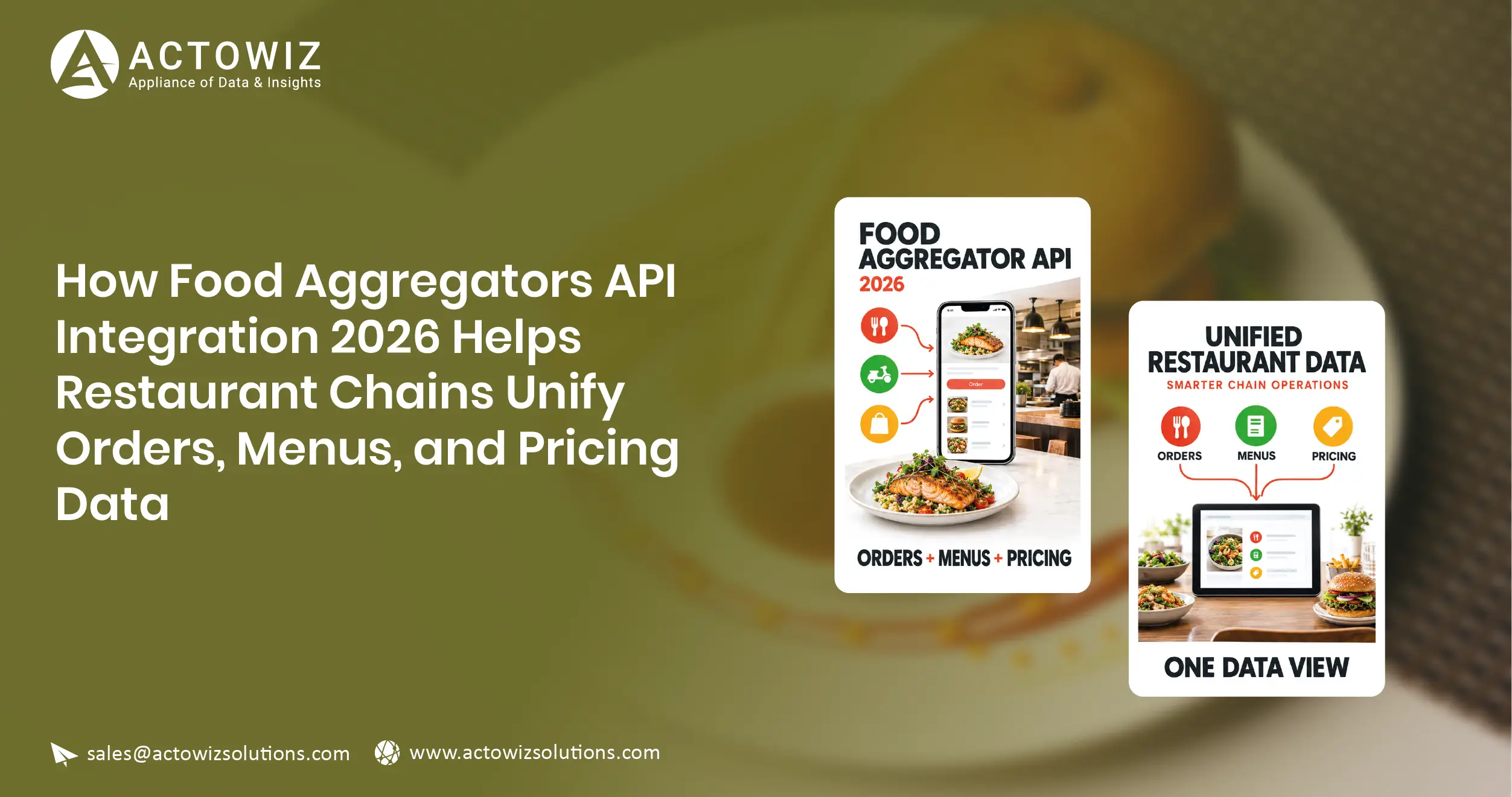
Restaurant chains can unify orders, menus, pricing, availability, and location-level information by connecting food-delivery platforms and restaurant systems through structured APIs, webhooks, and centralized data pipelines. Food Aggregators API Integration 2026 enables this connected approach, while Food Data Scraping can supplement API-accessible information where permitted and where external marketplace intelligence is required.
The need for unified restaurant data is growing as delivery platforms, first-party ordering systems, POS platforms, and digital marketplaces operate simultaneously. DoorDash reported more than 56 million monthly active users at the end of 2025 and said its Marketplace GOV grew 27% year over year in 2025. (DoorDash Investor Relations) Toast, meanwhile, reported approximately 164,000 locations and $51.4 billion in gross payment volume at the end of 2025. (Toast Investors)
For restaurant chains, the challenge is no longer simply accepting digital orders. It is maintaining consistent menu structures, prices, modifiers, availability, promotions, and operational data across hundreds or thousands of locations and multiple ordering channels.
A centralized integration layer can normalize these inputs into a common data model. This gives restaurant operations, digital commerce, pricing, analytics, and technology teams a shared view of what customers see and what each location can actually fulfill.
How Can Restaurant Chains Build a Reliable Integration Layer?
A successful Food aggregator API integration for restaurant chains should connect ordering platforms, POS systems, restaurant databases, menu systems, and analytics environments through a controlled data architecture.
The key is not simply moving information from one system to another. Restaurant chains need standardized identifiers for locations, menu items, modifier groups, prices, availability states, order statuses, and timestamps.
For example, Toast's API documentation shows that restaurant integrations can access menu and order information, while its APIs support both read and write operations depending on integration type and permissions. (Toast Docs) Its Orders API includes information such as items ordered, prices, payments, discounts, and customer data. (Toast Docs)
DoorDash's Marketplace APIs similarly support menu and order-related workflows through API endpoints and webhooks, although its documentation states that Marketplace API access is limited and prospective partners must apply. (DoorDash Developer)
What should the integration architecture capture?
| Data Layer |
Typical Data Captured |
Business Use |
| Location |
Store ID, address, region, operating hours |
Location management |
| Menu |
Item, category, modifier, description |
Menu synchronization |
| Pricing |
Base price, modifier price, discounts |
Pricing control |
| Availability |
Item status, store status, schedule |
Availability monitoring |
| Orders |
Order ID, items, value, status |
Operations analytics |
| Promotions |
Offer, discount, campaign period |
Promotion analysis |
| Delivery |
Status, timestamps, fulfillment events |
Delivery visibility |
| Audit |
Timestamp, source, response status |
Data quality |
The integration should also maintain source-level lineage. Every record should identify its originating platform, location, timestamp, and synchronization status.
2020–2026: How did restaurant data integration evolve?
Between 2020 and 2026, restaurant technology moved from relatively fragmented digital ordering environments toward increasingly connected commerce ecosystems. The pandemic accelerated digital ordering adoption, while restaurant operators subsequently expanded their use of POS integrations, delivery marketplaces, online ordering, loyalty systems, and analytics. By 2024, DoorDash reported more than 42 million monthly active users in December and more than 22 million DashPass and Wolt+ members exiting the year. (DoorDash Investor Relations) By 2025, DoorDash reported more than 56 million monthly active users. (DoorDash Investor Relations) Toast also continued expanding its restaurant technology footprint, reaching approximately 164,000 locations by the end of 2025. (Toast Investors) The technical implication is significant: a restaurant chain increasingly needs an integration architecture capable of handling many locations, multiple data sources, different schemas, and changing event states. APIs became important for transactional connectivity, while webhooks enabled event-driven workflows. By 2026, the emphasis is increasingly on synchronization, normalization, observability, and analytics rather than simple one-way data transfers.
How Can Chains Keep Menu, Price, and Availability Information Consistent?
A Restaurant chain menu pricing and availability Data API can create a structured layer for monitoring and synchronizing the information customers encounter across digital ordering channels.
Menu inconsistency is particularly problematic for large restaurant groups. A menu item may have different prices by location, different modifier combinations, different operating hours, or different availability rules. A centralized data model must preserve these legitimate differences while identifying accidental inconsistencies.
Toast's documentation illustrates why this matters. Its menus API can return a fully resolved menu for a specified restaurant, while menu visibility can determine where menu entities appear. (Toast Docs)
The objective should therefore be controlled consistency, not blindly making every restaurant identical.
What should be monitored?
| Dimension |
Example Check |
Alert Trigger |
| Item |
Product exists across channels |
Missing item |
| Price |
Channel price vs source price |
Unexpected variance |
| Modifier |
Add-on and customization pricing |
Missing/incorrect modifier |
| Availability |
Item currently orderable |
Unexpected unavailable state |
| Hours |
Store ordering schedule |
Channel mismatch |
| Category |
Item mapped to correct category |
Incorrect placement |
| Promotion |
Discount or offer |
Promotion mismatch |
| Timestamp |
Last successful sync |
Stale data |
A practical pipeline can compare the latest source record with the last successfully synchronized record and classify changes as additions, updates, removals, or exceptions.
2020–2026: How did menu management become more complex?
From 2020 through 2026, restaurant menus increasingly became digital assets rather than static documents. Restaurants added online ordering, third-party marketplaces, first-party ordering channels, kiosks, mobile applications, and other digital touchpoints. As the number of channels increased, the same item could require different visibility, pricing, availability, and modifier logic. Toast's current documentation shows channel-specific menu visibility and identifies ordering partner channels such as Grubhub and Uber Eats. (Toast Docs) DoorDash's current menu integration documentation describes asynchronous menu creation and updates, with menu-status webhooks used to communicate processing outcomes. (DoorDash Developer) These capabilities demonstrate why modern restaurant menu operations require more than a simple spreadsheet. By 2026, chains need location-aware menu records, controlled synchronization, exception management, and timestamped audit trails. The resulting data can also support pricing analysis, digital merchandising, operational monitoring, and downstream reporting.
How Does Real-Time Synchronization Improve Digital Ordering Operations?
Real-time food delivery menu Data API integration helps restaurant chains react faster when orders, menus, prices, or operational conditions change.
The important distinction is between scheduled batch updates and event-driven synchronization. A batch process might refresh data every few hours. A webhook-based architecture can notify a system when a relevant event occurs.
DoorDash's developer documentation describes webhooks that deliver event data to an application's endpoint and includes order-related events among its Marketplace webhook capabilities. (DoorDash Developer) Its delivery APIs also support webhook-based updates for delivery events. (DoorDash Developer)
Toast's APIs provide another example of event and transaction-oriented integration. Its Orders API supports retrieving and creating orders, while menu data can be retrieved to construct ordering experiences. (Toast Docs)
Which events deserve real-time monitoring?
| Event |
Example Signal |
Operational Response |
| New order |
Order received |
Send to order workflow |
| Cancellation |
Order cancelled |
Update status |
| Menu update |
Menu changed |
Validate and synchronize |
| Price update |
Price changed |
Recalculate downstream data |
| Item unavailable |
Product unavailable |
Update channel status |
| Store closed |
Location unavailable |
Suppress ordering |
| Delivery update |
Driver/order event |
Update fulfillment status |
| Sync failure |
API error |
Retry or escalate |
Real-time does not necessarily mean zero latency. A better objective is to define acceptable freshness by business event. Pricing changes may require faster synchronization than historical reporting.
2020–2026: Why did real-time restaurant data become important?
The 2020–2026 period saw restaurant technology evolve from periodic digital updates toward increasingly event-driven operations. Early digital transformation often focused on enabling online ordering. Later systems increasingly connected orders, menus, payments, POS platforms, delivery operations, customer engagement, and analytics. API platforms now support more granular workflows. Toast, for example, documents APIs for menus, orders, restaurant availability, and other operational functions. (Toast Docs) DoorDash's documentation describes webhook-driven updates for orders and delivery events, allowing applications to receive information as events occur. (DoorDash Developer) This matters because restaurant operations can change quickly: an item sells out, a store closes temporarily, an order is cancelled, or a menu is modified. In 2026, restaurant chains can therefore benefit from event-driven architectures that combine APIs, webhooks, validation rules, retry logic, and centralized monitoring rather than depending entirely on periodic exports.
How Can Multi-Channel Ordering Be Managed Without Creating Data Silos?
A Multi-platform food delivery API for restaurant chains can provide a standardized approach for connecting multiple ordering ecosystems while preserving the unique rules of each platform.
The architecture should use a canonical restaurant data model rather than forcing every platform to use the same schema. This allows the integration layer to map platform-specific fields into common entities.
For example, one platform may use a particular identifier for a menu item while another uses a different identifier. A centralized system can maintain both identifiers while assigning a master product ID internally.
What does a multi-platform data model look like?
| Master Entity |
Platform-Specific Attributes |
Centralized Output |
| Restaurant |
Store IDs, platform IDs |
Master location ID |
| Menu item |
External item IDs |
Master item ID |
| Modifier |
Modifier/group IDs |
Standard modifier mapping |
| Price |
Platform-specific price fields |
Comparable price record |
| Availability |
Channel status |
Unified availability state |
| Order |
External order ID |
Master order reference |
| Promotion |
Offer-specific fields |
Standard promotion object |
This model allows restaurant technology teams to distinguish between data synchronization and data comparison.
Synchronization asks: "Did the required information reach the platform?"
Comparison asks: "Does the information currently shown on each platform match the approved source?"
That distinction is valuable for enterprise restaurant groups.
2020–2026: How did multi-platform complexity increase?
Restaurant digital commerce expanded substantially from 2020 to 2026 as operators combined first-party ordering with third-party marketplaces and increasingly sophisticated restaurant technology platforms. DoorDash reported that its Commerce Platform served more than 250,000 merchants in its 2024 shareholder communication, supporting online ordering and delivery through merchants' first-party channels. (DoorDash Investor Relations) Toast's 2025 results also showed its platform reaching approximately 164,000 locations, highlighting the scale at which restaurant technology systems can operate. (Toast Investors) At the platform level, integrations have become more structured. Toast documents scoped API access and separate integration types, while DoorDash provides API and webhook workflows for marketplace integrations. (Toast Docs) The 2026 challenge is consequently less about connecting a single ordering channel and more about governing a network of systems. Restaurant chains need master IDs, field mapping, validation, error handling, API monitoring, and historical records to maintain a reliable multi-platform data environment.
How Can Location-Level Intelligence Improve Restaurant Chain Decisions?
Multiple-Restaurant Location Data Intelligence gives restaurant chains a way to move from platform-level information to location-level business intelligence. In this context, Food Aggregators API Integration 2026 can connect location, menu, pricing, availability, ordering, and performance information into a common analytical layer.
For a restaurant group with hundreds or thousands of stores, national averages can hide meaningful differences. One location may have a complete menu while another has missing products. One region may have different pricing. Another may experience recurring availability problems.
Location intelligence helps identify these exceptions.
Which location-level indicators should chains track?
| KPI |
Location-Level View |
Why It Matters |
| Menu completeness |
% of expected items live |
Digital visibility |
| Price consistency |
Variance by channel |
Pricing governance |
| Availability |
% of items available |
Revenue opportunity |
| Sync freshness |
Time since last update |
Data reliability |
| Order volume |
Orders by location/channel |
Demand analysis |
| Cancellation rate |
Cancelled vs total orders |
Operational quality |
| Promotion coverage |
Locations running offer |
Campaign execution |
| API health |
Success/error rate |
Integration reliability |
A useful analytical layer should also preserve historical snapshots. Without history, teams can identify today's problem but cannot determine whether the issue is recurring, seasonal, or isolated.
2020–2026: Why did location intelligence become more valuable?
From 2020 to 2026, restaurant chains increasingly operated digital channels at the same time as traditional physical locations. This created a need to understand not only overall restaurant performance but also how individual stores appeared and performed across digital ordering environments. The growth of restaurant technology platforms reinforced this shift. Toast reported approximately 156,000 locations in Q3 2025 and approximately 164,000 locations at year-end 2025. (Toast Investors) DoorDash also expanded its merchant and marketplace footprint, reporting more than 100,000 additional stores added to marketplace selection during 2024. (DoorDash Investor Relations) As networks grow, manual location audits become harder to scale. A centralized location intelligence layer can compare stores against approved menu, pricing, availability, and operational rules. By 2026, this supports exception-based management: teams can focus attention on locations with significant deviations rather than manually reviewing every store. Historical snapshots additionally make it possible to identify recurring synchronization failures and regional patterns.
How Can AI Improve Large-Scale Restaurant Data Collection?
AI-Powered Scraping can complement API integrations when restaurant chains need external marketplace intelligence, competitor information, or data from digital sources that are not exposed through authorized APIs.
API integration should remain the preferred method when a platform provides authorized access to the required information. Scraping can serve a different purpose: monitoring publicly accessible information, benchmarking competitors, validating digital presentation, or collecting external marketplace signals where permitted by applicable terms and laws.
AI can make large-scale collection more useful by supporting entity matching, classification, anomaly detection, schema mapping, and change identification.
For example, two platforms may describe the same menu item differently. An AI-assisted normalization layer can help identify semantic relationships while deterministic rules remain responsible for critical fields such as price, currency, location ID, and timestamp.
Where can AI assist the pipeline?
| AI Capability |
Data Challenge |
Potential Application |
| Entity matching |
Different item names |
Match equivalent products |
| Classification |
Unstructured categories |
Standardize menu taxonomy |
| Change detection |
Large data volumes |
Identify meaningful updates |
| Anomaly detection |
Unusual price changes |
Flag exceptions |
| OCR/vision |
Image-based menus |
Extract permitted visible data |
| NLP |
Descriptions and modifiers |
Normalize text |
| Deduplication |
Repeated records |
Improve dataset quality |
| Forecasting |
Historical patterns |
Support planning |
AI should not replace validation. A robust architecture combines machine-assisted processing with deterministic checks, confidence thresholds, source attribution, and human review for high-impact exceptions.
2020–2026: How did AI enter restaurant data workflows?
Between 2020 and 2026, restaurant data workflows moved from basic digital collection toward automation, intelligence, and increasingly AI-assisted operations. Early systems primarily focused on transferring menu and order information between applications. As data volumes expanded, businesses needed automated classification, normalization, anomaly detection, and natural-language analysis. Restaurant technology companies also began incorporating AI into their products. Toast reported in 2025 that it was expanding its Toast IQ intelligence ecosystem, including conversational AI capabilities for restaurant operators. (Toast Investors) By 2026, AI can increasingly support the data layer itself, particularly when organizations must process large numbers of products, locations, menu descriptions, images, and platform-specific structures. However, API permissions and source reliability remain fundamental. AI-generated interpretations should be treated as an enrichment layer rather than a substitute for authoritative transactional data. For restaurant chains, the most practical model is therefore hybrid: authorized APIs for structured first-party connectivity, permitted web or mobile data collection for external intelligence, and AI for normalization, classification, monitoring, and insight generation.
How Can Actowiz Solutions Help Restaurant Chains Build a Unified Data Pipeline?
Actowiz Solutions can help restaurant chains design data workflows that combine API-based integration, permitted web data collection, mobile app data collection, normalization, validation, and analytics-ready delivery.
A Web Scraping API can be positioned within a broader data architecture when external web information is required alongside authorized API feeds. The objective is not to replace APIs unnecessarily but to create a complementary intelligence layer for data sources that businesses are permitted to monitor.
Food Aggregators API Integration 2026 can be supported through a structured workflow covering source discovery, API connectivity, authentication, schema mapping, location matching, data normalization, validation, monitoring, and delivery.
What can the workflow include?
| Stage |
Actowiz Solutions Approach |
Output |
| Source mapping |
Identify APIs, web sources, and mobile sources |
Source inventory |
| Authentication |
Configure authorized credentials and access scopes |
Secure connectivity |
| Data modeling |
Create common restaurant schema |
Unified structure |
| Extraction |
API, web, or mobile data collection |
Raw data |
| Normalization |
Standardize fields and identifiers |
Consistent dataset |
| Validation |
Check price, menu, availability, and IDs |
Quality-controlled data |
| Monitoring |
Track changes and pipeline failures |
Exception alerts |
| Delivery |
API, database, cloud storage, or files |
Analytics-ready output |
For API integrations, access permissions must be respected. Toast's documentation, for example, explains that integration access is scoped according to the integration type and required functionality. (Toast Docs) DoorDash likewise states that its Marketplace APIs have limited availability and require prospective partners to apply for access. (DoorDash Developer)
This makes access governance an important part of enterprise restaurant integration.
Actowiz Solutions can also structure datasets around a restaurant chain's analytical requirements rather than simply returning raw responses. That can include master location IDs, platform identifiers, product IDs, historical prices, availability states, menu categories, promotion fields, timestamps, and source metadata.
For chains operating across multiple digital channels, this approach creates a foundation for digital shelf monitoring, pricing intelligence, menu analytics, competitor analysis, and operational reporting.
Conclusion
Restaurant chains need more than separate feeds from delivery marketplaces. They need a unified data architecture that connects menus, prices, availability, orders, locations, promotions, and operational events while preserving source-specific information.
Food Aggregators API Integration 2026 provides the foundation for connecting authorized restaurant and marketplace systems, while Web Scraping and Mobile App Scraping can complement that foundation for permitted external data collection and competitive intelligence. A well-designed real-time dataset can then turn these fragmented inputs into structured information for analytics, monitoring, and decision-making.
The most effective architecture combines APIs where authorized, event-driven webhooks where available, controlled data collection for external sources, standardized schemas, validation rules, historical snapshots, and AI-assisted enrichment.
As restaurant technology ecosystems continue to expand, centralized data management can help enterprise restaurant teams answer practical questions faster: Which locations have missing menu items? Where do prices differ across channels? Which products are unavailable? Which integrations are failing? Which changes require immediate attention?
Ready to Build a Unified Restaurant Data Ecosystem? Partner with Actowiz Solutions to develop scalable restaurant data collection, API integration, web scraping, mobile app data extraction, normalization, and analytics-ready data pipelines.
You can also reach us for all your mobile app scraping, data collection, web scraping , and instant data scraper service requirements!

 By industry🏷 By platform🌐 By market
 Pricing & Promotions
MAP Violations Brand Protection Counterfeit Detection Price Intelligence AI HOT Data Intelligence
Pricing & Promotions
MAP Violations Brand Protection Counterfeit Detection Price Intelligence AI HOT Data Intelligence Brand & Intelligence
Share of Search Content Audit & PDP Reviews & Ratings Retail Media Buy Box Monitoring Social Commerce HOT Live Commerce NEW Agentic Commerce NEW
Brand & Intelligence
Share of Search Content Audit & PDP Reviews & Ratings Retail Media Buy Box Monitoring Social Commerce HOT Live Commerce NEW Agentic Commerce NEW Digital Shelf & Search
Assortment Planning Competitive Benchmarking Product Availability Q-Commerce NEW
Digital Shelf & Search
Assortment Planning Competitive Benchmarking Product Availability Q-Commerce NEW AssortmentE-commerce Intelligence Hyperlocal Insights POI & Store Locator DTC Brand Analytics NEW
 For Retailers
 E-Commerce Dashboard
 Flipkart Insights (Live) #1
 Grocery Intelligence
.svg) Grocery Price (U.S.)
Grocery Price (U.S.)
.svg) Quick Commerce (India) HOT
Quick Commerce (India) HOT
 Food & Restaurant
 Fashion Intelligence
 Automotive
 Travel & Hospitality
 Real Estate
 Food Delivery Intelligence NEW
 OTT & Streaming NEW
 Fuel & EV Charging Price Tracker NEW
 By Use Case
 Pricing Intelligence
 Digital Shelf Analytics
 MAP Monitoring HOT
 Cross-Border Price Parity NEW
 Share of Search
 Review Sentiment
 Kitchen Market Gaps NEW
 Dynamic Pricing / AI Repricing NEW
 Promotions & Deals Alerts NEW
 B2B / POI & Lead Data NEW
 AI Search Visibility Dashboard NEW
 Baby Products on Quick Commerce NEW
 Hotel & Flight Rate Parity NEW
 By Region🇮🇳 India 🇺🇸 USA 🇦🇪 Middle East 🇬🇧 UK 🇦🇺 Australia 🌏 SE Asia 🇪🇺 Europe 🌎 LATAMIndia
 Flipkart Real-Time Insights
 Quick Commerce — Zepto · Blinkit
 Pincode Price Tracker
Middle East
Pincode Price Tracker
Middle East GCC Q-Commerce — Talabat · Noon NEW
UK & Australia
GCC Q-Commerce — Talabat · Noon NEW
UK & Australia UK Grocery — Tesco, Sainsbury's, Asda
 AU Grocery — Coles & Woolworths NEW
 Marketplace Scrapers
Amazon API TikTok Shop API HOT Uber Eats API Airbnb API Zepto / Blinkit API Instacart API NEW Talabat API NEW
Marketplace Scrapers
Amazon API TikTok Shop API HOT Uber Eats API Airbnb API Zepto / Blinkit API Instacart API NEW Talabat API NEW Developer APIsWeb Extract API Reviews API SERP API Pricing Webhook NEW
 Universal APIsStreaming Crawl API Scheduler Realtime Alerts Webhook Delivery 🐍 Python SDK 💚 Node.js SDK
 Delivery & SDKs
 Knowledge Center
Digital Shelf Playbook MAP Compliance Guide Pricing Intel Guide Scraping Compliance TikTok Shop Guide NEW Cross-Border Guide NEW
Knowledge Center
Digital Shelf Playbook MAP Compliance Guide Pricing Intel Guide Scraping Compliance TikTok Shop Guide NEW Cross-Border Guide NEW Guides & Playbooks
🎉 Seasonal & event tracking NEWBlack Friday pricing report Festive season, India Ramadan, GCC grocery All seasonal reportsSample Datasets HOT ROI Calculator NEW API Postman Collection Demo Dashboards Free API Playground NEW Press Kit
Guides & Playbooks
🎉 Seasonal & event tracking NEWBlack Friday pricing report Festive season, India Ramadan, GCC grocery All seasonal reportsSample Datasets HOT ROI Calculator NEW API Postman Collection Demo Dashboards Free API Playground NEW Press Kit Downloads & Tools
Trust Center About Us FAQs Careers
Downloads & Tools
Trust Center About Us FAQs Careers Trust & CompanyRetail shelf research NEWRetail shelf research






































 4.8/5 Average Rating
 50+ Video Testimonials
 92% Client Retention
 50+ Countries Served