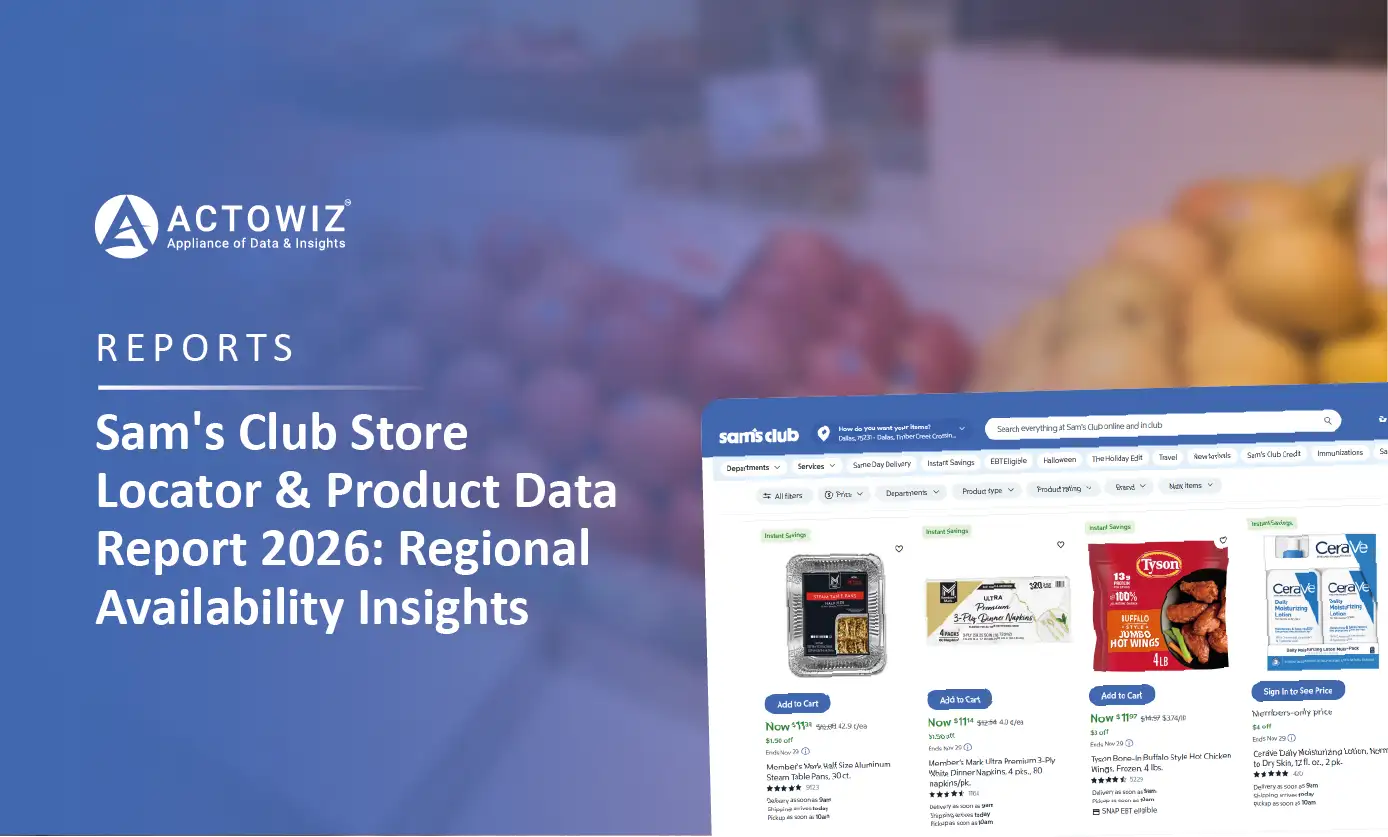
Explore the Sam's Club Store Locator & Product Data Report 2026 - store locations, product listings, pricing trends, and regional availability insights in one place.
The U.S. membership-warehouse market is becoming increasingly data-driven as retailers connect physical club locations with digital assortments, localized availability, pricing, and member experiences. This Sam's Club Store Locator & Product Data Report 2026 examines how structured store and product information can help brands understand regional coverage, product visibility, pricing movements, and availability patterns across Sam's Club. As of July 31, 2026, Sam's Club had 602 U.S. clubs according to Walmart's location facts, while its FY2026 annual-report disclosure listed 601 U.S. clubs as of January 31, 2026. (Walmart News Center)
The report also examines the value of a Sam's Club Store Locations Dataset for businesses seeking consistent location-level intelligence. Store-level records can connect club identifiers, addresses, geographic coordinates, operating information, regional coverage, and product observations, creating a foundation for market mapping and competitive analysis. Sam's Club has also continued investing in omnichannel capabilities, including digital shopping, curbside pickup, delivery, Scan & Go, and personalized experiences, making the relationship between physical locations and online product information increasingly important. (Walmart News Center)
Location data is one of the most important foundations for understanding a large membership retailer. Sam's Club store location Data Scraping can capture structured information such as store name, address, city, state, ZIP code, latitude, longitude, club identifier, operating status, and available services. When this information is combined with Ecommerce Data Scraping, businesses can connect physical club coverage with online product visibility and regional shopping patterns.
The importance of this approach has increased as Sam's Club has developed a stronger omnichannel model. Walmart reported 602 Sam's Club U.S. units as of July 31, 2026, compared with 601 in the January 31, 2026 annual-report disclosure. (Walmart News Center)
| Metric | 2026 Benchmark | Intelligence Value |
|---|---|---|
| Sam's Club U.S. units | 602 | National location coverage |
| Sam's Club U.S. units at Jan. 31, 2026 | 601 | Annual-report reference |
| Average Sam's Club size | 134,000 sq. ft. | Physical footprint context |
| Minimum reported club size | 94,000 sq. ft. | Format variation |
| Maximum reported club size | 168,000 sq. ft. | Format variation |
Source: Walmart FY2026 Annual Report and Walmart Location Facts. (Walmart News Center)
From 2020 onward, retail location intelligence moved beyond simple address collection toward continuously updated geographic datasets. During 2020–2021, businesses increasingly needed reliable information about operating locations and availability. In 2022–2023, location data became more useful when combined with digital assortment and local inventory signals. By 2024, Sam's Club was emphasizing a more digitally connected member experience, while its Member's Mark Community reached 50,000 participants. (Walmart News Center) In 2025, omnichannel services such as curbside pickup and express delivery strengthened the connection between clubs and digital shopping. (Walmart News Center) By 2026, Walmart's reported 602 Sam's Club locations demonstrate the scale at which location-level monitoring can operate. A structured location database can therefore support territory analysis, competitor mapping, regional assortment studies, delivery coverage analysis, and expansion planning without relying on manually maintained spreadsheets.
Retail products rarely behave identically across every location. A product can have different availability, promotional status, or purchasing conditions depending on the market being served. Sam's Club product pricing and availability by store analysis helps businesses identify these differences and understand how product conditions change across regions.
A useful dataset can capture product name, SKU, product URL, price, promotional price, availability status, club/location, category, brand, pack size, and collection timestamp. Historical observations can then be compared to determine whether a product is consistently available, temporarily unavailable, newly introduced, or subject to price movement.
| Metric | Example Measurement | Business Use |
|---|---|---|
| Product price | Current listed price | Price benchmarking |
| Availability | Available / unavailable | Stock visibility |
| Store coverage | Number of locations | Distribution analysis |
| Discount status | Regular vs. promotional | Promotion tracking |
| SKU coverage | Unique products observed | Assortment analysis |
| Observation date | Timestamp | Historical comparison |
Sam's Club has emphasized price consistency across its shopping channels, with company leadership stating that members pay the same price regardless of how they shop. (Walmart News Center) This makes structured monitoring useful for validating how products appear across different digital and physical shopping contexts.
Between 2020 and 2021, product availability became a major retail intelligence concern because businesses needed to distinguish genuine assortment changes from temporary stock disruptions. During 2022–2023, historical price and availability records became more useful for identifying recurring promotional cycles and regional assortment differences. In 2024, Sam's Club expanded its member-driven product development approach, giving greater importance to consumer feedback and product-level insights. (Walmart News Center) In 2025, the retailer continued expanding digital fulfillment capabilities and regionalized experiences. (Walmart News Center) By 2026, organizations can combine product observations with location identifiers to calculate store coverage, availability rates, pricing ranges, and product persistence over time. This creates a stronger foundation for category management, competitive benchmarking, assortment optimization, and regional demand analysis.
Raw store records become considerably more valuable when they are connected to analytical systems. Retail Store Location Data intelligence can help organizations understand where clubs operate, how densely they are distributed, and which geographic markets have greater retail coverage. When combined with an E-commerce Dashboard, this information can be presented alongside product prices, availability, assortment, and historical changes.
A dashboard can allow users to filter by state, city, ZIP code, product category, brand, SKU, price range, and availability. This transforms thousands of individual observations into a practical decision-making environment.
| Data Layer | Example Fields | Analytical Output |
|---|---|---|
| Location | Club ID, address, ZIP | Geographic coverage |
| Product | SKU, name, brand | Assortment visibility |
| Pricing | Regular/current price | Price comparison |
| Availability | In-stock status | Availability rate |
| Time | Date/time collected | Trend analysis |
| Geography | State, city, coordinates | Regional intelligence |
In 2020–2021, retail analytics were frequently focused on basic operational visibility and geographic availability. During 2022, organizations increasingly began integrating location information with product and pricing datasets. In 2023, dashboards became more useful for combining historical observations with competitive intelligence. Sam's Club's member-driven product development model also demonstrated the growing importance of feedback and structured consumer information. In 2024, its Member's Mark Community launched at scale with 50,000 participating consumers, creating another example of data-driven retail engagement. (Walmart News Center) By 2025, digital penetration, curbside pickup, delivery, and personalized digital experiences were becoming important components of Sam's Club's omnichannel strategy. (Walmart News Center) In 2026, the opportunity is to connect these signals into a unified dashboard where businesses can monitor regional availability, price movements, product assortment, and store-level changes. Such systems can support category managers, brands, retailers, distributors, and market researchers with faster access to actionable intelligence.
A reliable location database should be designed around consistency, historical tracking, and geographic usability. A Sam's Club store locations dataset can contain one standardized record for every monitored club and may include club name, address, ZIP code, state, coordinates, store identifier, operating information, services, and collection timestamp.
The broader Sam's Club Store Locator & Product Data Report 2026 perspective shows why location data should not be treated as a static directory. Walmart reported 601 Sam's Club U.S. locations in its FY2026 annual report, while its current location facts page reports 602 U.S. Sam's Club units as of July 31, 2026. (Walmart News Center) This difference illustrates why recurring collection and historical versioning matter.
| Dataset Component | Example |
|---|---|
| Club identifier | Unique club ID |
| Store name | Sam's Club location |
| Address | Street and city |
| State | U.S. state |
| ZIP code | Postal area |
| Coordinates | Latitude / longitude |
| Services | Pickup, pharmacy, fuel, etc. |
| Status | Active / changed |
| Timestamp | Collection date |
From 2020 to 2021, businesses often treated store directories as relatively static reference information. By 2022, location records increasingly became inputs for geographic analytics and territory planning. During 2023–2024, retailers and brands began connecting physical-store information with digital commerce signals, delivery coverage, and local assortment. Sam's Club's omnichannel strategy accelerated this transition by creating more ways for members to interact with the retailer digitally and physically. (Walmart News Center) In 2025, regionalized online assortments and expanded curbside and delivery options further strengthened the need for location-aware product intelligence. (Walmart News Center) By 2026, a structured location dataset can support market mapping, regional assortment comparisons, store expansion studies, logistics planning, and competitive research. Historical snapshots also allow businesses to detect newly opened, relocated, modified, or discontinued locations rather than relying on a single current-state directory.
Price intelligence becomes more meaningful when it is collected consistently over time and connected to specific products and locations. Sam's Club product pricing data can be used to monitor listed prices, promotional changes, pack sizes, discounts, product categories, brands, and historical price movement.
For brands competing in consumer categories, a recurring dataset can help answer questions such as: Which products experience frequent price changes? Which categories show stronger promotional activity? Where are products consistently available? Which SKUs have maintained stable prices over several collection cycles?
| Metric | Purpose |
|---|---|
| Current price | Current market benchmark |
| Previous price | Change detection |
| Price difference | Increase/decrease measurement |
| Discount percentage | Promotion analysis |
| Price history | Trend identification |
| Category median | Category benchmarking |
| SKU-level variance | Product comparison |
Sam's Club has positioned value and price leadership as central elements of its member proposition. Walmart also reported that Member's Mark represented approximately 50% of merchandise sales growth over the prior two years at its 2025 Investment Community Meeting. (Walmart News Center)
From 2020–2021, volatile consumer markets made price tracking especially important for retailers and brands. During 2022–2023, historical pricing datasets became increasingly valuable for distinguishing temporary promotions from sustained price changes. In 2024, member expectations around value continued influencing product and merchandising decisions. In 2025, Sam's Club highlighted value, assortment, experience, and trust as major components of its member proposition. (Walmart News Center) The retailer also continued developing its Member's Mark portfolio, with product innovation influenced by member feedback. By 2026, automated historical price monitoring can help businesses identify category-level movements, promotional intensity, price stability, and changes in competitive positioning. Instead of evaluating one price snapshot, analysts can use timestamped records to calculate trends and identify meaningful deviations. This makes pricing intelligence more useful for assortment planning, competitive benchmarking, promotion analysis, and strategic decision-making.
Product intelligence becomes significantly stronger when every observation can be associated with a stable product identifier. Sam's Club product SKU ID Data Extraction can help create a structured product universe in which individual SKUs are tracked across collection cycles.
A SKU-oriented system can capture product ID, SKU, product name, brand, category, pack size, price, discount, availability, product URL, image information where accessible, and timestamp. Historical records can then identify new products, discontinued items, changed descriptions, price revisions, and availability fluctuations.
| Attribute | Intelligence Function |
|---|---|
| SKU/product ID | Unique identification |
| Product name | Catalog matching |
| Brand | Brand analysis |
| Category | Assortment analysis |
| Pack size | Unit comparison |
| Price | Benchmarking |
| Availability | Stock visibility |
| URL | Source reference |
| Timestamp | Historical tracking |
During 2020–2021, product datasets were often organized around product names and URLs, creating difficulties when listings changed. In 2022, stronger identifier-based structures became increasingly important for maintaining product histories. During 2023–2024, SKU-level monitoring supported more precise catalog comparisons, price tracking, and assortment analysis. Sam's Club's continued development of Member's Mark also illustrates the importance of understanding individual products rather than analyzing only broad categories. The retailer reported that more than 1,200 Member's Mark items had been launched, renovated, or reformulated since 2020. (Walmart News Center) In 2025, Sam's Club continued expanding and refining its private-brand assortment, including new product launches informed by member preferences. (Walmart News Center) By 2026, SKU-level historical data can provide a stronger basis for identifying assortment changes, monitoring product lifecycles, measuring pricing movements, and connecting product observations with specific store or geographic markets.
Actowiz Solutions combines structured collection, data engineering, validation, normalization, and analytics-oriented delivery to help businesses turn retail information into usable intelligence. For a retailer with hundreds of clubs and a large digital assortment, simply collecting records is not enough. Data needs to be standardized so that locations, products, SKUs, prices, availability, and timestamps can be analyzed together.
Our Pricing & Product Data solutions can be designed around recurring collection requirements, product-level monitoring, location-based analysis, and historical datasets. The approach can support businesses that need to compare pricing, understand assortment changes, identify availability patterns, or build internal dashboards.
The Sam's Club Store Locator & Product Data Report 2026 framework demonstrates how store and product observations can work together. Actowiz Solutions can structure collected information into analytics-ready datasets, apply validation rules, remove inconsistencies, normalize product attributes, and organize historical observations for downstream analysis.
Key capabilities can include:
This approach enables organizations to move from fragmented retail observations toward a repeatable data intelligence workflow.
The retail landscape in 2026 increasingly depends on connecting physical store networks with digital product intelligence. Sam's Club's scale, omnichannel strategy, and continued investment in member experience create a strong use case for structured monitoring of locations, products, pricing, availability, and SKU-level information. Walmart's latest location data shows 602 Sam's Club U.S. units as of July 31, 2026, highlighting the geographic scale that businesses may need to analyze. (Walmart News Center)
A well-designed Sam's Club Store Locator & Product Data Report 2026 can help brands understand regional market coverage, product availability, pricing movements, assortment changes, and location-level opportunities. Historical collection is particularly important because a single snapshot cannot explain whether a product was temporarily unavailable, permanently removed, newly introduced, or simply changed its listing.
For organizations seeking scalable retail intelligence, combining Web Crawling service capabilities with structured Web Data Mining can create a repeatable framework for collecting, validating, enriching, and analyzing large volumes of retail information.
Our web scraping expertise is relied on by 4,000+ global enterprises including Zomato, Tata Consumer, Subway, and Expedia — helping them turn web data into growth.
Watch how businesses like yours are using Actowiz data to drive growth.
From Zomato to Expedia — see why global leaders trust us with their data.
Backed by automation, data volume, and enterprise-grade scale — we help businesses from startups to Fortune 500s extract competitive insights across the USA, UK, UAE, and beyond.
We partner with agencies, system integrators, and technology platforms to deliver end-to-end solutions across the retail and digital shelf ecosystem.
Explore the Myntra India Thrice a week E-Commerce Dataset to track fashion pricing, product availability, discounts, and market trends.
Simplify product data management with a Product database & storage API for organized storage, efficient access, and scalable business operations.
Explore the Sam's Club Store Locator & Product Data Report 2026 - store locations, product listings, pricing trends, and regional availability insights in one place.
Whether you're a startup or a Fortune 500 — we have the right plan for your data needs.