Introduction
Travel insurance is sold almost entirely online, and it is compared almost entirely on price. For insurers, brokers and travel platforms in the UK, India and the UAE, knowing where your premium sits is not enough. You also need to know what each competitor's plan actually covers for that price.
Direct answer: Travel insurance price comparison data is a structured dataset of publicly displayed premiums and published plan wordings. It covers insurers, aggregators and travel platforms, captured for standard test profiles (age band, trip length, destination region). It is never based on real customer data. Teams use it to benchmark price against cover limits, excess and exclusions.
This guide sets out the fields, the test-profile design, a strategy by country and how to choose a data provider. It complements our travel insurance data service page, which focuses on policy limits tables.
Why travel insurance benchmarking matters
Price alone is a weak signal in travel insurance. The UK Financial Conduct Authority's review of price comparison websites in general insurance (which included travel) was concerned that consumers focus on headline price and brand. It found this could distract them from cover, terms and excess levels (FCA TR14/11 (https://www.fca.org.uk/publications/thematic-reviews/tr14-11-price-comparison-websites-general-insurance-sector)). The FCA now marks that review as historical, but the point still shapes how product teams think about value.
Claims show why cover matters. According to ABI figures reported by ITIJ, UK travel insurers paid £472 million on more than 500,000 claims in 2024. Medical claims made up 34% of cases, up from 29% in 2023, with £262 million paid on medical claims (ITIJ (https://www.itij.com/latest/news/abi-reports-ps472m-travel-insurance-payouts-2024)). A cheap plan with a low medical limit or a high excess is not the same product as a mid-priced plan with strong medical cover.
Who uses travel insurance price comparison data:
- Insurer pricing and product teams checking position by age band and destination.
- Insurtechs and MGAs launching into a new market and setting a first rate card.
- Travel platforms and OTAs choosing which partner plans to show at checkout.
- Brokers and aggregators monitoring panel competitiveness and plan changes.
Sources compared: where public premium and cover data lives
| Source type |
UK examples of page type |
India examples of page type |
UAE examples of page type |
What is usually public |
| Insurer direct websites |
Plan pages, policy wording PDFs, IPIDs |
Plan pages, policy wordings, brochures |
Plan pages, Schengen plan pages |
Cover limits, excess, exclusions; sometimes "from" prices |
| Price comparison / aggregator sites |
Results pages for a set trip |
Plan listing pages |
Plan listing pages |
Displayed premiums, plan names, key limits |
| Travel platforms and airline add-ons |
Checkout add-on summaries |
Add-on plan summaries |
Add-on plan summaries |
Add-on price and headline benefits |
| Banks and card benefit pages |
Packaged travel cover terms |
Card travel benefit terms |
Card travel benefit terms |
Cover terms only, no premium |
| Regulator and visa pages |
– |
Standard product rules |
Visa insurance requirements |
Minimum cover rules |
Two rules apply across all sources: collect only public pages, and never enter real personal data. Where a site shows prices only after a quote form, any collection uses a pre-agreed set of standard test profiles. It is reviewed against that site's terms first, never answers medical screening questions and never completes a purchase. Many programmes start with published "from" prices and plan wordings, and add quote-page capture only where it is permitted. Our insurance aggregator listing data page explains what aggregators publish before any quote is requested.
The 10 data fields to collect
- provider and plan_name – the insurer or distributor and the exact plan tier (for example, basic, standard, premium).
- policy_type – single trip or annual multi-trip, plus any specialist type (Schengen, student, cruise, winter sports add-on).
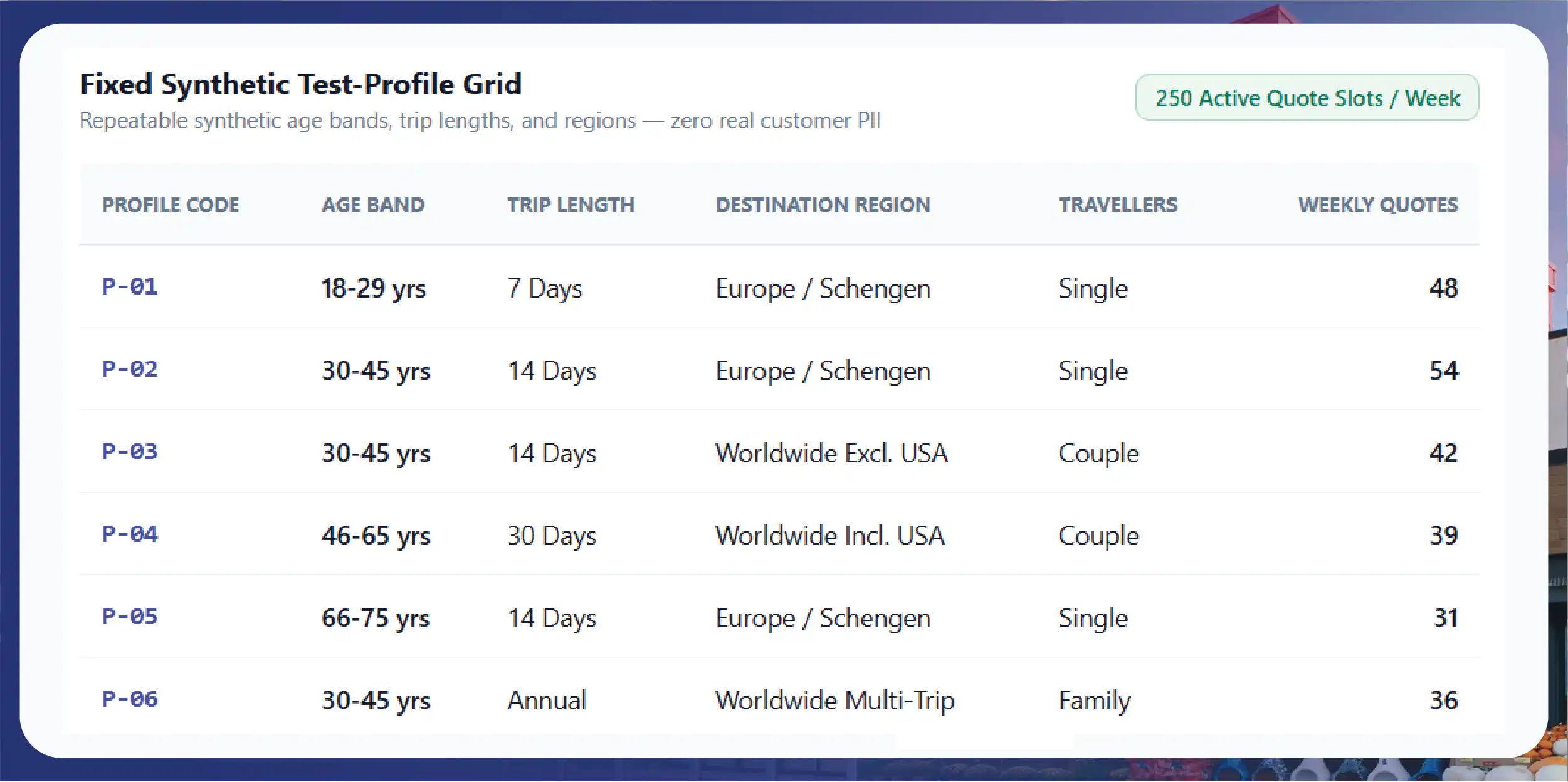
- test_profile_id – a code for the standard profile: age band, trip length, destination region and number of travellers.
- premium_amount and currency – the displayed price, with tax treatment noted (for example, Insurance Premium Tax included in the UK, GST in India, VAT in the UAE).
- medical_expenses_limit – the headline medical and repatriation limit.
- cancellation_limit and curtailment_limit – trip cancellation and cutting a trip short.
- baggage_limit, single_item_limit and valuables_limit – the sub-limits that most often separate cheap and mid-priced plans.
- excess_amount and excess_waiver_option – the standard excess and any paid waiver.
- key_exclusions and add_ons – for example, cover for pre-existing conditions as an option, sports and activities, gadget cover.
- captured_at and source_url – the timestamp and public page the record came from, for audit.
From these, teams calculate derived metrics such as premium per £/₹/AED 1,000 of medical cover, price index vs market median per test profile, and plan change flags when limits or wording change.
How to collect, clean and match plans
Design the test-profile grid
A good grid is small and repeatable. A typical starting point is three or four age bands, three trip lengths (for example, 7, 14 and 30 days), three or four destination regions and single vs couple. Keep the grid fixed so trends are comparable week to week. No real names, dates of birth or contact details are used. Profiles are synthetic bands agreed in writing with your compliance team.
Clean and normalise
- Currency and tax: store the displayed price and a tax-normalised price.
- Limits: convert text such as "up to £10m" or "unlimited" into numeric fields plus a flag.
- Region definitions: insurers define "Europe" or "Worldwide excluding USA" differently. Store each insurer's own definition rather than forcing a mapping.
Match plans across sources
The same plan can appear on an insurer site, an aggregator and a travel platform under slightly different names. Match on provider, plan tier and the limits table, then flag differences in displayed price by channel. Plan wordings change, so keep version history. Our insurer product page data service covers the collection layer.
Strategy by country
| Market |
What to benchmark |
Regulatory or market context |
Practical note |
| UK |
Single trip vs annual multi-trip, medical limit, excess, IPT-inclusive price |
FCA concerns about price vs cover on comparison sites (FCA TR14/11 (https://www.fca.org.uk/publications/thematic-reviews/tr14-11-price-comparison-websites-general-insurance-sector)) |
Track excess waiver add-ons separately; they change effective price |
| India |
Standard vs insurer-specific overseas plans, sum insured options, destination pricing |
IRDAI required general and health insurers to offer standardised travel policies with common wording; premiums are set by insurers and can vary by destination (ITIJ (https://www.itij.com/latest/news/india-standardise-travel-insurance)) |
Compare like-for-like using the standard wording as the baseline |
| UAE |
Schengen visa plans, worldwide plans, family plans |
For a Schengen visa (Sweden example), minimum medical cover must be EUR 30,000 and valid in all Schengen countries (Embassy of Sweden, UAE (https://www.swedenabroad.se/en/about-sweden-non-swedish-citizens/united-arab-emirates/going-to-sweden/visiting-sweden/medical-travel-insurance2/)) |
Visa-compliant entry-level plans are a distinct price segment; benchmark them separately |
Run each market as its own benchmark. Cross-country comparison only makes sense on derived metrics such as price per unit of medical cover, and even then region definitions differ.
Use cases
- Rate-card positioning. See where your premium ranks per test profile and age band, every week.
- Price-to-cover benchmarking. Plot premium against medical limit and excess to find plans that undercut you only by cutting cover.
- New-market entry. Build a launch rate card for India or the UAE from public competitor plans.
- Partner selection for travel platforms. Compare candidate insurer plans before choosing what to show at checkout.
- Plan wording change alerts. Get notified when a competitor changes a limit, exclusion or excess.
- Seasonal monitoring. Track price movements ahead of summer and winter holiday peaks.
Legal and compliance basics
- Public data only. Collect public plan pages, wordings and displayed prices; no logins are bypassed.
- No personal data, ever. Use synthetic test profiles only; never real customer data, and never answer health screening questions.
- Respect site terms. Review each site's terms before quote-page capture; where it is not permitted, use published prices and wordings only.
- No purchases or binding actions. Collection stops at the displayed price.
- Fair use of results. Benchmarking supports your own pricing and product decisions; it does not replace actuarial pricing or regulatory duties.
Build vs buy: choosing a travel insurance data provider
An in-house script can capture a few plan pages. Keeping a profile grid stable across dozens of insurers and aggregators in three countries is harder. Sites change, PDFs are updated and region definitions drift.
When evaluating a provider, ask for:
- Coverage by country and source, listed before the project starts.
- A written test-profile protocol and how it respects each site's terms.
- Freshness: daily, weekly or seasonal cadence.
- QA: numeric parsing of limits, currency and tax handling, and version history.
- Delivery: API, S3, Snowflake or BigQuery, or CSV.
- Usage rights and SLA in the contract.
- A sample in 48 hours on your own competitor set.
Actowiz Solutions builds custom insurance datasets for pricing and product teams. See insurance pricing intelligence and insurance aggregator listing data. Related resources: travel insurance data, insurer product page data and Policybazaar insurance data tracking.
Ready to benchmark travel insurance premiums against published cover limits, excess and exclusions? Request a sample on your own competitor set and test profiles.
Contact Us Today!
Frequently Asked Questions
What is travel insurance price comparison data?
It is a structured dataset of publicly displayed travel insurance premiums and published cover terms from insurers, aggregators and travel platforms. It is captured for standard test profiles, so prices and limits can be compared like for like.
Do you use real customer details to get quotes?
No. Only synthetic test profiles (age band, trip length, destination region) are used, and only where a site's terms allow it. Medical screening questions are never answered and no personal data is collected.
Why benchmark cover as well as price?
Two plans at similar prices can have very different medical limits, excesses and exclusions. Price per unit of cover shows whether a competitor is cheaper or simply covers less.
Which countries can be covered?
This guide focuses on the UK, India and the UAE. Other markets can be scoped on request, subject to the sources being public.
How is the data delivered?
Via API, S3, Snowflake, BigQuery or CSV, on a daily, weekly or seasonal schedule agreed with your team.
Conclusion
You can also reach us for all your mobile app scraping, data collection, web scraping , and instant data scraper service requirements!
 Actowiz Solutions

 By industry
 Pricing & Promotions
 Brand & Intelligence
 Digital Shelf & Search
 Assortment
 For Retailers
 E-Commerce Dashboard
 Flipkart Insights (Live)
 Grocery Intelligence
.svg) Grocery Price (U.S.)
.svg) Quick Commerce (India)
 Food & Restaurant
 Fashion Intelligence
 Automotive
 Travel & Hospitality
 Real Estate
 Food Delivery Intelligence
 OTT & Streaming
 Fuel & EV Charging Price Tracker
 By Use Case
 Pricing Intelligence
 Digital Shelf Analytics
 MAP Monitoring
 Cross-Border Price Parity
 Share of Search
 Review Sentiment
 Kitchen Market Gaps
 Dynamic Pricing / AI Repricing
 Promotions & Deals Alerts
 B2B / POI & Lead Data
 AI Search Visibility Dashboard
 Baby Products on Quick Commerce
 Hotel & Flight Rate Parity
 By Region
 Flipkart Real-Time Insights
 Quick Commerce — Zepto · Blinkit
 Pincode Price Tracker
 GCC Q-Commerce — Talabat · Noon
 UK Grocery — Tesco, Sainsbury's, Asda
 AU Grocery — Coles & Woolworths
 Marketplace Scrapers
 Developer APIs
 Universal APIs
 Delivery & SDKs
 Knowledge Center
 Guides & Playbooks
 Downloads & Tools
 Trust & Company


 4.8/5 Average Rating
 50+ Video Testimonials
 92% Client Retention
 50+ Countries Served