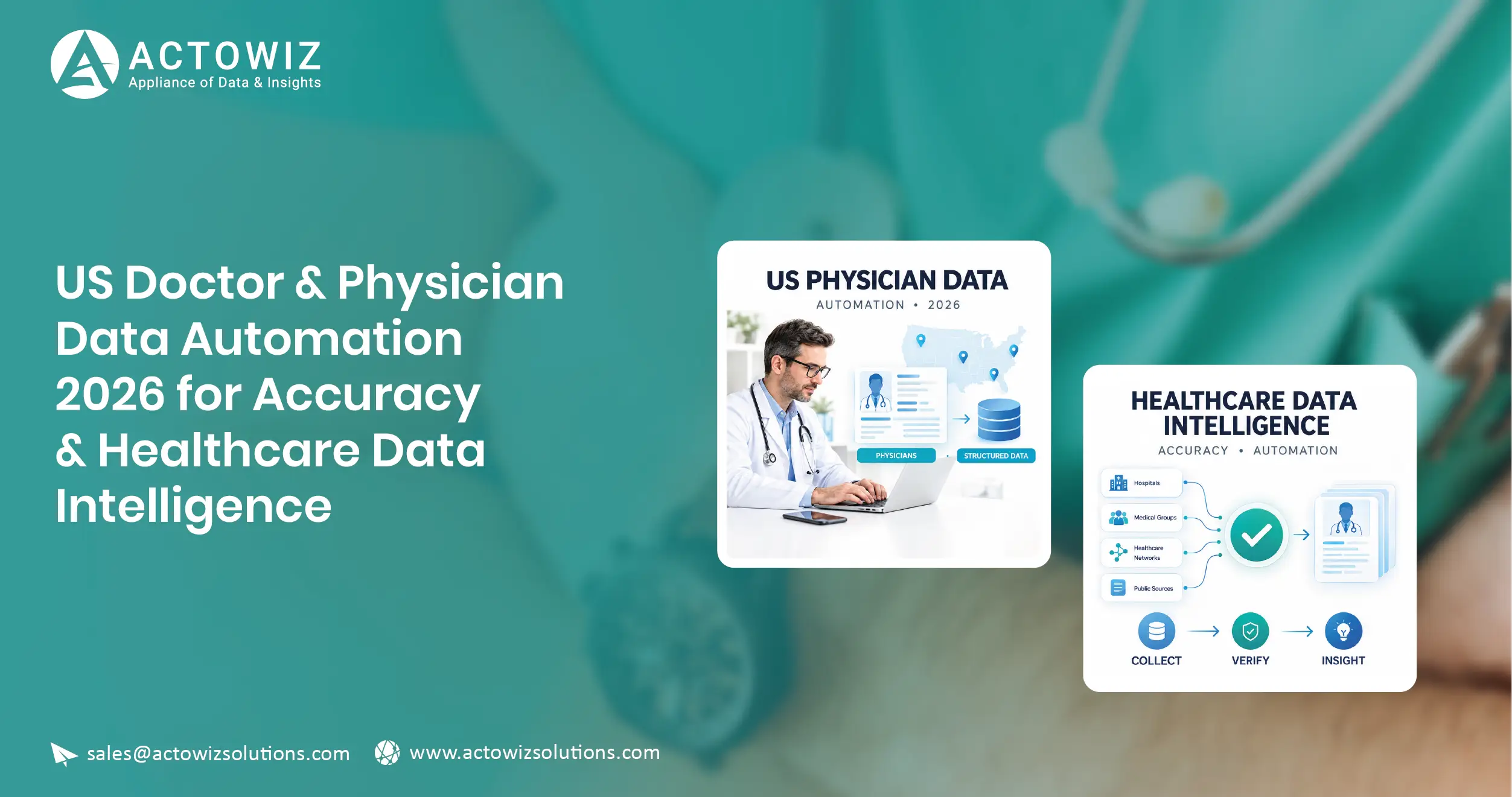
Introduction
Healthcare organizations, health-tech companies, pharmaceutical businesses, medical recruiters, and market intelligence teams increasingly depend on accurate physician information to support provider discovery, market expansion, outreach, analytics, and competitive research. US Doctor & Physician Data Healthcare Automation 2026 addresses a central challenge: physician information is distributed across directories, practice websites, healthcare platforms, specialty pages, and public provider datasets, making manual collection difficult to maintain at scale.
The U.S. physician landscape is substantial. The Association of American Medical Colleges reported 1,032,365 active physicians in the United States in 2024, including 866,460 physicians providing direct patient care. (AAMC) This scale makes structured data management important for organizations that need to identify providers by specialty, geography, practice, affiliation, and other business-relevant attributes.
At the same time, U.S. healthcare spending reached $5.3 trillion in 2024, with physician and clinical services accounting for approximately $1.11 trillion. Prescription drug spending reached $467 billion. (Centers for Medicare & Medicaid Services) These figures demonstrate the size and complexity of the ecosystem in which provider and healthcare intelligence is being used.
The core answer is straightforward: Doctors & Physicians Data Scraping Services improves physician data accuracy by systematically collecting, standardizing, validating, enriching, and refreshing provider information instead of relying entirely on manual research. When implemented with appropriate privacy, security, source governance, and validation controls, automated collection can turn fragmented provider information into structured datasets that support repeatable analysis.
For healthcare data buyers, the objective is not simply to collect more records. It is to build a dependable provider intelligence layer that can answer practical questions such as:
- Which physicians practice in a particular location?
- Which specialties are expanding or underserved?
- Which providers are associated with specific practices or healthcare systems?
- How frequently does provider information change?
- Which records require verification?
- How can provider data be connected with broader healthcare or pharmacy datasets?
This blog explains how automated physician data workflows can address these challenges in 2026.
Why Is Structured Physician Information Becoming More Important?
The U.S. provider ecosystem changes continuously. Physicians relocate, join or leave practices, update specialties, change affiliations, open new locations, retire, or appear across multiple directories under slightly different information.
For a business development team, an outdated phone number can reduce outreach efficiency. For a healthcare marketplace, an incorrect specialty can affect search results. For a market research organization, duplicate physician records can distort market-size calculations.
CMS also provides NPPES downloadable files containing provider information, including practice-location and endpoint reference files. Importantly, CMS states that an NPI by itself does not guarantee that a healthcare provider is licensed or credentialed. (CMS Downloads)
That distinction is important. A high-quality provider dataset should separate identity information from verification attributes instead of treating every available record as independently validated.
Data Challenges & Automation Responses
| Data challenge |
Business consequence |
Automation response |
| Duplicate physician records |
Inflated provider counts |
Entity matching and deduplication |
| Outdated practice information |
Failed outreach |
Recurring refreshes |
| Inconsistent specialty names |
Weak segmentation |
Standardized taxonomy |
| Multiple practice locations |
Incomplete market coverage |
Location-level normalization |
| Missing attributes |
Limited analytics |
Data enrichment |
| Directory changes |
Dataset deterioration |
Scheduled monitoring |
The goal is therefore usable accuracy, not simply large record volume.
How Can Automated Workflows Improve Provider Data Accuracy?
US physician data scraping for healthcare automation can help organizations collect publicly available provider information from permitted sources, normalize fields, identify changes, and prepare records for downstream analytics.
The workflow begins with source identification. Depending on the business requirement, sources can include physician directories, practice websites, healthcare organization pages, specialty directories, public datasets, and other legally accessible web sources.
The collected information can then be mapped into a common schema. A healthcare organization may want fields such as physician name, specialty, subspecialty, practice name, address, city, state, ZIP code, phone number, website, affiliation, professional profile URL, and source URL.
The key improvement comes from separating collection from validation. A scraper can collect information quickly, but a robust data pipeline should also check formatting, duplicates, missing values, conflicting attributes, and changes between collection cycles.
What does 2020–2026 show about the scale of the opportunity?
Between 2020 and 2026, healthcare organizations have continued operating across increasingly digital provider ecosystems. During the pandemic period, healthcare organizations accelerated digital workflows and remote interactions, while subsequent years brought continued growth in online provider discovery, healthcare marketplaces, telehealth infrastructure, and data-driven healthcare services.
By 2024, AAMC counted more than one million active physicians in the U.S., highlighting the scale that provider intelligence platforms must accommodate. (AAMC) CMS also continues publishing updated NPPES files, including weekly incremental files and monthly dissemination files; in 2026, CMS moved its downloadable NPPES format toward Version 2 with expanded field lengths. (CMS Downloads)
This creates a practical lesson for 2026: provider data should be treated as a living dataset, not a one-time spreadsheet.
A recurring workflow can compare newly collected information with historical records and flag:
- New physicians
- Removed physicians
- Address changes
- Practice changes
- Specialty changes
- New practice locations
- Website changes
- Contact-data changes
- Potential duplicate profiles
The result is a more maintainable provider intelligence system.
How Can Directory Data Support Scalable Healthcare Automation?
US doctor directory data for healthcare automation provides a structured foundation for organizations that need to discover and segment healthcare professionals at scale.
Doctor directories can contain valuable attributes such as physician names, specialties, practice locations, hospital affiliations, professional descriptions, contact information, and appointment-related details. However, the same physician may appear in multiple sources, with differences in spelling, address formatting, specialty descriptions, or practice names.
Automation can reconcile these variations by creating standardized fields.
For example:
| Raw value |
Standardized value |
| Cardiology |
Cardiology |
| Cardiologist |
Cardiology |
| Cardiac Medicine |
Cardiology |
| NYC |
New York City |
| N.Y. |
New York |
| Ste 200 |
Suite 200 |
This normalization improves searchability and downstream analytics.
What changed from 2020 to 2026?
From 2020 through 2026, healthcare businesses increasingly needed digital-first methods for provider discovery and market intelligence. The pandemic accelerated dependence on online healthcare information, while the subsequent expansion of digital health services increased the importance of structured provider information.
The market is also geographically diverse. AAMC's 2025 physician workforce data shows that active physician density differs by region and that primary-care specialties such as internal medicine, family medicine/general practice, and pediatrics represent some of the largest physician groups. (AAMC)
For a healthcare marketplace, that means a directory dataset should support both national coverage and local segmentation.
A scalable directory workflow can organize physicians by:
- State
- City
- ZIP code
- Specialty
- Subspecialty
- Practice
- Healthcare system
- Physician status
- Practice location
- Source and collection date
This makes the dataset useful for territory planning, healthcare market research, provider-network analysis, and business development.
How Does Automated Enrichment Turn Raw Records Into Usable Intelligence?
Automated physician data collection & enrichment combines extraction with transformation and contextual enhancement.
Collection alone answers "what information was found?" Enrichment attempts to answer "how can that information become useful for analysis?"
A basic provider record may contain only: Physician name + specialty + city
An enriched record could include: Physician name + specialty + subspecialty + practice + multiple locations + healthcare-system affiliation + website + source URL + standardized geography + collection timestamp.
The enrichment layer can also assign consistent categories and geographic identifiers.
Which enrichment fields create the most analytical value?
| Enrichment area |
Example |
Business use |
| Specialty |
Cardiology |
Segment providers |
| Subspecialty |
Interventional Cardiology |
Detailed targeting |
| Geography |
State/City/ZIP |
Territory analysis |
| Practice |
Group practice |
Account mapping |
| Affiliation |
Healthcare system |
Network analysis |
| Location count |
Multiple offices |
Coverage analysis |
| Source |
Directory/website |
Traceability |
| Timestamp |
Collection date |
Freshness tracking |
| Change status |
New/updated/removed |
Monitoring |
What do 2020–2026 trends indicate?
The expansion of healthcare data infrastructure during 2020–2026 increased the importance of interoperability, structured records, and repeatable data workflows. CMS continues to publish provider-related datasets and APIs, while its NPPES files explicitly include practice-location and endpoint reference files. (CMS Downloads)
Meanwhile, healthcare spending continued to rise. CMS reports that total U.S. healthcare spending increased 7.2% in 2024 to $5.3 trillion, while physician and clinical services spending increased 8.1% to $1.1097 trillion. (Centers for Medicare & Medicaid Services)
For data buyers, this means provider intelligence increasingly intersects with broader healthcare market intelligence.
A mature enrichment process should therefore preserve the original source value, normalized value, transformation logic, and collection date. This improves auditability and makes it easier to identify why a record changed.
How Can Provider Intelligence Strengthen Healthcare Market Analysis?
US doctor data for healthcare market analysis 2026 can help organizations understand physician distribution, specialty concentration, practice networks, and geographic opportunities.
For example, a healthcare company evaluating expansion into a new state could analyze:
- Number of physicians by specialty
- Physician density by geography
- Concentration of practices
- Healthcare-system presence
- Specialty gaps
- Practice-location clusters
- New provider additions
- Provider movement over time
These datasets can support market research without requiring analysts to manually review thousands of profiles.
Which market indicators should businesses monitor?
| Indicator |
What it reveals |
| Physician count |
Overall provider availability |
| Specialty mix |
Clinical service concentration |
| Provider density |
Geographic supply |
| Practice count |
Market fragmentation |
| New locations |
Expansion activity |
| Affiliation patterns |
Healthcare network structure |
| Provider changes |
Market movement |
| Specialty growth |
Potential demand signals |
How has the market evolved from 2020–2026?
The healthcare market expanded in scale and spending during this period. CMS reports that U.S. national health expenditures reached $5.3 trillion in 2024, representing 18.0% of GDP. (Centers for Medicare & Medicaid Services) Physician and clinical services alone reached $1.1097 trillion in 2024. (Centers for Medicare & Medicaid Services)
The physician workforce also remains extensive. AAMC reported 1,032,365 active physicians in 2024, providing a large population for geographic and specialty analysis. (AAMC)
These figures should not be interpreted as direct measures of business opportunity. Instead, they establish the scale of the underlying market.
A useful 2026 market-analysis dataset should combine provider identity, specialty, geography, practice, and time-series attributes. Comparing historical snapshots can then reveal changes that a static directory cannot show.
How Can Specialty and Location Data Improve Geographic Segmentation?
Physician specialty & practice location data US enables organizations to move from broad national datasets to precise market segmentation.
Specialty is one of the most important dimensions. A healthcare company focused on cardiology does not need an undifferentiated list of every U.S. physician. It needs a clean population of relevant physicians, categorized consistently and linked to practice locations.
Location adds another analytical layer. A single physician may work at multiple offices, while one medical practice may employ dozens of physicians. Therefore, provider-level and location-level records should be modeled separately.
What fields should a location-aware physician dataset contain?
| Field |
Purpose |
| Physician name |
Provider identification |
| Specialty |
Clinical segmentation |
| Subspecialty |
Detailed targeting |
| Practice name |
Organization mapping |
| Address |
Physical location |
| City |
Local segmentation |
| State |
Regional analysis |
| ZIP code |
Micro-market analysis |
| Affiliation |
Network mapping |
| Source URL |
Verification |
| Last-seen date |
Freshness monitoring |
What does the 2020–2026 period tell us?
AAMC's 2025 workforce release shows that physician distribution varies across U.S. regions and provides physician counts and density by specialty and location. In 2024, the national count reached more than one million active physicians. (AAMC)
This makes geographic normalization essential. "Los Angeles," "Los Angeles, CA," and different ZIP-code representations should not become separate markets simply because their formatting differs.
A robust system can standardize addresses, map locations to states and ZIP codes, identify duplicate practice addresses, and maintain historical versions.
For healthcare businesses, the practical benefit is clearer territory intelligence. Teams can identify where relevant physician populations are concentrated, compare regions consistently, and build datasets suitable for recurring analysis.
How Can Healthcare and Pharmacy Data Be Connected With Physician Intelligence?
Healthcare & Pharmacy Data Scraping can extend physician intelligence beyond provider profiles by connecting information across healthcare, pharmaceutical, and pharmacy ecosystems. US Doctor & Physician Data Healthcare Automation 2026 becomes more valuable when physician records can be analyzed alongside other permitted, publicly available healthcare data.
For example, organizations may study relationships among physician specialties, practice locations, healthcare organizations, pharmacy presence, medication information, and regional healthcare activity.
CMS publishes Medicare Part D spending-by-drug data, including information about spending for drugs prescribed by physicians and other healthcare providers. The dataset includes average spending per dosage unit, changes over time, manufacturer information, and clinical-use descriptions. (CMS Data)
CMS also maintains broader Medicare and Medicaid drug datasets covering Part B, Part D, and Medicaid spending. (CMS Data)
What should a combined healthcare intelligence workflow track?
| Dataset layer |
Example attributes |
| Physician |
Name, specialty, location |
| Practice |
Practice name, locations |
| Healthcare system |
Affiliation, facilities |
| Pharmacy |
Location, category |
| Drug |
Product, indication, spending |
| Geography |
State, city, ZIP |
| Time |
Collection/update date |
| Source |
Source URL or dataset |
What changed between 2020 and 2026?
Healthcare and pharmacy data became increasingly important for analytics as U.S. healthcare spending expanded. CMS reported prescription drug spending of $467 billion in 2024, up 7.9% from the previous year. (Centers for Medicare & Medicaid Services)
However, combining datasets requires careful governance. Publicly accessible information does not automatically mean every possible use is appropriate. Organizations should distinguish publicly available business/provider information from protected health information and establish source-specific collection, usage, security, and retention policies.
HHS continues enforcing HIPAA requirements, and recent enforcement actions demonstrate the importance of security controls. In April 2026, OCR announced four ransomware-related settlements involving breaches affecting more than 427,000 individuals. (HHS.gov)
Therefore, healthcare data automation should prioritize privacy-by-design, source governance, access controls, secure storage, and appropriate contractual and legal review.
What Should Businesses Consider Before Automating Physician Data?
Automation works best when the business defines the intended output before building the collection pipeline.
A practical implementation framework includes:
- Define the data schema – Identify the exact fields required for the use case. Avoid collecting unnecessary attributes simply because they are technically available.
- Establish source rules – Document which websites, directories, APIs, and public datasets can be used and under what conditions.
- Normalize records – Standardize names, specialties, addresses, phone formats, organizations, and geographic values.
- Deduplicate providers – Use combinations of identity and contextual fields to reduce duplicate records.
- Validate critical fields – Apply rules to identify incomplete, malformed, contradictory, or potentially outdated values.
- Track freshness – Every record should have a collection or last-verified timestamp where practical.
- Preserve provenance – Maintain source references so analysts can understand where information originated.
- Monitor changes – Recurring collection allows businesses to detect new, updated, or removed provider information.
- Protect sensitive information – Avoid collecting protected health information unless the relevant legal, contractual, technical, and compliance framework explicitly supports it.
- Deliver analytics-ready datasets – Data should be delivered in formats and structures compatible with databases, BI platforms, APIs, analytics environments, and internal systems.
What Data Quality Metrics Should a Physician Intelligence Program Track?
A healthcare data program should measure quality rather than assume that a larger dataset is automatically better.
| KPI |
Measurement approach |
| Completeness |
Percentage of required fields populated |
| Accuracy |
Percentage passing validation checks |
| Freshness |
Average age of records |
| Duplicate rate |
Duplicate records ÷ total records |
| Coverage |
Providers captured versus defined target universe |
| Change detection |
New/updated/removed records identified |
| Standardization |
Records conforming to schema |
| Source traceability |
Records with source metadata |
A dashboard built around these metrics gives data teams a practical way to monitor performance.
For example, a business might set internal thresholds such as:
- 95%+ completeness for critical fields
- Less than 2% duplicate records
- Weekly refresh for rapidly changing fields
- Monthly refresh for relatively stable fields
- 100% source tracking for collected records
These are illustrative operational targets, not industry-wide benchmarks. Actual thresholds should depend on the business use case, source behavior, compliance requirements, and acceptable error rates.
How Can Actowiz Solutions Help?
Actowiz Solutions can design custom data collection workflows around a company's provider intelligence requirements rather than forcing every customer into the same dataset structure.
The approach can cover source discovery, extraction, normalization, validation, enrichment, deduplication, recurring monitoring, and structured delivery.
US Doctor & Physician Data Healthcare Automation 2026 can be implemented as a recurring data workflow for businesses that need structured physician intelligence across specialties, locations, practices, or healthcare markets.
Potential deliverables include:
- Physician name and professional details
- Specialty and subspecialty
- Practice and organization information
- Practice locations
- City, state, and ZIP-code segmentation
- Healthcare-system affiliations where publicly available
- Public professional profile information
- Source URLs
- Collection timestamps
- Historical change tracking
- Normalized and deduplicated datasets
Web scraping API
A Web scraping API can provide programmatic access to structured data for organizations that need to integrate provider intelligence into internal applications, analytics platforms, CRM workflows, or data pipelines.
Custom Datasets
Custom Datasets can be designed around specific specialties, states, cities, practice types, healthcare organizations, or other business-defined parameters.
instant data scraper
An instant data scraper workflow can support faster extraction for defined public web sources and one-time or recurring collection requirements, subject to source terms, technical feasibility, and applicable laws.
The most important principle is that automation should be built around the buyer's actual decision workflow. A pharmaceutical market research team, healthcare marketplace, recruitment organization, and health-tech company may all require physician data, but their schemas and refresh frequencies can differ significantly.
What Are the Key Benefits of an Automated Physician Data Pipeline?
An automated pipeline can create value across multiple business functions.
- Better provider discovery: Structured records make it easier to identify physicians by specialty and geography.
- More consistent data: Normalization reduces variations that make records difficult to compare.
- Faster updates: Scheduled workflows can reduce dependence on manual spreadsheet maintenance.
- Improved market segmentation: Physician information can be organized by location, specialty, practice, and affiliation.
- Historical intelligence: Recurring snapshots can reveal provider additions, removals, location changes, and other changes.
- Easier integration: Structured datasets can be prepared for APIs, databases, CRM systems, dashboards, and analytics tools.
- Reduced manual research: Automation can handle repetitive collection and transformation tasks, allowing analysts to focus on interpretation.
The benefit is therefore not merely speed. The broader value comes from establishing a repeatable data lifecycle.
What Does the 2026 Physician Data Landscape Mean for Healthcare Businesses?
The 2026 environment combines a large physician workforce, extensive healthcare spending, continuously changing provider information, and growing demand for structured healthcare intelligence.
AAMC reported more than one million active U.S. physicians in 2024. (AAMC) CMS reported $5.3 trillion in national healthcare spending for the same year, including more than $1.1 trillion in physician and clinical services. (Centers for Medicare & Medicaid Services) CMS also continues to update provider and healthcare datasets, including NPPES and drug-spending datasets. (CMS Downloads)
Together, these facts point to a clear operational requirement: healthcare data teams need systems capable of managing scale, freshness, consistency, provenance, and security.
For organizations using physician intelligence for market research, provider discovery, healthcare analytics, pharmaceutical research, or business development, automation can provide the infrastructure required to move from fragmented web information to structured, reusable datasets.
Conclusion
US Doctor & Physician Data Healthcare Automation 2026 can improve physician intelligence by combining automated collection with normalization, validation, enrichment, deduplication, geographic segmentation, and recurring monitoring.
The strongest implementation is not simply a large list of doctors. It is a structured and maintainable data asset with clear source provenance, defined quality rules, appropriate refresh schedules, and a schema designed around a specific business objective.
With more than one million active physicians reported in the U.S. in 2024 and healthcare spending reaching $5.3 trillion, the scale of the healthcare ecosystem makes automated data management increasingly relevant. (AAMC)
Businesses can use these workflows to build provider directories, analyze healthcare markets, monitor physician movements, segment specialties and locations, and connect provider intelligence with broader healthcare and pharmacy datasets.
Ready to build a reliable physician intelligence pipeline? Contact Actowiz Solutions to discuss your healthcare data collection, enrichment, monitoring, and automation requirements!
You can also reach us for all your mobile app scraping, data collection, web scraping , and instant data scraper service requirements!

 By industry🏷 By platform🌐 By market
 Pricing & Promotions
MAP Violations Brand Protection Counterfeit Detection Price Intelligence AI HOT Data Intelligence
Pricing & Promotions
MAP Violations Brand Protection Counterfeit Detection Price Intelligence AI HOT Data Intelligence Brand & Intelligence
Share of Search Content Audit & PDP Reviews & Ratings Retail Media Buy Box Monitoring Social Commerce HOT Live Commerce NEW Agentic Commerce NEW
Brand & Intelligence
Share of Search Content Audit & PDP Reviews & Ratings Retail Media Buy Box Monitoring Social Commerce HOT Live Commerce NEW Agentic Commerce NEW Digital Shelf & Search
Assortment Planning Competitive Benchmarking Product Availability Q-Commerce NEW
Digital Shelf & Search
Assortment Planning Competitive Benchmarking Product Availability Q-Commerce NEW AssortmentE-commerce Intelligence Hyperlocal Insights POI & Store Locator DTC Brand Analytics NEW
 For Retailers
 E-Commerce Dashboard
 Flipkart Insights (Live) #1
 Grocery Intelligence
.svg) Grocery Price (U.S.)
Grocery Price (U.S.)
.svg) Quick Commerce (India) HOT
Quick Commerce (India) HOT
 Food & Restaurant
 Fashion Intelligence
 Automotive
 Travel & Hospitality
 Real Estate
 Food Delivery Intelligence NEW
 OTT & Streaming NEW
 Fuel & EV Charging Price Tracker NEW
 By Use Case
 Pricing Intelligence
 Digital Shelf Analytics
 MAP Monitoring HOT
 Cross-Border Price Parity NEW
 Share of Search
 Review Sentiment
 Kitchen Market Gaps NEW
 Dynamic Pricing / AI Repricing NEW
 Promotions & Deals Alerts NEW
 B2B / POI & Lead Data NEW
 AI Search Visibility Dashboard NEW
 Baby Products on Quick Commerce NEW
 Hotel & Flight Rate Parity NEW
 By Region🇮🇳 India 🇺🇸 USA 🇦🇪 Middle East 🇬🇧 UK 🇦🇺 Australia 🌏 SE Asia 🇪🇺 Europe 🌎 LATAMIndia
 Flipkart Real-Time Insights
 Quick Commerce — Zepto · Blinkit
 Pincode Price Tracker
Middle East
Pincode Price Tracker
Middle East GCC Q-Commerce — Talabat · Noon NEW
UK & Australia
GCC Q-Commerce — Talabat · Noon NEW
UK & Australia UK Grocery — Tesco, Sainsbury's, Asda
 AU Grocery — Coles & Woolworths NEW
 Marketplace Scrapers
Amazon API TikTok Shop API HOT Uber Eats API Airbnb API Zepto / Blinkit API Instacart API NEW Talabat API NEW
Marketplace Scrapers
Amazon API TikTok Shop API HOT Uber Eats API Airbnb API Zepto / Blinkit API Instacart API NEW Talabat API NEW Developer APIsWeb Extract API Reviews API SERP API Pricing Webhook NEW
 Universal APIsStreaming Crawl API Scheduler Realtime Alerts Webhook Delivery 🐍 Python SDK 💚 Node.js SDK
 Delivery & SDKs
 Knowledge Center
Digital Shelf Playbook MAP Compliance Guide Pricing Intel Guide Scraping Compliance TikTok Shop Guide NEW Cross-Border Guide NEW
Knowledge Center
Digital Shelf Playbook MAP Compliance Guide Pricing Intel Guide Scraping Compliance TikTok Shop Guide NEW Cross-Border Guide NEW Guides & Playbooks
🎉 Seasonal & event tracking NEWBlack Friday pricing report Festive season, India Ramadan, GCC grocery All seasonal reportsSample Datasets HOT ROI Calculator NEW API Postman Collection Demo Dashboards Free API Playground NEW Press Kit
Guides & Playbooks
🎉 Seasonal & event tracking NEWBlack Friday pricing report Festive season, India Ramadan, GCC grocery All seasonal reportsSample Datasets HOT ROI Calculator NEW API Postman Collection Demo Dashboards Free API Playground NEW Press Kit Downloads & Tools
Trust Center About Us FAQs Careers
Downloads & Tools
Trust Center About Us FAQs Careers Trust & CompanyRetail shelf research NEWRetail shelf research






































 4.8/5 Average Rating
 50+ Video Testimonials
 92% Client Retention
 50+ Countries Served


.webp)