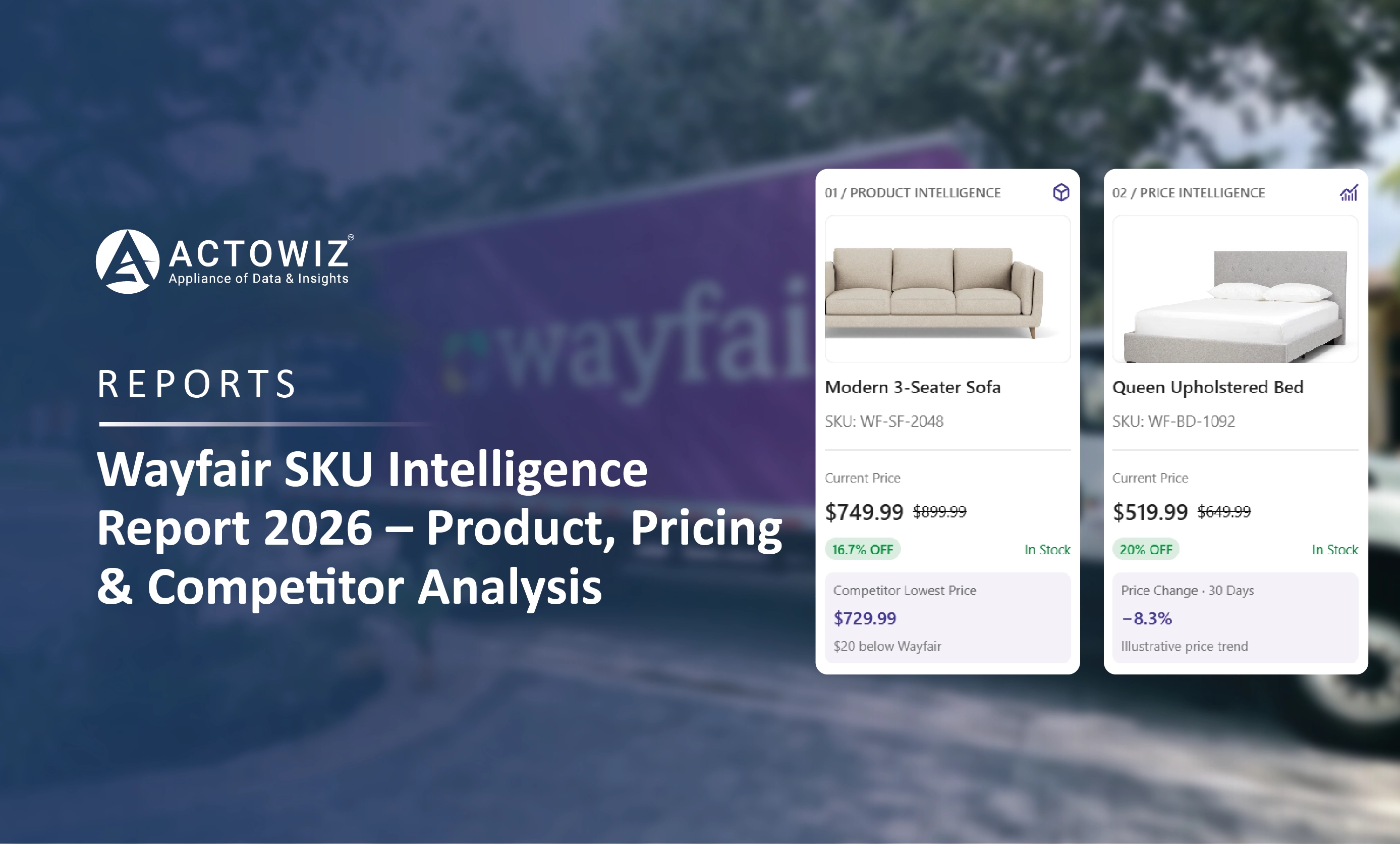
Wayfair SKU Data Intelligence Report 2026 explores SKU, product, pricing, assortment, and competitor data for smarter home and furniture decisions.
The Wayfair SKU Data Intelligence Report 2026 examines how SKU-level product, pricing, availability, review, and assortment information can support smarter decisions across home and furniture e-commerce. With Wayfair Data Scraping, businesses can transform publicly available product information into structured datasets for competitive benchmarking, price monitoring, assortment analysis, stock visibility, review intelligence, and product-market research. Wayfair remains focused on the home category, covering furniture, outdoor, bedding and bath, rugs, décor, lighting, kitchen, appliances, and other home-related categories. (Sell With Wayfair)
The scale of the marketplace makes product intelligence particularly valuable. Wayfair reported $12.5 billion in full-year 2025 revenue, 21.3 million active customers at the end of 2025, and 21.7 million active customers in Q2 2026. Q2 2026 revenue reached $3.5 billion, up 7.5% year over year, while orders delivered increased 6.0%. (Wayfair Investor Relations)
For retailers, manufacturers, furniture brands, marketplaces, and investors, the important question is not simply how many products exist. The deeper questions are: Which products are gaining visibility? How frequently do prices change? Which SKUs go out of stock? Which products accumulate stronger ratings? Which categories expand or contract? And how do competitors position comparable products?
Wayfair home and furniture Data Scraping can help businesses organize product names, SKU identifiers, categories, brands, prices, discounts, ratings, reviews, availability, dimensions, materials, colors, images, and other publicly displayed attributes into structured datasets.
Wayfair's category breadth makes this especially relevant. Its current marketplace spans furniture, outdoor products, bedding and bath, rugs, décor and pillows, lighting, organization, kitchen, baby and kids, home improvement, appliances, pet products, and seasonal merchandise. (Wayfair)
The Wayfair SKU Data Intelligence Report 2026 therefore focuses on SKU-level signals rather than relying only on overall marketplace performance.
| Wayfair business indicator | 2023 | 2024 | 2025 | Q2 2026 |
|---|---|---|---|---|
| Net revenue | $12.0B | $11.9B | $12.5B | $3.5B quarterly |
| Active customers | 22.4M | 21.4M | 21.3M | 21.7M |
| Average order value | $276* | $290* | $301* | $332* |
| Orders delivered | 11.3M* | 10.7M* | 11.1M* | 10.6M* |
Quarterly figures shown for Q4 in 2023–2025 and Q2 2026; therefore they should not be compared as full-year totals. (Wayfair Investor Relations)
From 2020 through 2026, e-commerce product intelligence moved from basic catalog collection toward continuous digital-shelf monitoring. During the pandemic, home improvement and furniture demand shifted rapidly, making availability and price visibility increasingly important. After the demand normalization period, retailers placed greater emphasis on profitability, assortment efficiency, and customer retention.
Wayfair's own operating metrics demonstrate this transition. In Q4 2023, it reported 22.4 million active customers and 1.84 orders per customer. By Q2 2026, active customers had risen to 21.7 million and orders per customer to 1.89 on a trailing-twelve-month basis. (Wayfair Investor Relations)
For data teams, the implication is clear: product datasets should be collected repeatedly, not treated as one-time snapshots.
Home and furniture SKU-level market Data intelligence provides a granular view of how individual products compete within a category. Instead of measuring a category only through average prices, businesses can analyze every monitored SKU according to price, discount, availability, reviews, ratings, attributes, and positioning.
This is particularly important for furniture because apparently similar products can differ substantially by dimensions, material, finish, configuration, color, brand, and delivery availability. Wayfair's current catalog includes extensive subcategories such as sofas, sectionals, coffee tables, desks, bookcases, beds, dressers, nightstands, dining tables, outdoor seating, rugs, mattresses, and bathroom products. (Wayfair)
| SKU intelligence metric | What it reveals |
|---|---|
| Current price | Market positioning |
| Previous price | Discount depth |
| Availability | Stock visibility |
| Rating | Customer satisfaction signal |
| Review count | Product adoption/engagement proxy |
| Brand | Competitive presence |
| Category | Assortment structure |
| Product attributes | Feature-level comparison |
| SKU status | New, active, unavailable, discontinued signals |
A SKU-level dataset can also calculate category price distributions, median selling prices, discount frequencies, brand share, review velocity, and assortment gaps.
Between 2020 and 2026, home and furniture e-commerce became increasingly data-driven. In the early pandemic period, demand shocks made inventory visibility critical. By 2023–2024, businesses were more focused on balancing product availability with profitability. In 2025–2026, the emphasis increasingly shifted toward share capture and efficient assortment.
Wayfair's 2025 results illustrate the shift: full-year revenue grew 5.1% to $12.5 billion, while Q4 revenue grew 6.9% year over year. In Q2 2026, revenue increased another 7.5%, and Wayfair reported 6% growth in orders delivered. (Wayfair Investor Relations)
For market researchers, SKU-level intelligence can reveal the product-level changes underneath those broader company results.
Wayfair furniture pricing and availability monitoring allows brands and retailers to understand how prices move across comparable products and how frequently product availability changes.
Furniture pricing is particularly complex because products can vary in dimensions, material, finish, configuration, shipping options, and promotional status. A simple price comparison can therefore produce misleading results unless SKUs are normalized according to comparable attributes.
Wayfair's Q2 2026 average order value was $332, compared with $328 in Q2 2025, while LTM revenue per active customer reached $596, up 4.2% year over year. (Wayfair Investor Relations) These figures do not represent individual SKU prices, but they provide useful context for understanding customer spending patterns at the marketplace level.
| Monitoring area | Example insight |
|---|---|
| List price | Standard market position |
| Sale price | Promotional competitiveness |
| Discount percentage | Promotion intensity |
| Stock status | Availability changes |
| Delivery estimate | Fulfillment competitiveness |
| Price history | Discount and repricing behavior |
| Variant availability | Color/size-level stock |
| Category median | Benchmark position |
The period from 2020 to 2026 shows why static pricing research is insufficient. Home demand experienced major changes during the pandemic, followed by normalization and a stronger focus on efficiency.
Wayfair reported improvements in availability, speed, and price competitiveness during 2023, linking these improvements to share expansion and customer loyalty. (Wayfair Investor Relations) By Q2 2026, the company reported 7.5% revenue growth and a 6% increase in orders delivered year over year. (Wayfair Investor Relations)
For competitive teams, daily or weekly monitoring can identify price changes that may otherwise remain invisible. Historical price series can reveal recurring promotions, seasonal discount patterns, and competitor positioning.
Extract Wayfair Products Stock Availability Data to identify when individual products, variants, or categories become unavailable. Stock visibility can be especially valuable for home and furniture because products may have long fulfillment cycles, large physical dimensions, and multiple configuration options.
Availability data can be combined with pricing and review information to distinguish between popular products and products that simply have limited supply. A product that disappears from the catalog after accumulating substantial engagement may require different interpretation from an SKU that consistently remains unavailable.
| Stock intelligence | Business question |
|---|---|
| In-stock percentage | How much assortment is currently available? |
| Out-of-stock rate | Which categories face availability gaps? |
| Variant stock | Which colors/sizes/configurations are available? |
| Availability duration | How long does an SKU remain unavailable? |
| Price + stock | Are promotions affecting availability? |
| Category stock | Which departments face the greatest gaps? |
The Wayfair SKU Data Intelligence Report 2026 perspective connects stock monitoring with broader marketplace performance. In Q2 2026, Wayfair delivered 10.6 million orders, up 6% year over year, while active customers reached 21.7 million. (Wayfair Investor Relations)
In 2020–2021, stockouts became a major e-commerce concern as supply chains experienced disruptions and demand shifted sharply toward home products. By 2022–2024, businesses increasingly used availability data to improve assortment planning and reduce missed sales opportunities.
Wayfair's 2023 results specifically highlighted improvements in availability, speed, and price competitiveness. (Wayfair Investor Relations) This illustrates why stock data should be analyzed alongside price and customer behavior.
By 2026, an effective monitoring system can calculate stockout frequency, average availability duration, category-level availability, variant-level gaps, and changes in availability following promotional campaigns.
A Wayfair Products Review & Rating Dataset can connect customer feedback with product, price, category, and availability information. Reviews provide qualitative information, while ratings and review counts provide measurable signals that can be tracked over time.
For home and furniture products, reviews can reveal recurring concerns around dimensions, assembly, material quality, color accuracy, comfort, durability, packaging, and delivery. These insights can help brands identify product improvement opportunities and help retailers understand which attributes influence customer perception.
Wayfair's marketplace currently provides rating filters and reviewed-product discovery across furniture categories, demonstrating the importance of ratings as part of product discovery. (Wayfair)
| Review intelligence metric | Potential use |
|---|---|
| Average rating | Product satisfaction benchmark |
| Review count | Engagement/adoption proxy |
| Rating distribution | Quality consistency |
| New reviews per period | Review velocity |
| Positive themes | Product strengths |
| Negative themes | Improvement opportunities |
| Attribute mentions | Feature-level sentiment |
| Competitor rating gap | Competitive benchmarking |
From 2020 to 2026, customer-generated content became increasingly important to e-commerce product intelligence. Consumers use reviews to evaluate furniture quality, dimensions, durability, assembly complexity, and visual accuracy before making purchases.
Wayfair's active-customer and repeat-order metrics provide useful context. Repeat customers represented 80.2% of total orders delivered in Q2 2026, while repeat customers placed 8.5 million orders during the quarter. (Wayfair Investor Relations) This makes customer experience signals particularly relevant to product and retention analysis.
A historical review dataset can identify whether ratings improve or decline following product changes, price adjustments, or new manufacturing batches. Natural-language processing can further classify recurring themes and connect them with SKU-level performance.
Extract Wayfair API Product Data can support structured product workflows where appropriate APIs, feeds, or authorized data-access mechanisms are available. API-based approaches can reduce repetitive page-level collection and provide structured data for downstream analytics, subject to applicable access permissions and terms.
A robust product data architecture can combine product identifiers, titles, category paths, prices, availability, attributes, ratings, reviews, URLs, images, and timestamps. Historical snapshots can then be compared to identify changes.
The Wayfair SKU Data Intelligence Report 2026 approach is especially relevant as Wayfair's business grows. Q2 2026 revenue reached $3.519 billion, up 7.5% year over year, while U.S. revenue reached $3.125 billion, up 8.7%. (Wayfair Investor Relations)
| API/data pipeline component | Intelligence value |
|---|---|
| SKU/product ID | Stable product matching |
| Product attributes | Catalog normalization |
| Price | Competitive analysis |
| Availability | Stock monitoring |
| Ratings | Quality benchmarking |
| Reviews | Customer intelligence |
| Category | Assortment analysis |
| Timestamp | Historical tracking |
| Image URL | Visual catalog monitoring |
Product data infrastructure evolved substantially between 2020 and 2026. Early catalog projects frequently relied on manual exports and simple crawlers. Modern e-commerce intelligence requires scheduled extraction, change detection, schema validation, deduplication, historical storage, and automated analytics.
Wayfair's recent growth reinforces the importance of scalable architecture. In Q2 2026, the company recorded $3.5 billion in quarterly revenue, 21.7 million active customers, and 10.6 million orders delivered. (Wayfair Investor Relations)
For data teams, the objective should be a reusable pipeline that can detect changes rather than repeatedly rebuild the entire dataset. Change detection can reduce unnecessary processing while maintaining an accurate historical record of product and market movements.
Actowiz Solutions can help businesses build structured product intelligence workflows around their specific competitive, pricing, assortment, and market-research requirements.
Ecommerce Data Scraping can be designed around defined product fields, categories, SKUs, prices, availability, reviews, ratings, and other publicly accessible attributes. The resulting datasets can be normalized and delivered in formats suitable for analytics, business intelligence, databases, or internal applications.
The Wayfair SKU Data Intelligence Report 2026 approach emphasizes repeatable monitoring rather than one-time extraction. A recurring pipeline can capture product changes over time, allowing teams to build historical price series, availability histories, review trends, assortment changes, and competitor benchmarks.
Actowiz Solutions can also support data validation and deduplication so that product variants are not incorrectly treated as separate or identical SKUs. This is particularly important for furniture, where size, color, configuration, material, and finish can create multiple variants.
A well-designed workflow can ultimately connect marketplace data with pricing teams, category managers, merchandising departments, product teams, and executive dashboards.
The Wayfair SKU Data Intelligence Report 2026 demonstrates why SKU-level intelligence is becoming increasingly important in home and furniture e-commerce. Wayfair generated $12.5 billion in revenue during 2025 and reached 21.7 million active customers by Q2 2026. During that quarter, revenue grew 7.5% year over year to $3.5 billion, orders delivered increased 6%, and average order value reached $332. (Wayfair Investor Relations)
An E-commerce Dashboard can transform product, price, availability, rating, review, and assortment records into actionable views for category managers and competitive teams. A Web scraping API can support scalable data workflows where appropriate access is available, while Custom Datasets can be designed around specific categories, SKU fields, competitors, or historical requirements.
Businesses may also use an instant data scraper for smaller exploratory requirements, while larger programs benefit from scheduled pipelines, validation, change detection, and historical storage.
The biggest opportunity is to move beyond isolated product records and create a continuously updated view of the digital shelf. With structured SKU intelligence, brands can identify pricing gaps, detect stock changes, benchmark competitors, analyze customer feedback, and improve assortment decisions.
Partner with Actowiz Solutions to build scalable Wayfair product and SKU intelligence datasets that turn e-commerce catalog data into actionable pricing, assortment, availability, and competitive insights!
Our web scraping expertise is relied on by 4,000+ global enterprises including Zomato, Tata Consumer, Subway, and Expedia — helping them turn web data into growth.
Watch how businesses like yours are using Actowiz data to drive growth.
From Zomato to Expedia — see why global leaders trust us with their data.
Backed by automation, data volume, and enterprise-grade scale — we help businesses from startups to Fortune 500s extract competitive insights across the USA, UK, UAE, and beyond.
We partner with agencies, system integrators, and technology platforms to deliver end-to-end solutions across the retail and digital shelf ecosystem.
Explore the Milk Basket India Weekly Q-Commerce Dataset to track FMCG pricing, grocery trends, and quick commerce market insights.
Simplify product data management with a Product database & storage API for organized storage, efficient access, and scalable business operations.
Wayfair SKU Data Intelligence Report 2026 explores SKU, product, pricing, assortment, and competitor data for smarter home and furniture decisions.
Whether you're a startup or a Fortune 500 — we have the right plan for your data needs.