Introduction
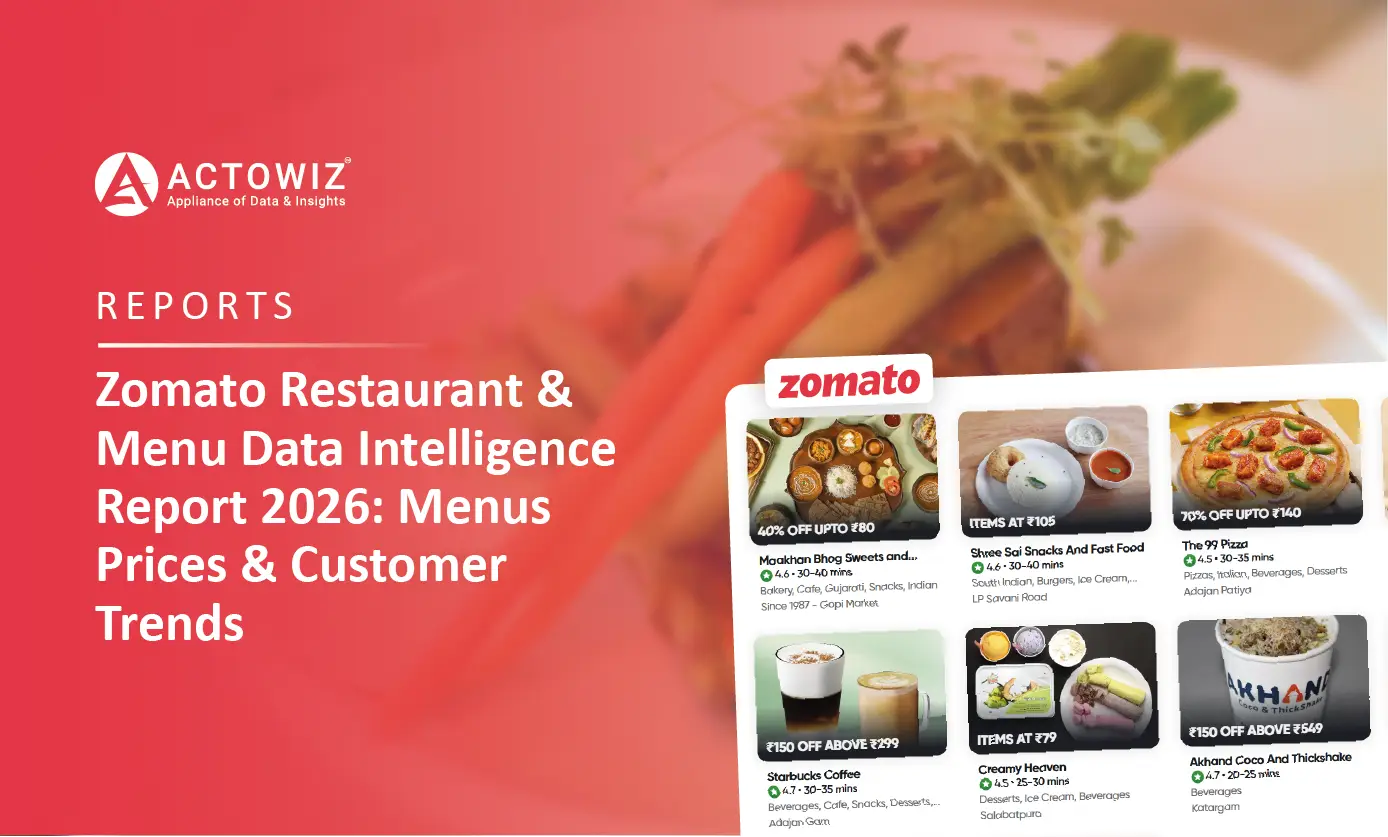
Zomato Restaurant & Menu Data Intelligence Report 2026 examines how restaurant listings, menu items, pricing, ratings, cuisines, availability, and customer signals can be transformed into actionable intelligence for food businesses. As India's food-service ecosystem becomes increasingly digital, restaurant and menu information is no longer useful only for consumers. It can help brands benchmark competitors, optimize menus, monitor pricing, identify demand patterns, and understand changing customer preferences.
India's food-services market has expanded substantially over the past several years. Industry data cited by Swiggy and Redseer estimates that India's food-services market increased from approximately ₹4 trillion in FY2020 to around ₹7 trillion in FY2025, with a projected ₹11–12 trillion by FY2030. The online food-delivery market also grew from roughly ₹0.27 trillion in FY2020 to approximately ₹0.79 trillion in FY2025.
Businesses using Zomato Data Scraping Services can collect and organize publicly accessible restaurant and menu information into structured datasets. These datasets can support competitive research, menu benchmarking, pricing intelligence, location analysis, restaurant performance monitoring, and long-term market research.
What Restaurant Data Reveals About India's Food Market
Zomato Restaurant Menu Data Analysis India provides a structured approach to understanding restaurant assortment, cuisine preferences, menu depth, pricing, ratings, and geographic variations. Instead of examining restaurants individually, businesses can analyze thousands of listings together to identify broader market patterns.
Zomato's current ecosystem demonstrates significant scale. Eternal states that more than 27 million customers use Zomato monthly and that more than 300,000 restaurants are serviced by the platform.
Key Market Indicators
| Indicator |
Latest Reported Level |
Business Relevance |
| Monthly Zomato customers |
27M+ |
Indicates consumer reach |
| Restaurants serviced |
300,000+ |
Shows restaurant ecosystem scale |
| Food-services market FY2025 |
~₹7 trillion |
Indicates market size |
| Online food delivery FY2025 |
~₹0.79 trillion |
Shows digital ordering scale |
| Food-services market FY2030 projection |
₹11–12 trillion |
Indicates growth opportunity |
| Online food delivery FY2030 projection |
₹1.7–2.2 trillion |
Indicates digital expansion |
The breadth of this ecosystem creates significant opportunities for structured restaurant intelligence. Businesses can compare restaurants by city, cuisine, price range, rating, menu size, meal type, and other attributes.
2020–2026 Market Evolution
From 2020 to 2026, India's restaurant ecosystem experienced a major transition from predominantly offline discovery toward digitally enabled food discovery and ordering. In 2020, lockdowns accelerated dependence on delivery platforms, making online restaurant visibility increasingly important. In 2021, restaurants adapted menus, packaging, pricing, and delivery-focused operations to meet changing customer expectations. By 2022, online menus had become an important source of restaurant discovery and comparison. In 2023, restaurants increasingly experimented with cloud kitchens, specialized concepts, delivery-first brands, and digital promotions. Industry data indicates that cloud-kitchen activity grew substantially from 2018 to 2023, reinforcing the importance of digital food-service platforms. In 2024, structured restaurant information became increasingly valuable for competitive benchmarking as organized food services continued gaining share. By 2025, India's food-services market had reached approximately ₹7 trillion, while online food delivery approached ₹0.79 trillion. In 2026, restaurant intelligence increasingly focuses on granular information such as item-level pricing, cuisine mix, ratings, restaurant density, menu changes, and geographic differences. This shift means that restaurant data can now support strategic decisions across expansion, pricing, product development, competitor monitoring, and customer experience.
How Can Businesses Build a Reliable Restaurant Dataset?
Zomato Restaurant Data Collection enables businesses to create structured records from restaurant listings and associated menu information. A reliable dataset can contain restaurant name, location, cuisine, rating, review count, price range, menu categories, item names, item prices, descriptions, availability, and other publicly accessible attributes.
The scale of the platform makes automated collection especially useful. Manual research can become difficult when businesses need to compare restaurants across multiple cities or monitor changes over time.
Example Restaurant Dataset
| Data Attribute |
Example Information |
Intelligence Use |
| Restaurant name |
Brand/outlet name |
Restaurant identification |
| Location |
City/locality |
Geographic analysis |
| Cuisine |
Indian, Chinese, Italian |
Cuisine benchmarking |
| Rating |
Star rating |
Customer perception |
| Reviews |
Review volume |
Popularity indicator |
| Price range |
₹ / ₹₹ / ₹₹₹ |
Affordability analysis |
| Menu items |
Dish names |
Assortment analysis |
| Item price |
Listed price |
Pricing intelligence |
| Availability |
Available/unavailable |
Menu monitoring |
| Timestamp |
Collection date |
Historical tracking |
A recurring dataset can reveal whether restaurants are adding or removing dishes, changing prices, modifying cuisine positioning, or experiencing shifts in ratings.
2020–2026 Market Evolution
The need for structured restaurant data increased significantly between 2020 and 2026. In 2020, restaurants primarily focused on maintaining online presence and delivery availability as physical dining was disrupted. During 2021, digital menus became more important because customers increasingly depended on online information before ordering. In 2022, restaurants began optimizing digital listings, promotions, and delivery menus to compete for online visibility. By 2023, the growing number of organized restaurants, cloud kitchens, and digital-first brands made manual restaurant research less practical. In 2024, businesses increasingly needed historical data to understand competitor movement rather than relying on one-time snapshots. By 2025, more than 300,000 restaurants were being serviced by Zomato, according to Eternal, illustrating the scale of the platform's restaurant ecosystem. In 2026, restaurant datasets are increasingly designed around recurring collection. Instead of simply recording what a restaurant offers today, businesses can compare historical menus, price changes, rating movements, restaurant openings, closures, cuisine trends, and location-level competition. This makes structured restaurant data useful for market research, expansion planning, competitive benchmarking, menu optimization, and investment analysis.
How Does Menu Pricing Intelligence Improve Competitive Decisions?
Zomato Menu Pricing Data Scraping can help businesses monitor item-level prices across restaurants, cities, cuisines, and categories. Menu prices are highly dynamic and can change because of ingredient costs, promotions, demand, competition, delivery economics, and restaurant strategy.
A structured pricing dataset can identify the average price of comparable dishes and highlight restaurants positioned above or below category benchmarks.
Menu Pricing Benchmark
| Metric |
Example Analysis |
Strategic Value |
| Average item price |
Category average |
Benchmark pricing |
| Lowest listed price |
Market minimum |
Identify value competitors |
| Highest listed price |
Market premium |
Analyze premium positioning |
| Price change |
Previous vs current |
Detect inflation or strategy |
| Discounted price |
Offer price |
Promotional analysis |
| Cuisine-level price |
Pizza vs biryani vs Chinese |
Category comparison |
| City-level price |
Mumbai vs Delhi vs Bengaluru |
Geographic benchmarking |
Pricing intelligence becomes more valuable when combined with ratings and review volumes. A restaurant with premium prices and strong ratings may have a different positioning strategy from a low-priced restaurant with high order visibility.
2020–2026 Market Evolution
Menu pricing underwent substantial changes from 2020 through 2026. In 2020, restaurants faced major operational disruption and changing ingredient, labor, packaging, and delivery costs. During 2021, restaurants increasingly adapted menus for delivery, sometimes reducing menu complexity to improve operational efficiency. In 2022, inflation and changing consumer purchasing behavior made price benchmarking increasingly important. By 2023, restaurants were experimenting with bundles, discounts, premium products, value menus, and delivery-exclusive offerings. In 2024, competitive menu monitoring became increasingly relevant as customers could compare restaurants and dishes instantly through digital platforms. By 2025, India's online food-delivery market had reached approximately ₹0.79 trillion, up from around ₹0.27 trillion in FY2020. This expansion created a larger environment for systematic price comparison. In 2026, menu intelligence increasingly goes beyond recording a single price. Businesses can track price movements, promotional discounts, category averages, premium positioning, portion descriptions, add-ons, combos, and changes in menu architecture. When price data is combined with customer ratings and restaurant characteristics, brands can assess whether higher prices correspond with stronger customer perception or whether competitors are delivering greater perceived value.
What Can Restaurant Intelligence Reveal About Competition?
Zomato Restaurant Market Intelligence allows businesses to analyze the competitive structure of food markets at city, locality, cuisine, and restaurant levels. A restaurant brand can use this intelligence to understand where competitors operate, what cuisines dominate an area, how pricing varies, and which restaurant characteristics appear to correlate with stronger ratings.
Competitive Intelligence Indicators
| Indicator |
What It Measures |
Potential Use |
| Restaurant density |
Number of competitors |
Market-entry planning |
| Cuisine distribution |
Category concentration |
Identify gaps |
| Average rating |
Customer perception |
Benchmark quality |
| Review volume |
Customer engagement |
Estimate visibility |
| Average menu price |
Pricing position |
Pricing strategy |
| Menu size |
Assortment breadth |
Product planning |
| Location concentration |
Geographic competition |
Expansion strategy |
| New listings |
Market activity |
Detect emerging competitors |
Eternal's current Zomato business overview states that the platform has more than 27 million monthly users and services more than 300,000 restaurants. Such scale provides a large environment for restaurant-market research.
2020–2026 Market Evolution
From 2020 to 2026, competitive restaurant intelligence evolved from basic restaurant discovery into a broader analytical discipline. In 2020, businesses were largely concerned with survival, delivery availability, and digital visibility. During 2021, restaurant operators increasingly optimized digital listings and delivery-oriented menus. In 2022, competition intensified as restaurants returned to growth and customers became more comfortable with online ordering. By 2023, cloud kitchens and delivery-first concepts had expanded the competitive landscape. Industry research indicated that India's organized food-services share increased from approximately 36–41% in FY2020 to 47–52% in FY2025, with further growth projected through 2030. In 2024, restaurant operators increasingly needed localized intelligence because competition varied substantially between neighborhoods and cities. In 2025, India's food-services market reached roughly ₹7 trillion, while organized formats continued expanding. By 2026, market intelligence increasingly combines restaurant locations, cuisine types, pricing, ratings, menu assortment, customer feedback, and availability. This allows businesses to identify underserved locations, emerging cuisines, premium opportunities, competitive price gaps, and changes in local restaurant density before making expansion or menu decisions.
How Can Businesses Monitor Restaurant Menus at Scale?
Scrape Zomato Restaurant Menu Data workflows can help organizations create recurring snapshots of restaurant menus and identify changes over time. Menu information can be collected and standardized into a consistent schema so that businesses can compare restaurants, cuisines, locations, and individual menu items.
This is particularly useful for food brands, restaurant chains, aggregators, market researchers, and competitive intelligence teams.
Menu Monitoring Framework
| Monitoring Area |
Example Fields |
Business Benefit |
| Restaurant |
Name, location, cuisine |
Competitive mapping |
| Menu category |
Starters, mains, desserts |
Assortment analysis |
| Item |
Name, description |
Product benchmarking |
| Price |
Current/listed price |
Price monitoring |
| Availability |
Available/unavailable |
Supply visibility |
| Rating |
Restaurant rating |
Customer perception |
| Reviews |
Count and trends |
Demand signal |
| Changes |
Added/removed items |
Menu strategy |
Menu monitoring can also identify seasonal products, newly introduced dishes, discontinued items, price changes, and differences in menu structures across locations.
2020–2026 Market Evolution
The role of digital menus expanded rapidly from 2020 to 2026. In 2020, online menus became critical as customers shifted toward delivery and takeaway. During 2021, restaurants refined their digital menus to improve delivery suitability and operational efficiency. In 2022, customers increasingly used online menus to compare dishes, prices, ratings, and restaurants before placing orders. By 2023, menu optimization became an important competitive activity for restaurants and cloud kitchens. In 2024, the ability to track menu changes became increasingly valuable because restaurants could modify prices and assortment quickly in response to competition and ingredient costs. During 2025, continued expansion of digital food ordering strengthened the need for structured menu intelligence. Industry projections show India's online food-delivery market could reach ₹1.7–2.2 trillion by FY2030, compared with approximately ₹0.79 trillion in FY2025. In 2026, menu monitoring increasingly involves historical comparisons. Businesses can determine when an item was introduced, whether its price increased, whether it remained available, how its rating changed, and how competitors positioned similar products. This creates an evolving menu intelligence layer that can support restaurant benchmarking, menu engineering, pricing decisions, and competitive research.
How Can Automation Improve Restaurant Data Workflows?
Zomato Scraping API solutions can help organizations automate recurring restaurant and menu data workflows. Instead of depending on manual spreadsheets, businesses can establish structured pipelines for collecting, validating, normalizing, and delivering data at predefined intervals.
The value of automation becomes particularly clear when a business needs to monitor thousands of restaurants or compare multiple cities.
Automated Intelligence Workflow
| Stage |
Activity |
Output |
| Discovery |
Identify restaurant listings |
Restaurant universe |
| Collection |
Capture restaurant/menu fields |
Raw dataset |
| Normalization |
Standardize fields |
Consistent records |
| Validation |
Check missing/duplicate data |
Clean dataset |
| Scheduling |
Repeat collection |
Historical dataset |
| Analytics |
Compare trends |
Business insights |
| Delivery |
Export/API/database |
Analytics-ready data |
An automated workflow can support dashboards, research reports, pricing systems, competitor-monitoring tools, and internal business intelligence platforms.
2020–2026 Market Evolution
Automation became increasingly important as the Indian food ecosystem scaled from 2020 to 2026. In 2020, data collection was often performed manually or through limited internal systems because restaurant operations were focused on immediate continuity. By 2021 and 2022, the growth of online ordering created larger quantities of restaurant and menu information that required more systematic management. In 2023, restaurant chains, cloud kitchens, and food-tech businesses increasingly required recurring data rather than isolated research. By 2024, automated collection and historical monitoring became more relevant for pricing, assortment, and competitive intelligence. In 2025, India's online food-delivery market was estimated at approximately ₹0.79 trillion, demonstrating the growing scale of digitally mediated restaurant consumption. Zomato's ecosystem also continued operating at substantial scale, with more than 27 million monthly customers and more than 300,000 restaurants serviced according to Eternal's current overview. In 2026, automation allows businesses to move from occasional research to continuous intelligence. Historical datasets can reveal restaurant openings, closures, menu additions, price changes, rating movements, cuisine trends, and competitive shifts. This supports faster decision-making while reducing the operational burden associated with large-scale restaurant research.
Food Data Scraping Services from Actowiz Solutions can help businesses transform publicly accessible food-platform information into structured, analytics-ready datasets. The objective is not simply to collect restaurant records but to create reliable data pipelines that support recurring market intelligence.
For the Zomato Restaurant & Menu Data Intelligence Report 2026, businesses can use structured data to understand restaurant availability, menu assortment, pricing, ratings, locations, cuisines, and customer-facing signals.
Actowiz Solutions Can Support
| Requirement |
Supported Approach |
| Restaurant discovery |
Structured listing collection |
| Menu monitoring |
Recurring menu snapshots |
| Price intelligence |
Item-level price tracking |
| Competitor analysis |
Cross-restaurant benchmarking |
| Location intelligence |
City and locality analysis |
| Rating monitoring |
Historical rating datasets |
| Menu changes |
Added/removed item tracking |
| Data delivery |
Custom datasets and integrations |
Actowiz Solutions can customize data fields, collection schedules, geographic coverage, and delivery formats according to project requirements. Data can be prepared for databases, dashboards, research reports, analytics systems, and internal business applications.
The broader market opportunity supports this requirement. India's food-services market is projected to reach ₹11–12 trillion by FY2030, while the online food-delivery segment is projected at ₹1.7–2.2 trillion. These trends indicate that restaurant and menu intelligence will become increasingly important as more food businesses compete through digital channels.
Conclusion
Zomato Restaurant & Menu Data Intelligence Report 2026 highlights how restaurant listings, menus, pricing, ratings, locations, and customer signals can become valuable sources of business intelligence. As digital food ordering expands, businesses need more than static restaurant lists. They need historical, structured, and comparable data that explains how the competitive landscape changes over time.
Restaurant and menu intelligence can support pricing decisions, menu optimization, competitor benchmarking, location planning, cuisine analysis, restaurant discovery, and customer-focused strategies. Combining restaurant-level and item-level information also helps businesses identify market gaps and emerging opportunities.
Actowiz Solutions can help organizations establish scalable data collection workflows designed around their restaurant intelligence requirements. With structured extraction, normalization, validation, recurring monitoring, and analytics-ready delivery, businesses can turn complex food-platform information into practical insights.
Its Web Crawling service capabilities can support recurring collection requirements, while Web Data Mining can help businesses analyze large volumes of structured and unstructured marketplace information.
Ready to transform restaurant and menu information into actionable market intelligence? Contact Actowiz Solutions for customized food data scraping, restaurant monitoring, menu intelligence, pricing analysis, and structured dataset solutions tailored to your business needs!

 Pricing & Promotions
MAP Violations Brand Protection Counterfeit Detection Price Intelligence AI HOT Data Intelligence
Pricing & Promotions
MAP Violations Brand Protection Counterfeit Detection Price Intelligence AI HOT Data Intelligence Brand & Intelligence
Share of Search Content Audit & PDP Reviews & Ratings Retail Media Buy Box Monitoring Social Commerce HOT Live Commerce NEW Agentic Commerce NEW
Brand & Intelligence
Share of Search Content Audit & PDP Reviews & Ratings Retail Media Buy Box Monitoring Social Commerce HOT Live Commerce NEW Agentic Commerce NEW Digital Shelf & Search
Assortment Planning Competitive Benchmarking Product Availability Q-Commerce NEW
Digital Shelf & Search
Assortment Planning Competitive Benchmarking Product Availability Q-Commerce NEW AssortmentE-commerce Intelligence Hyperlocal Insights POI & Store Locator DTC Brand Analytics NEW
 For Retailers
 E-Commerce Dashboard
 Flipkart Insights (Live) #1
 Grocery Intelligence
.svg) Grocery Price (U.S.)
Grocery Price (U.S.)
.svg) Quick Commerce (India) HOT
Quick Commerce (India) HOT
 Food & Restaurant
 Fashion Intelligence
 Automotive
 Travel & Hospitality
 Real Estate
 Food Delivery Intelligence NEW
 OTT & Streaming NEW
 By Use Case
 Pricing Intelligence
 Digital Shelf Analytics
 MAP Monitoring HOT
 Cross-Border Price Parity NEW
 Share of Search
 Review Sentiment
 Kitchen Market Gaps NEW
 Dynamic Pricing / AI Repricing NEW
 Promotions & Deals Alerts NEW
 B2B / POI & Lead Data NEW
 By Region🇮🇳 India 🇺🇸 USA 🇦🇪 Middle East 🇬🇧 UK 🇦🇺 Australia 🌏 SE Asia 🇪🇺 Europe 🌎 LATAMIndia
 Flipkart Real-Time Insights
 Quick Commerce — Zepto · Blinkit
 Pincode Price Tracker
Middle East
Pincode Price Tracker
Middle East GCC Q-Commerce — Talabat · Noon NEW
UK & Australia
GCC Q-Commerce — Talabat · Noon NEW
UK & Australia UK Grocery — Tesco, Sainsbury's, Asda
 AU Grocery — Coles & Woolworths NEW
 Marketplace Scrapers
Amazon API TikTok Shop API HOT Uber Eats API Airbnb API Zepto / Blinkit API Instacart API NEW Talabat API NEW
Marketplace Scrapers
Amazon API TikTok Shop API HOT Uber Eats API Airbnb API Zepto / Blinkit API Instacart API NEW Talabat API NEW Developer APIsWeb Extract API Reviews API SERP API Pricing Webhook NEW
 Universal APIsStreaming Crawl API Scheduler Realtime Alerts Webhook Delivery 🐍 Python SDK 💚 Node.js SDK
 Delivery & SDKs
 Knowledge Center
Digital Shelf Playbook MAP Compliance Guide Pricing Intel Guide Scraping Compliance TikTok Shop Guide NEW Cross-Border Guide NEW
Knowledge Center
Digital Shelf Playbook MAP Compliance Guide Pricing Intel Guide Scraping Compliance TikTok Shop Guide NEW Cross-Border Guide NEW Guides & Playbooks
🎉 Seasonal & event tracking NEWBlack Friday pricing report Festive season, India Ramadan, GCC grocery All seasonal reportsSample Datasets HOT ROI Calculator NEW API Postman Collection Demo Dashboards Free API Playground NEW Press Kit
Guides & Playbooks
🎉 Seasonal & event tracking NEWBlack Friday pricing report Festive season, India Ramadan, GCC grocery All seasonal reportsSample Datasets HOT ROI Calculator NEW API Postman Collection Demo Dashboards Free API Playground NEW Press Kit Downloads & Tools
Trust Center About Us FAQs Careers
Downloads & Tools
Trust Center About Us FAQs Careers Trust & CompanyRetail shelf research NEWRetail shelf research






































 4.8/5 Average Rating
 50+ Video Testimonials
 92% Client Retention
 50+ Countries Served