Core services
Enterprise Data Extraction

Scalable web, app and AI-powered collection across 40+ countries.

All 58 services →
New 2026
AI Training Data

Corpus building with provenance and opt-out compliance.

Learn more →
Free pilot
24-hour sample

We run collection on your own sources before you commit.

Get a sample →
58Services
40+Countries
DEVELOPER

Ready-Made Scrapers

Pre-built for top platforms. Self-serve, no setup.

View All →
TRY FREE

API Playground

Test endpoints instantly. No credit card.

Start Free →
28Tools
2SDKs
icons Delivery & SDKs
Streaming Crawl API Scheduler Realtime Alerts Webhook Delivery 🐍 Python SDK 💚 Node.js SDK

Need it managed instead?

Fixed monthly retainer, named engineer, no per-request metering.

Managed Data API →
HOT

Case Studies

How brands use Actowiz, with named outcomes.

Read →
FREE

Sample Datasets

Real output, no signup.

Download →
NEW

ROI Calculator

Model the return on a data engagement.

Calculate →
Competitor markdown tracking guide 2026 – strike-through prices, clearance badges and markdown depth chart

Introduction

Competitor markdown tracking is the regular collection of competitors' public prices, reference prices, clearance badges and stock messages so you can see when they cut prices, how deep the cuts go and how often they repeat. It helps retailers and brands time their own markdowns, protect margin and avoid matching cuts that are really clearance.

Discounting is now a core part of peak season. Adobe reported that US shoppers spent $257.8 billion online from 1 November to 31 December 2025, with discounts peaking at 30.9% off list price in electronics and 25.1% in apparel Adobe 2025 holiday season report. NRF counted a record 202.9 million shoppers over the 2025 Thanksgiving-to-Cyber-Monday weekend NRF, 2 December 2025.

This guide explains which signals to collect, how to measure markdown depth and cadence, how to read stock signals as sell-through proxies, and when to watch most closely in 2026.

Why does competitor markdown tracking matter?

Competitor markdown tracking tells you more than a price change. It hints at a competitor's stock position, season plan and margin pressure, which helps you decide whether to follow, hold or wait.

  • Avoid matching clearance. A competitor clearing old stock is not a reason to cut a new-season product.
  • Time your own markdowns. If rivals start end-of-season cuts earlier each year, your first markdown may need to move too.
  • Protect margin. Knowing the usual depth of a rival's first cut helps you avoid going deeper than needed.
  • Brand compliance. Brands can see which retailers discount their products, how deep and how early.

Interest in competitor markdown tracking is growing. Pricing and competitor intelligence inquiries to Actowiz rose this week (four genuine requests versus one the week before), and one US retail-analytics client asked for store-level online price, availability and clearance flags by item and ZIP code.

What do markdown and clearance signals look like online?

For competitor markdown tracking, online markdowns show up as a handful of visible page elements. Each one should become a separate field so you can tell a temporary deal from a permanent clearance.

Signal What it looks like What it usually means Field to store
Strike-through price Crossed-out price above the current price Price cut against a stated reference price_reference, price_current
Was/now text "Was $49.99, now $29.99" Explicit markdown with stated depth was_price, now_price
Clearance badge "Clearance", "Final sale", "Reduced to clear" Permanent markdown to exit stock clearance_flag, badge_text
Rollback or price-drop label Retailer-specific price-cut label Temporary or longer-term cut promo_label
Coupon Clip coupon, promo code, cart discount Discount not shown in the shelf price coupon_value, coupon_type
Bundle or multi-buy "2 for $30", "Buy 2 save 15%" Per-unit markdown hidden in a deal bundle_terms, unit_price_effective
Sale or outlet page End-of-season or outlet category Range-wide markdown event listing_source, sale_page_url
Low-stock message "Only 3 left", limited sizes Stock running down (proxy only) stock_message, sizes_available

In the EU, price-reduction announcements must state the lowest price of the prior 30 days, and the UK has its own pricing-practices guidance. So the reference price itself is regulated, and it is worth storing exactly as shown.

How do you measure markdown depth and cadence?

Markdown depth is the percentage cut from a stable reference price; cadence is how often and how far apart the cuts come. Competitor markdown tracking needs a clean price history per product to measure either one.

Markdown depth

Use a consistent baseline. The displayed reference price is easy but can be inflated, so also compute depth against the product's own regular price, for example the most common price over the previous 30 to 60 days.

  • Displayed depth = (reference price − current price) ÷ reference price.
  • Observed depth = (regular price from your history − current price) ÷ regular price.
  • Effective depth = observed depth after coupons, bundles and loyalty prices.

A big gap between displayed and observed depth suggests an inflated reference price. Our Holiday 2026 US retail price war report looks at that question for peak season.

Markdown cadence

Cadence shows the competitor's playbook. Record the date of each step-down, the depth of each step and the days between them.

  • Collect prices daily (or several times a day in peak weeks) for a fixed product list.
  • Clean out errors, out-of-stock placeholder prices and currency issues.
  • Set the regular price per product from its recent history.
  • Detect steps when the price drops beyond a threshold and stays there for at least a day.
  • Label each step: promotion (price returns later), markdown (stays down) or clearance (clearance badge or final-sale text).
  • Aggregate by brand, category and retailer to see first-markdown timing, typical depth and number of steps.

How can stock signals act as sell-through proxies?

You cannot see a competitor's sales, but public availability signals give a rough, indirect read. Treat them as proxies, never as sell-through figures.

  • Size and variant breaks – when only extreme sizes or a few colours remain, the core range has probably sold. This is a proxy.
  • Low-stock messages – "only a few left" text is a signal, not a count. Its rules differ by retailer.
  • Out-of-stock duration – a product that goes out of stock and is not restocked after a clearance cut has likely exited. This is a proxy.
  • Listing removals – a product that disappears from listings ends its markdown cycle.
  • Store-level availability – where retailers publish online store availability by ZIP code, you can see which locations still hold stock.

In competitor markdown tracking, pair these signals with markdown steps. A deep cut followed quickly by size breaks suggests the cut worked; a second cut with full sizes still available suggests it did not. Both are inferences, so label them as such in reports.

When should you watch competitor markdowns most closely in 2026?

Markdown activity clusters around a few predictable windows. Increase competitor markdown tracking frequency before each one and keep it high until clearance ends.

Window 2026 dates What to watch
Autumn/winter build-up October to mid-November Early "Black Friday" pricing, reference-price changes
Thanksgiving (US) Thursday 26 November 2026 Early-access deals and doorbusters
Black Friday Friday 27 November 2026 Peak depth across electronics, toys, apparel
Cyber Monday Monday 30 November 2026 Online-only cuts, coupons, bundle deals
December price drops 1 to 24 December 2026 Second markdowns and last-shipping-day deals
Boxing Day (UK) Saturday 26 December 2026 (bank holiday on Monday 28 December) Clearance badges and end-of-season sale pages
January clearance Late December to January 2027 Final-sale cuts on winter ranges
Summer end-of-season Typically late June to August Apparel, garden and outdoor clearance

For December specifically, see our December price-drop deal mapping across Amazon, Walmart and Target.

How do markdowns differ by category?

Each category marks down for different reasons and at a different pace, so your competitor markdown tracking setup should differ too. The table combines Adobe's 2025 peak-discount figures with the signals we see most often.

Category Typical markdown driver Key signals Peak 2025 US online discount (Adobe) Suggested cadence
Apparel Season end, size breaks Clearance badges, sizes left, outlet pages 25.1% Daily; twice daily in peak weeks
Electronics New models, event pricing Was/now, coupons, bundles, open-box 30.9% (TVs 24.3%, computers 23.4%) Several times a day around events
Grocery Short shelf life, promotions Rollback-style labels, multi-buys, unit price Not reported Daily, by store or ZIP where available
Home and furniture Range resets, bulky stock Clearance pages, delivery offers Furniture 18.8%, appliances 20.2% Daily; weekly for long-tail items

Source for discount figures: Adobe 2025 holiday season report. Grocery markdowns on short-dated stock often happen in store and may not appear online.

How do retailers and brands use markdown data?

Retailers and brands use competitor markdown tracking data from different sides. Retailers want to price against rivals; brands want to see how their products are treated.

  • Retail pricing teams – set first-markdown timing and depth against rivals, and avoid matching clearance on current-season lines.
  • Merchandising teams – compare competitors' sale assortment with their own to spot over- or under-stocked ranges.
  • Brand managers – check which retailers discount their products, by how much and how early. Our promo tracking and compliance solutions support this.
  • Revenue and finance teams – plan peak-season margin with realistic rival depth assumptions.
  • Analysts and investors – read markdown intensity as a signal of retailer inventory health, labelled as an estimate.

What data fields do you need for competitor markdown tracking?

A good markdown dataset is one row per product, per retailer, per location, per crawl. Keep raw values as shown and add derived fields separately.

Field Description
retailer / country Retailer name and market (e.g. Walmart US, a UK fashion retailer)
product_id / upc_gtin Retailer item ID and UPC/GTIN where shown, for matching
title / brand / category Product identity and category path
store_id / zip Location for store-level online prices, where published
price_current Price shown to the shopper at crawl time
price_reference Strike-through or "was" price as shown
promo_label / clearance_flag Badge text and a yes/no clearance flag
coupon_value / bundle_terms Extra discounts not in the shelf price
availability / stock_message In stock, out of stock, low-stock text
sizes_available Variants still available (apparel, footwear)
crawl_timestamp Date and time of collection
depth_displayed / depth_observed Derived markdown depth fields

Public data only: collect what any shopper can see without logging in, respect each site's terms and rate limits, avoid personal data, and get legal review before you start.

Should you build or buy competitor markdown tracking?

Build if you track a small, stable list of products on a few sites. Buy if you need many retailers, store-level data or peak-season frequency, because maintenance grows fastest exactly when markdowns peak.

Factor Build in-house Managed service
Speed to start Weeks of engineering per retailer Scope, sample, then schedule
Peak-season load You scale crawls and fix breakages Provider scales and monitors
Product matching Your own UPC and attribute rules Matching with QA checks
Store-level data Complex location handling Store or ZIP logic set up per retailer
Output Raw files CSV, JSON, API or dashboard

Actowiz provides price monitoring services and retailer-specific feeds such as Walmart search results data.

Frequently Asked Questions

What is competitor markdown tracking?

It is the regular collection of competitors' public prices, reference prices, clearance labels and stock messages to see when they cut prices, how deep and how often.

How is a markdown different from a promotion?

A promotion is temporary and the price returns afterwards. A markdown stays down, and clearance is a markdown meant to sell out the remaining stock.

How do you calculate markdown depth?

Subtract the current price from a stable regular price and divide by the regular price. Compare that with the displayed reference price to spot inflated "was" prices.

Can web data show competitors' sell-through rate?

Not directly. Size breaks, low-stock messages, out-of-stock duration and listing removals are proxies that suggest how stock is moving, and they should be labelled as such.

How often should I collect markdown data?

Daily competitor markdown tracking is enough for most categories. Move to several times a day for electronics and apparel around Black Friday, Cyber Monday and Boxing Day.

Can you track store-level clearance prices?

Where a retailer publishes online prices and availability by store or ZIP code, those public values can be collected. In-store shelf tags that are not online cannot.

You can also reach us for all your mobile app scraping, data collection, web scraping, and instant data scraper service requirements!

Share your competitor list, product IDs and markets, and we will send a sample with prices, reference prices, clearance flags and stock signals before Black Friday 2026. Contact Sales to start.
Talk to our data team
Social Proof That Converts

Trusted by Global Leaders Across Q-Commerce, Travel, Retail, and FoodTech

Our web scraping expertise is relied on by 4,000+ global enterprises including Zomato, Tata Consumer, Subway, and Expedia — helping them turn web data into growth.

4,000+ Enterprises Worldwide
50+ Countries Served
20+ Industries
Join 4,000+ companies growing with Actowiz →
Real Results from Real Clients

Hear It Directly from Our Clients

Watch how businesses like yours are using Actowiz data to drive growth.

▶
1 min
★★★★★
"Actowiz Solutions offered exceptional support with transparency and guidance throughout. Anna and Saga made the process easy for a non-technical user like me. Great service, fair pricing!"
TG
Thomas Galido
Co-Founder / Head of Product at Upright Data Inc.
▶
2 min
★★★★★
"Actowiz delivered impeccable results for our company. Their team ensured data accuracy and on-time delivery. The competitive intelligence completely transformed our pricing strategy."
II
Iulen Ibanez
CEO / Datacy.es
▶
1:30
★★★★★
"What impressed me most was the speed — we went from requirement to production data in under 48 hours. The API integration was seamless and the support team is always responsive."
FC
Febbin Chacko
-Fin, Small Business Owner
icons 4.8/5 Average Rating
icons 50+ Video Testimonials
icons 92% Client Retention
icons 50+ Countries Served

Join 4,000+ Companies Growing with Actowiz

From Zomato to Expedia — see why global leaders trust us with their data.

Why Global Leaders Trust Actowiz

Backed by automation, data volume, and enterprise-grade scale — we help businesses from startups to Fortune 500s extract competitive insights across the USA, UK, UAE, and beyond.

icons
7+
Years of Experience
Proven track record delivering enterprise-grade web scraping and data intelligence solutions.
icons
4,000+
Projects Delivered
Serving startups to Fortune 500 companies across 50+ countries worldwide.
icons
200+
In-House Experts
Dedicated engineers across scrapers, AI/ML models, APIs, and data quality assurance.
icons
9.2M
Automated Workflows
Running weekly across eCommerce, Quick Commerce, Travel, Real Estate, and Food industries.
icons
270+ TB
Data Transferred
Real-time and batch data scraping at massive scale, across industries globally.
icons
380M+
Pages Crawled Weekly
Scaled infrastructure for comprehensive global data coverage with 99% accuracy.

AI Solutions Engineered
for Your Needs

→
LLM-Powered Attribute Extraction: High-precision product matching using large language models for accurate data classification.
→
Advanced Computer Vision: Fine-grained object detection for precise product classification using text and image embeddings.
→
GPT-Based Analytics Layer: Natural language query-based reporting and visualization for business intelligence.
→
Human-in-the-Loop AI: Continuous feedback loop to improve AI model accuracy over time.
icons Product Matching icons Attribute Tagging icons Content Optimization icons Sentiment Analysis icons Prompt-Based Reporting

Connect the Dots Across
Your Retail Ecosystem

We partner with agencies, system integrators, and technology platforms to deliver end-to-end solutions across the retail and digital shelf ecosystem.

icons
Analytics Services
icons
Ad Tech
icons
Price Optimization
icons
Business Consulting
icons
System Integration
icons
Market Research
Become a Partner →

Popular Datasets — Ready to Download

Browse All Datasets →
icons
Amazon
eCommerce
Free 100 rows
icons
Zillow
Real Estate
Free 100 rows
icons
DoorDash
Food Delivery
Free 100 rows
icons
Walmart
Retail
Free 100 rows
icons
Booking.com
Travel
Free 100 rows
icons
Indeed
Jobs
Free 100 rows

Latest Insights & Resources

View All Resources →
thumb
Blog

Web Data RFP Checklist: How to Write an RFP for Web Data Collection (2026)

Use this web data RFP checklist to define scope, sources, fields, SLA, QA and pricing models, then score vendors fairly.

thumb
Case Study

How Sensitive Skin Skincare Product Data API Helps Brands Track Cleansers, Serums, Moisturizers, and Sunscreens

Sensitive Skin Skincare Product Data API helps brands track cleansers, serums, moisturizers, and sunscreens with structured product data.

thumb
Report

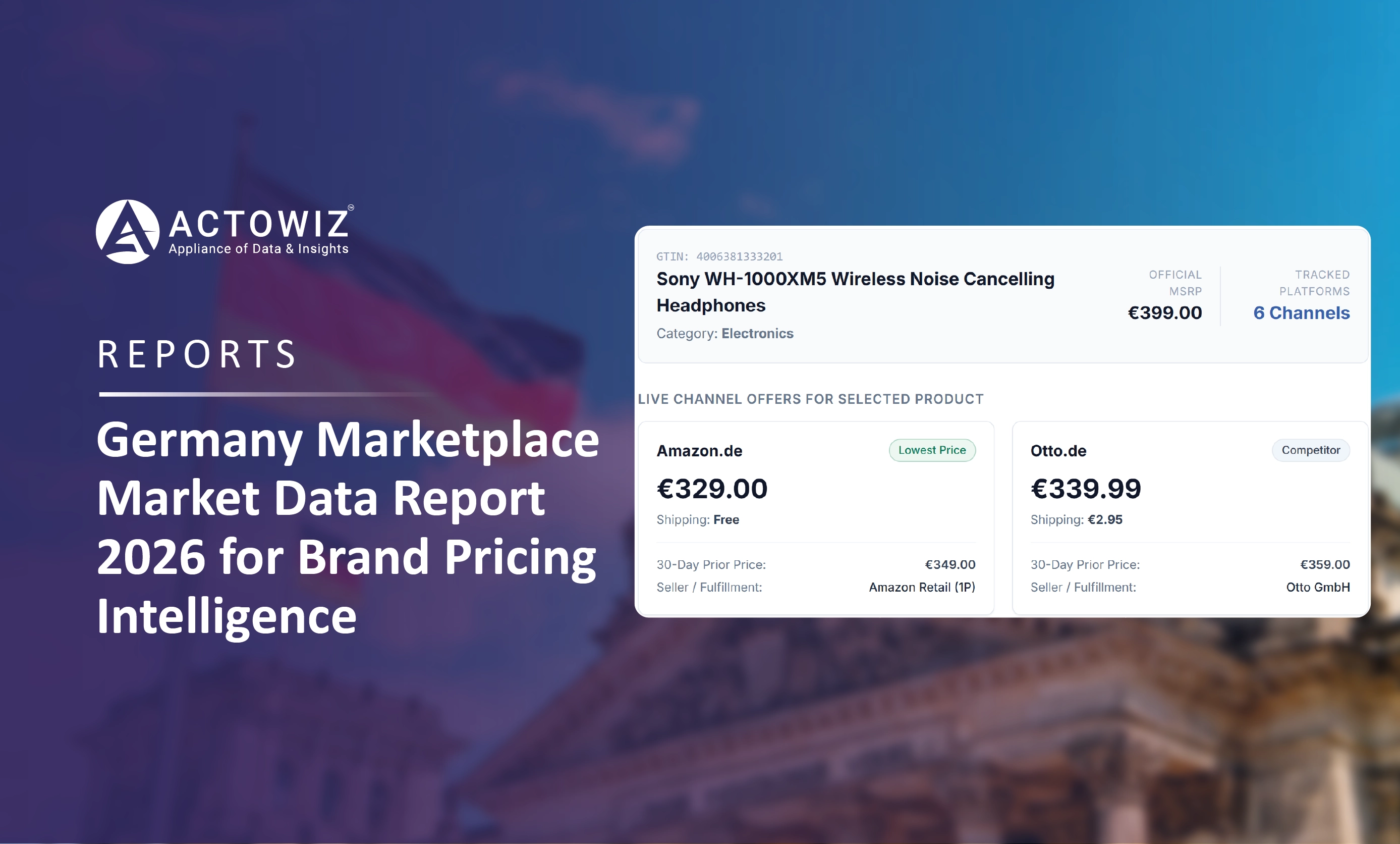
Germany Marketplace Market Data Report 2026 for Brand Pricing Intelligence

German marketplace data report 2026: online retail size, Amazon.de, Otto, Kaufland and Zalando price signals, PAngV rules and peak seasons.

Start Where It Makes Sense for You

Whether you're a startup or a Fortune 500 — we have the right plan for your data needs.

icons
Enterprise
Book a Strategy Call
Custom solutions, dedicated support, volume pricing for large-scale needs.
icons
Growing Brand
Get Free Sample Data
Try before you buy — 500 rows of real data, delivered in 2 hours. No strings.
icons
Just Exploring
View Plans & Pricing
Transparent plans from $500/mo. Find the right fit for your budget and scale.
Get in Touch
Let's Talk About
Your Data Needs
Tell us what data you need — we'll scope it for free and share a sample within hours.
  • icons
    Free Sample in 2 HoursShare your requirement, get 500 rows of real data — no commitment.
  • icons
    Plans from $500/monthFlexible pricing for startups, growing brands, and enterprises.
  • icons
    US-Based SupportOffices in New York & California. Aligned with your timezone.
  • icons
    ISO 9001 & 27001 CertifiedEnterprise-grade security and quality standards.
Request Free Sample Data
Fill the form below — our team will reach out within 2 hours.
+1 ▼
✓ Free 500-row sample · No credit card · Response within 2 hours

Request Free Sample Data

Our team will reach out within 2 hours with 500 rows of real data — no credit card required.

+1 ▼
✓ Free 500-row sample · No credit card · Response within 2 hours