Introduction
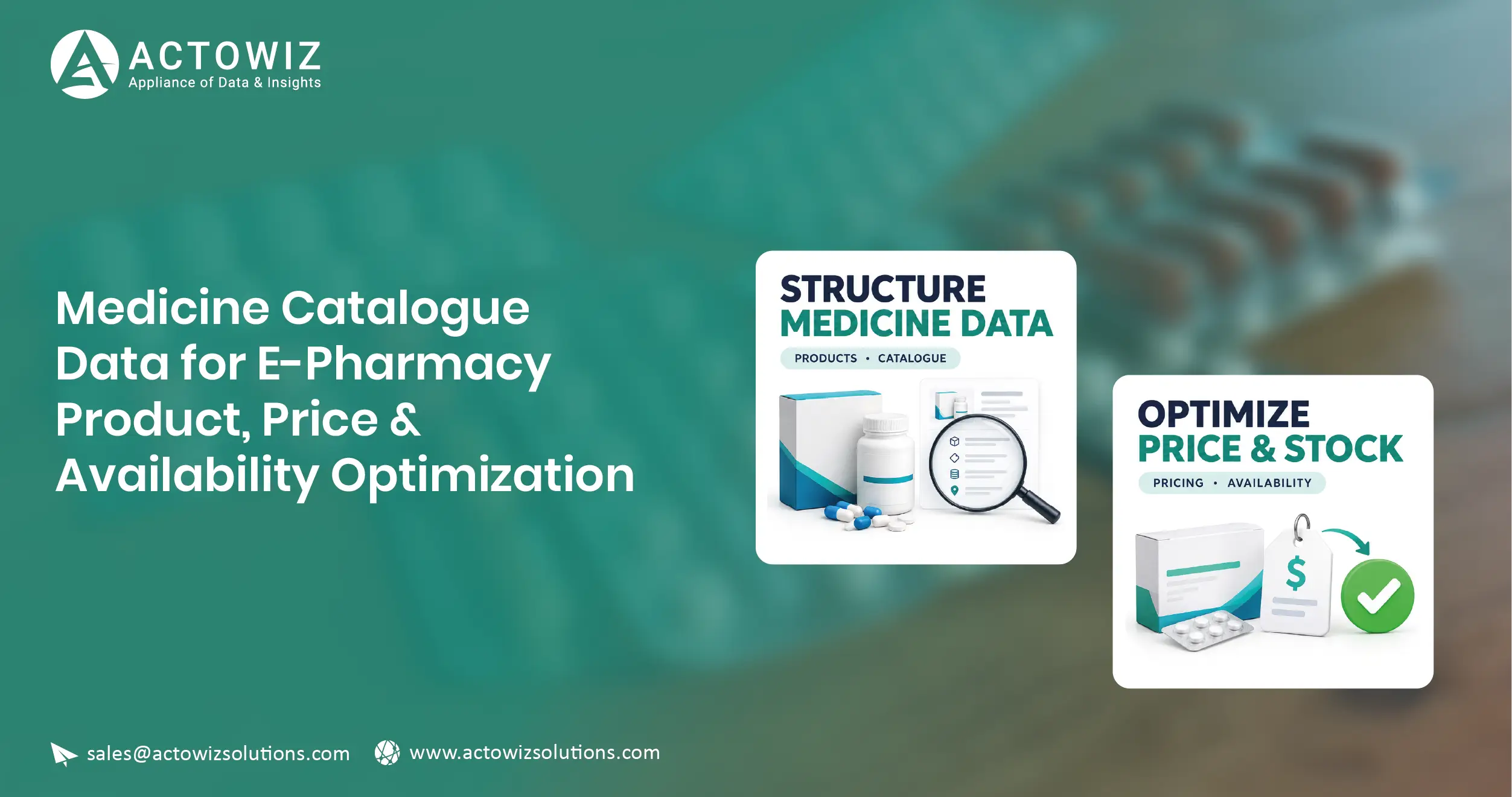
Medicine Catalogue Data for E-Pharmacy Platforms helps e-pharmacies maintain accurate product information, compare prices, monitor availability, understand customer feedback, and identify changes across competing digital pharmacies. For e-pharmacy businesses, the core value is simple: structured and frequently refreshed catalogue information turns scattered online listings into actionable product, pricing, and availability intelligence.
The shift toward digital healthcare has made catalogue accuracy increasingly important. WHO's digital-health strategy emphasizes the growing role of digital technologies in healthcare systems, while its medicine-safety guidance highlights the importance of reliable, timely information for monitoring medicines. (World Health Organization)
For e-pharmacy operators, manufacturers, distributors, healthcare marketplaces, and market-research teams, the challenge is no longer simply collecting medicine names. They need to connect SKU identifiers, brands, compositions, pack sizes, MRP, selling prices, discounts, stock status, ratings, reviews, seller information, and delivery availability.
This is where Healthcare & Pharmacy Data becomes strategically useful. A structured dataset can help businesses benchmark competitors, identify assortment gaps, monitor price movements, detect stock changes, and improve category-level decisions.
India's broader digital-commerce infrastructure also supports this transition. NPCI reported more than 24.5 billion UPI transactions in August 2026, showing the enormous scale of India's digital transaction ecosystem. (NPCI) For e-pharmacy businesses, this digital purchasing environment creates a strong need for dependable product intelligence.
How can businesses build a reliable medicine catalogue across multiple e-pharmacies?
Scrape E-Pharmacy Medicine Catalogue Data to create a structured view of products available across different online pharmacy platforms. Instead of manually checking thousands of listings, businesses can collect product-level attributes at scale and organize them into standardized records.
A typical catalogue dataset can include:
Catalogue Data Attributes
| Data Attribute |
Example Use |
| Medicine Name |
Product identification |
| Brand |
Brand comparison |
| Generic/Composition |
Therapeutic-level analysis |
| SKU/Product ID |
Product matching |
| Manufacturer |
Supplier intelligence |
| Pack Size |
Assortment comparison |
| MRP |
Price benchmarking |
| Selling Price |
Competitive monitoring |
| Discount |
Promotion analysis |
| Availability |
Stock monitoring |
| Product URL |
Source verification |
| Category |
Catalogue segmentation |
The value increases when the same medicine is available in multiple pack sizes, strengths, or formulations. Normalizing these variations helps distinguish genuinely different products from duplicate listings.
2020-2026 market progression
From 2020 onward, online healthcare experienced a stronger emphasis on digital access and remote purchasing. By 2021-2022, e-pharmacy catalogues increasingly needed richer attributes beyond basic medicine names, including availability, discounts, delivery information, and customer feedback. During 2023-2024, competitive benchmarking became more important as digital marketplaces matured. By 2025-2026, businesses increasingly require automated and recurring datasets rather than one-time catalogue snapshots.
WHO reported 877 incidents involving substandard and falsified medical products between August 2017 and December 2021, with an average annual increase of 36.3% in recorded incidents during the period. (World Health Organization) This reinforces why product identity, source, composition, and catalogue consistency deserve careful attention.
A scalable collection framework can therefore support:
- Product discovery
- Catalogue normalization
- Brand comparison
- Pack-size matching
- Competitor assortment tracking
- Duplicate detection
- Historical catalogue analysis
For buyers, the objective should not be collecting the maximum number of records. It should be building a clean, consistent, traceable, and refreshable catalogue that supports commercial decisions.
Why is SKU-level extraction important for e-pharmacy product matching?
E-Pharmacy Medicine SKU ID Data Extraction provides the product-level identifiers needed to connect catalogue records across websites, applications, sellers, and time periods.
Medicine names alone are often insufficient for reliable matching. The same medicine may appear with different naming conventions, abbreviations, capitalization, pack descriptions, or promotional titles. An SKU ID or equivalent product identifier provides an additional reference point for tracking the same listing.
For example, a dataset can structure a product as:
SKU Field Structure
| SKU Field |
Example |
| SKU ID |
MED-458921 |
| Product Name |
Product listing name |
| Brand |
Manufacturer/brand |
| Composition |
Active ingredients |
| Strength |
Dosage strength |
| Pack Size |
10 tablets |
| Seller |
Pharmacy/platform |
| Price |
Current selling price |
| Stock |
Available/out of stock |
| Timestamp |
Collection time |
2020-2026 progression
In 2020, many digital catalogue projects focused primarily on product names, prices, and availability. Between 2021 and 2022, businesses increasingly needed product identifiers to reconcile records from multiple sources. In 2023-2024, SKU-level matching became particularly valuable for competitive pricing and assortment analysis. During 2025-2026, recurring monitoring requires stable identifiers to compare current records against historical snapshots.
The benefit is particularly clear when monitoring thousands of products. An e-pharmacy may change product titles while retaining the same internal product ID. Conversely, similar names may represent different strengths or pack sizes. SKU-level logic helps reduce false matches.
A strong SKU intelligence workflow should therefore include:
- Identifier capture
- Product-name normalization
- Brand standardization
- Composition mapping
- Pack-size normalization
- Duplicate identification
- Historical record linking
- Timestamp management
This creates a product history rather than a collection of disconnected snapshots.
For manufacturers and distributors, SKU-level information can also help identify where particular products appear, how frequently they are listed, and whether competing pharmacies carry comparable products.
How can e-pharmacies compare medicine prices efficiently?
An E-Pharmacy Medicine Price Data API can deliver structured pricing information into internal dashboards, analytics systems, pricing engines, or business intelligence workflows. Instead of relying entirely on manual checks, businesses can integrate recurring price information into their existing technology environment.
Price intelligence becomes more useful when it captures more than the headline selling price.
Price Metrics & Business Applications
| Price Metric |
Business Application |
| MRP |
Reference pricing |
| Selling Price |
Current market price |
| Discount % |
Promotion comparison |
| Coupon/Offer |
Effective-price analysis |
| Pack Size |
Like-for-like comparison |
| Seller Price |
Seller benchmarking |
| Timestamp |
Historical tracking |
| Price Change |
Alert generation |
2020-2026 progression
During 2020-2021, price visibility was strongly connected to digital purchasing and availability. In 2022-2023, competitive price monitoring became more structured as businesses compared multiple e-pharmacy platforms. By 2024, historical price tracking became more valuable for identifying recurring promotions and pricing patterns. In 2025-2026, automated feeds and APIs are increasingly useful for organizations that need frequent updates across large product universes.
India's digital transaction environment illustrates the scale of this broader shift. NPCI's official statistics show UPI volume reaching 24,508.96 million transactions in August 2026, equivalent to more than 24.5 billion transactions in one month. (NPCI)
For pricing teams, this means the focus should move from occasional price checks toward systematic monitoring.
A useful pricing dataset can answer:
- Which products changed price today?
- Which competitors are offering deeper discounts?
- Which brands have the widest price gaps?
- Are price differences caused by pack size?
- Which products have frequent promotional changes?
- Which categories show persistent competitive pressure?
Businesses should also distinguish MRP, selling price, effective promotional price, and final payable price where the source makes those fields available. This avoids misleading comparisons.
How does real-time availability monitoring improve e-pharmacy decisions?
Real-Time E-Pharmacy Medicine Availability Data helps businesses identify whether products are available, unavailable, temporarily out of stock, or accessible only in particular locations.
Availability is particularly important because price intelligence without stock context can lead to poor conclusions. A competitor may show a lower price, but if the medicine is unavailable, the commercial meaning of that price is different.
A practical availability dataset can contain:
Availability Data Fields
| Availability Field |
Purpose |
| Stock Status |
Available/unavailable |
| Quantity Indicator |
Inventory signal where visible |
| Pincode/Location |
Local availability |
| Delivery ETA |
Fulfillment comparison |
| Seller |
Source identification |
| Collection Time |
Freshness |
| Restock Status |
Recovery tracking |
2020-2026 progression
The 2020 period highlighted the importance of medicine access and supply continuity. In 2021-2022, online pharmacy platforms increasingly provided location-dependent availability and delivery information. Between 2023 and 2024, businesses began using recurring monitoring to identify stock movements and assortment changes. By 2025-2026, real-time or near-real-time datasets became increasingly valuable for organizations operating across multiple locations.
WHO has emphasized that reliable, timely information is important for medicine safety monitoring. (World Health Organization) Its guidance on medicines sold online also warns that unauthorized online sources can increase the risk of illegal, unregistered, falsified, or substandard products. (World Health Organization)
For commercial teams, availability monitoring can support:
- Stock-out alerts
- Location-level availability analysis
- Competitor assortment monitoring
- Delivery-performance comparison
- Product substitution analysis
- Supply planning
- Demand opportunity identification
For example, if a frequently monitored product becomes unavailable across several competitors while remaining available through one channel, that signal may be commercially relevant. Similarly, repeated stock-outs can indicate assortment or supply problems that deserve deeper investigation.
The strongest approach combines availability with price, SKU, location, and timestamp information, allowing businesses to understand not just what is listed but what customers can actually purchase.
Why should e-pharmacies analyze ratings and customer feedback?
Extract E-Pharmacy Ratings & Reviews Data to understand customer sentiment, product perception, service quality, and recurring issues across online medicine platforms.
Ratings and reviews can add an important qualitative layer to catalogue and pricing intelligence. A medicine may have a competitive price and strong availability, yet recurring customer complaints about packaging, delivery, product condition, or service can influence purchasing behavior.
A structured review dataset may include:
Review Data Attributes
| Review Attribute |
Analytical Use |
| Rating |
Customer satisfaction |
| Review Text |
Sentiment analysis |
| Review Date |
Trend analysis |
| Product/SKU |
Product-level monitoring |
| Verified Status |
Review-quality assessment where available |
| Review Count |
Popularity indicator |
| Platform |
Competitive comparison |
2020-2026 progression
In 2020-2021, reviews were often treated primarily as customer-service feedback. During 2022-2023, businesses increasingly used review data to identify recurring product and fulfillment issues. In 2024-2025, sentiment analysis and topic classification became more useful for large review volumes. By 2026, combining review intelligence with product, pricing, and availability data can provide a more complete picture of digital pharmacy performance.
A useful review-monitoring system can classify themes such as:
- Delivery experience
- Packaging
- Product quality
- Availability
- Customer support
- Discount experience
- Ordering experience
- Product expectations
The goal is not to treat every review as an objective product-quality measurement. Reviews can be subjective, incomplete, duplicated, or influenced by individual experiences. Instead, businesses should look for patterns across sufficiently large datasets.
For pharmaceutical manufacturers and consumer-health brands, this can reveal how customers discuss products across different platforms. For e-pharmacies, it can highlight operational problems that may affect repeat purchases and customer retention.
Review data becomes particularly powerful when joined to SKU-level records. This enables teams to examine whether specific products, brands, pack sizes, or sellers consistently receive different customer feedback.
How can discount intelligence reveal competitive opportunities?
E-Pharmacy Deals & Discount Data Intelligence helps businesses monitor promotions, coupon offers, bundle deals, membership benefits, and other price incentives across competing digital pharmacy platforms.
A simple discount percentage does not always represent the actual customer value. An offer may depend on cart value, payment method, membership status, subscription eligibility, or a specific product combination.
Promotion Signals & Intelligence
| Promotion Signal |
What It Can Reveal |
| Discount % |
Promotional intensity |
| Coupon |
Conditional savings |
| Bundle |
Cross-selling strategy |
| Membership Offer |
Loyalty strategy |
| Payment Offer |
Channel-specific promotion |
| Minimum Cart Value |
Conversion strategy |
| Promotional Period |
Campaign timing |
2020-2026 progression
From 2020 to 2021, online medicine promotions were often focused on attracting digital customers. In 2022-2023, discounts became more competitive across pharmacy marketplaces. During 2024-2025, businesses increasingly needed historical promotion tracking to understand campaign frequency and competitive positioning. In 2026, combining promotion data with product price, availability, and customer response creates a stronger basis for commercial analysis.
A promotion dataset can help answer:
- Which categories receive the deepest discounts?
- Which competitors promote the same products?
- Are discounts seasonal or recurring?
- Which brands are frequently included in campaigns?
- Do promotional prices coincide with increased visibility?
- Which offers are available only to certain locations or customers?
This matters because aggressive discounting can affect both price perception and marketplace competitiveness.
A practical intelligence model should store the original price, discounted price, discount percentage, offer type, eligibility conditions, and collection timestamp wherever these fields are publicly available. This makes historical comparisons more meaningful and reduces the risk of interpreting a conditional promotion as a standard selling price.
How Can Actowiz Solutions Help?
Actowiz Solutions can help e-pharmacy businesses transform fragmented online product information into structured, analysis-ready datasets. The objective is to create a scalable data pipeline that supports catalogue intelligence, competitive monitoring, pricing analysis, and availability tracking.
Our Catalog & Assortment Data Services can be designed around specific business requirements, product categories, marketplaces, geographies, and refresh frequencies.
A typical workflow includes:
Data Collection
Data can be collected from relevant public e-pharmacy websites and mobile applications based on the agreed scope.
Data Structuring
Raw product information is transformed into organized fields such as product name, SKU, brand, composition, pack size, price, discount, availability, ratings, reviews, and source URL.
Data Normalization
Different naming conventions and catalogue structures can be standardized to support cross-platform comparison.
Validation
Records can be checked for missing fields, duplicate products, inconsistent prices, invalid values, and other quality issues.
Historical Tracking
Recurring collection enables businesses to compare current records with previous datasets and identify changes over time.
Flexible Delivery
Depending on the use case, structured data can be prepared for databases, dashboards, analytics environments, APIs, spreadsheets, or other downstream workflows.
Actowiz Solutions can also support projects requiring location-level collection, product-level monitoring, recurring schedules, and large-scale catalogue coverage.
For organizations managing thousands or millions of product records, automation is particularly valuable because manual monitoring becomes difficult to maintain consistently.
What Does a Complete E-Pharmacy Dataset Look Like?
A high-quality dataset should connect multiple dimensions instead of treating every data point separately.
For example:
Complete E-Pharmacy Dataset Structure
| Dataset Layer |
Key Fields |
| Product |
Name, brand, composition, category |
| SKU |
SKU ID, product ID, pack size |
| Pricing |
MRP, selling price, discount |
| Availability |
Stock status, location, delivery |
| Reviews |
Rating, review count, review text |
| Promotion |
Coupon, offer, campaign |
| Source |
Platform, URL, seller |
| Time |
Collection timestamp |
This structure allows businesses to move from basic catalogue collection toward more advanced intelligence.
For instance, an e-pharmacy operator can compare the same SKU across competitors, determine which platform offers the lowest available price, check whether that price is supported by stock, and analyze whether customers are responding positively to the product.
That is considerably more useful than maintaining a simple spreadsheet of medicine names and prices.
Why Is Data Freshness Important for E-Pharmacy Intelligence?
E-pharmacy information can change frequently. Prices can be updated, discounts can expire, stock can change, products can be added or removed, and reviews can accumulate continuously.
This makes real-time dataset delivery valuable for businesses that require current information for operational or analytical decisions.
Freshness requirements should depend on the use case:
Refresh Frequency by Use Case
| Business Requirement |
Suggested Refresh Approach |
| Catalogue discovery |
Daily/periodic |
| Competitive pricing |
Frequent |
| Stock monitoring |
Near-real-time where required |
| Reviews |
Daily/periodic |
| Promotions |
Frequent during campaigns |
| Historical research |
Scheduled snapshots |
The right frequency is not necessarily the fastest possible frequency. Businesses should balance freshness, source accessibility, data volume, infrastructure requirements, and analytical value.
How Do Web and Mobile Sources Complement Each Other?
A Web Scraping strategy can capture structured information from relevant e-pharmacy websites, while Mobile App Scraping can complement website-based collection where applications expose different catalogue, pricing, promotion, or availability information.
This matters because the same business may present different experiences across web and mobile channels.
A combined strategy can help identify:
- Product-listing differences
- Mobile-exclusive promotions
- Location-specific information
- Different availability signals
- App-specific offers
- Catalogue inconsistencies
Data collection should always respect applicable laws, contractual restrictions, platform terms, access controls, and privacy requirements. The focus should remain on lawful collection of publicly accessible business information and responsible data handling.
Conclusion
Medicine Catalogue Data for E-Pharmacy Platforms gives e-pharmacy businesses a structured foundation for monitoring products, SKUs, prices, availability, customer feedback, and promotional activity. When these datasets are refreshed consistently and normalized across sources, businesses can move beyond basic catalogue management toward competitive intelligence and faster commercial decision-making.
The most valuable approach connects catalogue records with E-pharmacy price data extraction, availability signals, product identifiers, reviews, and promotions. This creates a historical view of how digital pharmacy assortments and market conditions change over time.
A scalable solution can also combine Web Scraping, Mobile App Scraping, and a real-time dataset workflow to support recurring intelligence requirements.
For e-pharmacy operators, pharmaceutical brands, distributors, healthcare marketplaces, and research teams, the priority should be clear: collect the right product data, standardize it, validate it, refresh it, and turn it into actionable intelligence. Ready to build a scalable e-pharmacy data pipeline?
You can also reach us for all your mobile app scraping, data collection, web scraping , and instant data scraper service requirements!

 By industry🏷 By platform🌐 By market
 Pricing & Promotions
MAP Violations Brand Protection Counterfeit Detection Price Intelligence AI HOT Data Intelligence
 Brand & Intelligence
Share of Search Content Audit & PDP Reviews & Ratings Retail Media Buy Box Monitoring Social Commerce HOT Live Commerce NEW Agentic Commerce NEW
 Digital Shelf & Search
Assortment Planning Competitive Benchmarking Product Availability Q-Commerce NEW
 AssortmentE-commerce Intelligence Hyperlocal Insights POI & Store Locator DTC Brand Analytics NEW
 For Retailers
 E-Commerce Dashboard
 Flipkart Insights (Live) #1
 Grocery Intelligence
.svg) Grocery Price (U.S.)
.svg) Quick Commerce (India) HOT
 Food & Restaurant
 Fashion Intelligence
 Automotive
 Travel & Hospitality
 Real Estate
 Food Delivery Intelligence NEW
 OTT & Streaming NEW
 Fuel & EV Charging Price Tracker NEW
 By Use Case
 Pricing Intelligence
 Digital Shelf Analytics
 MAP Monitoring HOT
 Cross-Border Price Parity NEW
 Share of Search
 Review Sentiment
 Kitchen Market Gaps NEW
 Dynamic Pricing / AI Repricing NEW
 Promotions & Deals Alerts NEW
 B2B / POI & Lead Data NEW
 AI Search Visibility Dashboard NEW
 Baby Products on Quick Commerce NEW
 Hotel & Flight Rate Parity NEW
 By Region🇮🇳 India 🇺🇸 USA 🇦🇪 Middle East 🇬🇧 UK 🇦🇺 Australia 🌏 SE Asia 🇪🇺 Europe 🌎 LATAMIndia
 Flipkart Real-Time Insights
 Quick Commerce — Zepto · Blinkit
 Pincode Price Tracker
Middle East
 GCC Q-Commerce — Talabat · Noon NEW
UK & Australia
 UK Grocery — Tesco, Sainsbury's, Asda
 AU Grocery — Coles & Woolworths NEW
 Marketplace Scrapers
Amazon API TikTok Shop API HOT Uber Eats API Airbnb API Zepto / Blinkit API Instacart API NEW Talabat API NEW
 Developer APIsWeb Extract API Reviews API SERP API Pricing Webhook NEW
 Universal APIsStreaming Crawl API Scheduler Realtime Alerts Webhook Delivery 🐍 Python SDK 💚 Node.js SDK
 Delivery & SDKs
 Knowledge Center
Digital Shelf Playbook MAP Compliance Guide Pricing Intel Guide Scraping Compliance TikTok Shop Guide NEW Cross-Border Guide NEW
 Guides & Playbooks
🎉 Seasonal & event tracking NEWBlack Friday pricing report Festive season, India Ramadan, GCC grocery All seasonal reportsSample Datasets HOT ROI Calculator NEW API Postman Collection Demo Dashboards Free API Playground NEW Press Kit
 Downloads & Tools
Trust Center About Us FAQs Careers
 Trust & CompanyRetail shelf research NEWRetail shelf research


 4.8/5 Average Rating
 50+ Video Testimonials
 92% Client Retention
 50+ Countries Served