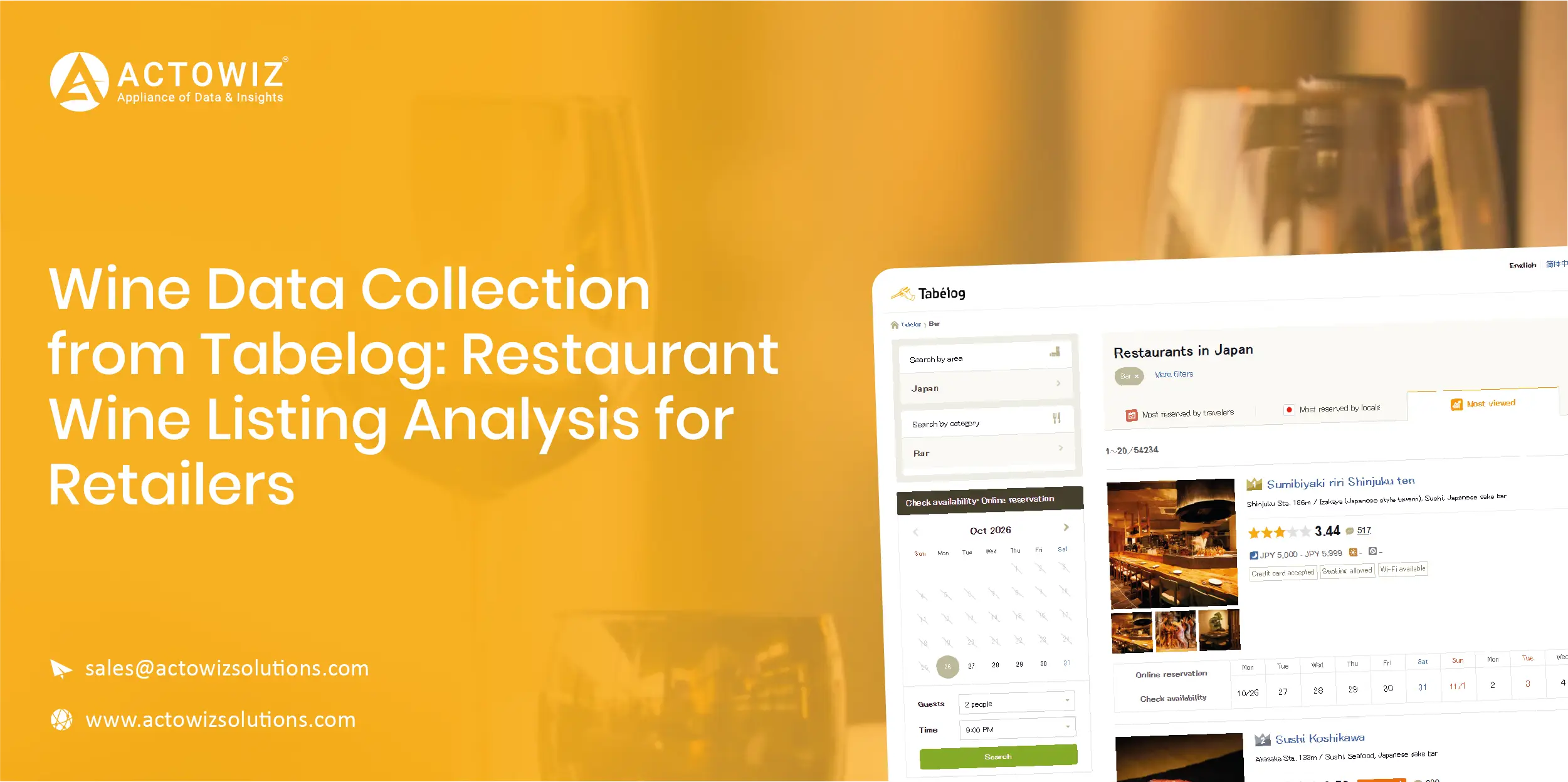
Explore Wine Data Collection from Tabelog to analyze restaurant wine listings, compare prices, and uncover valuable market insights for your business.
Japan’s restaurant industry offers a diverse wine market, with restaurants featuring domestic selections, international labels, premium bottles, and curated wine pairings. For businesses operating in wine distribution, hospitality, and beverage retail, understanding menu offerings and pricing across restaurants can support smarter decisions. Wine Data Collection from Tabelog helps businesses organize publicly available restaurant wine information into structured datasets for market research, competitive analysis, and pricing intelligence. By collecting details such as wine names, bottle prices, serving options, and restaurant information, businesses can gain a clearer view of market positioning. A structured Wine, Spirits & Liquor Data Scraping process can also help identify changing product availability, popular wine categories, and differences in pricing across locations. With organized data, wine distributors, restaurant groups, and hospitality analysts can evaluate market opportunities, compare competitors, and improve their understanding of customer preferences. This case study explores how Actowiz Solutions can approach restaurant wine data collection, address technical challenges, and transform fragmented menu information into actionable business intelligence.
The client is a beverage market intelligence company focused on helping wine distributors, hospitality businesses, importers, and beverage retailers understand Japan’s evolving wine market. Its business model relies on collecting restaurant menu information, evaluating competitive pricing, identifying product availability, and tracking wine selections across different dining establishments. The company serves clients seeking reliable market insights to improve purchasing decisions, refine distribution strategies, and identify new commercial opportunities.
Japan’s restaurant landscape includes traditional dining venues, international restaurants, upscale establishments, and casual dining chains, each offering different wine selections and pricing structures. To analyze this diverse market effectively, the client required a consistent approach to collecting restaurant-level wine information from Tabelog, a prominent Japanese restaurant discovery and review platform. Tabelog wine menu data collection Japan became a priority for understanding restaurant offerings across locations and dining categories. Through Wine Data Collection from Tabelog, the client aimed to establish an organized information resource that could support competitive benchmarking, menu analysis, and data-driven business planning.
Actowiz Solutions designed a collection strategy around publicly accessible restaurant information on Tabelog. The first step involved identifying relevant restaurant listings and available wine menu details, then determining which fields would provide the greatest business value. These fields could include restaurant names, locations, wine labels, grape varieties where listed, bottle or glass prices, menu descriptions, and source references. The collection workflow for Wine Data Collection from Tabelog would prioritize consistent field extraction, source traceability, and reliable handling of incomplete records. Japanese text processing would help preserve original wine names while supporting standardized categories for analysis. Collection rules would also account for differences between restaurant types and menu presentation formats. This structured discovery process would establish a consistent foundation for downstream analysis while reducing unnecessary duplication and making the resulting dataset easier to maintain.
Once the information was collected, the next step focused on cleaning and organizing records into a comparison-ready structure. Similar wine labels would be reviewed for spelling differences, vintage information, bottle sizes, and serving formats before being grouped into suitable categories. The Tabelog wine menu price comparison data workflow would distinguish glass prices from bottle prices to avoid misleading comparisons. Where sufficient information was available, records could be segmented by restaurant location, dining category, wine origin, and price range. Validation rules would flag missing values, unusual price entries, and potentially duplicated products for review. The resulting dataset could support dashboards and analytical reports that reveal differences in wine positioning across restaurant segments. Scheduled refreshes would help identify changes in listed prices and selections, subject to source accessibility and collection permissions. This approach would transform scattered menu details into a more consistent resource for pricing research and commercial planning.
Restaurant menus may present wine information in different formats, including text descriptions, categorized lists, images, or embedded page elements. A single extraction rule may therefore miss important details or incorrectly associate a price with a wine. To address this challenge, the proposed workflow would use adaptable parsing rules, field-level validation, and separate handling for different menu layouts. Image-based menus would require appropriate text recognition when permitted and technically feasible. Records that could not be interpreted confidently would be flagged for review instead of being automatically treated as complete.
Wine names can appear in Japanese scripts, Roman characters, abbreviations, or translated forms. This creates difficulties when identifying equivalent products across restaurant listings. The solution would combine Unicode normalization, language-aware text processing, carefully designed matching rules, and duplicate detection. Original text would be retained alongside standardized fields to preserve traceability. Vintage, producer, region, and bottle size would be considered when available, helping reduce incorrect matches between similar labels.
Website structures can change, while access restrictions, request limits, and incomplete listings may interrupt collection workflows. Rather than relying on a brittle, high-frequency process, the proposed system would use controlled request rates, retry handling, monitoring, and change detection. A Tabelog restaurant menu data API would be considered only if a suitable authorized API were available; otherwise, permitted collection methods would be evaluated. Validation logs and scheduled quality checks would help identify broken extraction rules and missing records. These safeguards would improve operational reliability without assuming uninterrupted access or guaranteed data completeness.
Actowiz Solutions proposed a structured data pipeline designed to convert restaurant wine menu information into a consistent, analysis-ready resource. The workflow would begin with identifying relevant public restaurant pages, collecting accessible wine details through permitted methods, and extracting essential attributes such as restaurant names, locations, wine labels, serving formats, and listed prices. Tabelog Wine catalog data Extraction would incorporate validation rules to identify missing fields, inconsistent price formats, and duplicate entries before records entered the final dataset. Japanese-language processing and normalization would help organize wine names while preserving the original descriptions for reference. Where available, producer, vintage, wine origin, and bottle size could provide additional dimensions for comparison. The system would also maintain source references and collection timestamps to support traceability and future updates.
For ongoing analysis, Wine Data Collection from Tabelog could feed structured files, databases, or reporting dashboards according to the client's technical requirements. Refresh schedules, change detection, and quality checks would help analysts review price movements and menu updates over time. Records with ambiguous descriptions or insufficient information would be flagged for verification rather than silently classified. Access controls and responsible collection practices would form part of the implementation. This approach would give the client a practical foundation for restaurant-level wine research, competitor benchmarking, and beverage market intelligence.
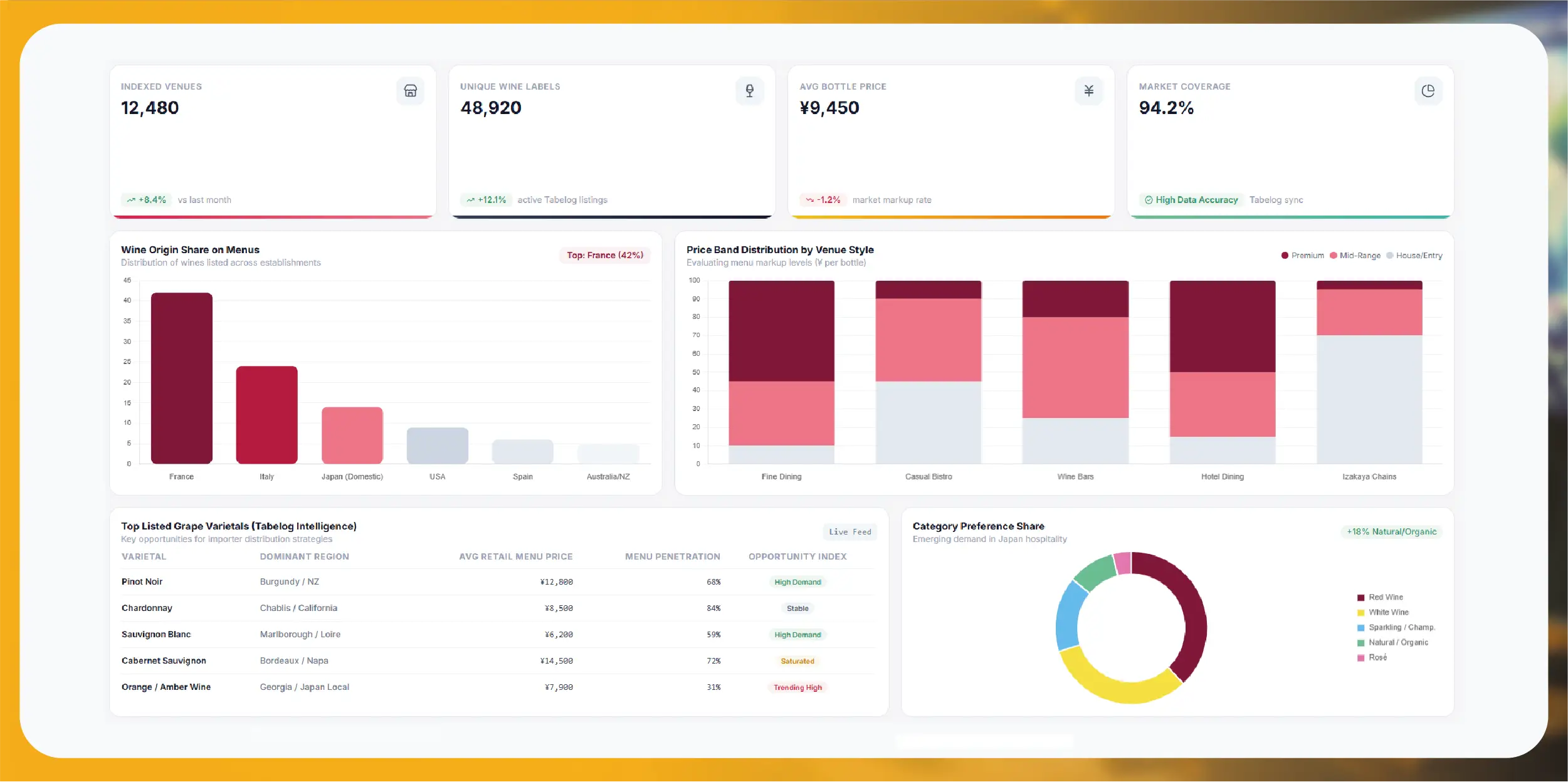
A structured restaurant wine dataset can improve how analysts evaluate pricing, product availability, and competitive positioning. Because no verified client performance figures were provided for this brief, the following metrics are targets for a proposed implementation, not confirmed results from an actual engagement.
A reliable Restaurant Wine List Data resource could help distributors identify pricing differences, evaluate wine availability, and discover opportunities across restaurant segments. With Wine Data Collection from Tabelog, the client could also develop repeatable reporting processes, prioritize promising markets, and support more informed commercial decisions. Actual improvements would depend on source coverage, data quality, refresh frequency, and adoption by business teams. KPIs should be measured against a documented baseline during a pilot before performance claims are published.
“Having restaurant wine information organized into a consistent dataset would make our market research more efficient. The ability to compare listed prices, identify changing menu selections, and review information by restaurant category would help our team develop more informed pricing and distribution strategies. A structured approach to Real-Time Price Monitoring would also support timely reviews of market movements, provided the underlying source information remains accessible and can be refreshed reliably. We see considerable value in combining standardized data with transparent quality checks to make our competitive analysis more dependable.”
- Market Intelligence Manager
Actowiz Solutions can help businesses turn fragmented online information into structured datasets that support market research, competitive analysis, and operational planning. For restaurant and beverage intelligence projects, the focus is on designing workflows around the client's required data fields, reporting needs, and technical environment.
Through its Data Intelligence Services, Actowiz Solutions can support businesses seeking actionable information rather than disconnected records. A tailored Wine Data Collection from Tabelog workflow can be designed around specific business objectives, whether those involve pricing research, restaurant benchmarking, or wine assortment analysis. Clear documentation, agreed KPIs, and an initial pilot can help establish realistic expectations before scaling the project. Collection methods would be selected according to technical feasibility, applicable permissions, and data availability.
Collecting restaurant wine information from Tabelog can help businesses understand Japan’s competitive wine market, evaluate menu pricing, and identify opportunities across restaurant categories. A structured approach brings together accessible menu details, standardized wine records, and repeatable quality checks to support meaningful market analysis. Actowiz Solutions can help organizations design a collection workflow aligned with their data requirements, reporting objectives, and technical environment. A suitable Web scraping API can support integration where authorized and technically appropriate, while Custom Datasets can accommodate specific analytical needs. Businesses exploring an instant data scraper should prioritize data accuracy, source accessibility, and responsible collection practices. Contact Actowiz Solutions to discuss a tailored restaurant wine data project and define measurable objectives for an initial pilot.
It is the process of gathering publicly accessible wine-related information from restaurant listings and menus on Tabelog, subject to applicable access permissions. Depending on the available source information, collected fields may include restaurant names, locations, wine labels, menu descriptions, serving formats, and listed prices. The resulting dataset can support restaurant benchmarking, pricing research, and beverage market analysis.
Potential fields include wine names, producer details, country or region of origin, vintage, grape variety, bottle size, glass prices, bottle prices, and restaurant identifiers. However, not every restaurant listing contains all these details. The dataset should distinguish unavailable information from verified values and preserve original menu descriptions wherever possible.
Pricing data enables distributors, importers, and hospitality businesses to compare wine offerings across restaurants and market segments. It can help identify pricing differences, assess product positioning, and explore opportunities for new distribution partnerships. Comparisons should account for serving size, bottle volume, vintage, and product identity to avoid misleading conclusions.
Update frequency depends on source accessibility, collection permissions, technical limitations, and the project's monitoring requirements. A scheduled process may run daily, weekly, or at another agreed interval. Change detection can identify differences between successive collections, but updates cannot guarantee that every restaurant change will be captured immediately.
Actowiz Solutions can design a tailored workflow that combines structured extraction, data cleaning, normalization, validation, and flexible delivery. Businesses can define the required fields, target restaurant categories, reporting formats, and refresh schedules before implementation. Starting with a pilot helps evaluate coverage, accuracy, and operational feasibility before expanding the project.
Our web scraping expertise is relied on by 4,000+ global enterprises including Zomato, Tata Consumer, Subway, and Expedia — helping them turn web data into growth.
Watch how businesses like yours are using Actowiz data to drive growth.
From Zomato to Expedia — see why global leaders trust us with their data.
Backed by automation, data volume, and enterprise-grade scale — we help businesses from startups to Fortune 500s extract competitive insights across the USA, UK, UAE, and beyond.
We partner with agencies, system integrators, and technology platforms to deliver end-to-end solutions across the retail and digital shelf ecosystem.
India Grocery Price Comparison for Sugar, Dal & Rice helps brands compare prices across BigBasket, Blinkit, Zepto, and JioMart for smarter pricing.
Explore Wine Data Collection from Tabelog to analyze restaurant wine listings, compare prices, and uncover valuable market insights for your business.
Attendee & Event Data Intelligence Report 2026 explores attendee, event, engagement, and market data to improve audience and competitive insights.
Whether you're a startup or a Fortune 500 — we have the right plan for your data needs.