Core services
Enterprise Data Extraction

Scalable web, app and AI-powered collection across 40+ countries.

All 58 services →
New 2026
AI Training Data

Corpus building with provenance and opt-out compliance.

Learn more →
Free pilot
24-hour sample

We run collection on your own sources before you commit.

Get a sample →
58Services
40+Countries
DEVELOPER

Ready-Made Scrapers

Pre-built for top platforms. Self-serve, no setup.

View All →
TRY FREE

API Playground

Test endpoints instantly. No credit card.

Start Free →
28Tools
2SDKs
icons Delivery & SDKs
Streaming Crawl API Scheduler Realtime Alerts Webhook Delivery 🐍 Python SDK 💚 Node.js SDK

Need it managed instead?

Fixed monthly retainer, named engineer, no per-request metering.

Managed Data API →
HOT

Case Studies

How brands use Actowiz, with named outcomes.

Read →
FREE

Sample Datasets

Real output, no signup.

Download →
NEW

ROI Calculator

Model the return on a data engagement.

Calculate →
HoReCa database India guide 2026 – restaurants, cafés and bars mapped by pincode

Introduction

A HoReCa database India teams can use is a de-duplicated list of hotels, restaurants, cafés, bars, pubs, clubs and QSRs, built from public business listings on Google Maps, Zomato, Swiggy and similar sites. Each outlet gets one record with name, address, pincode, outlet type, cuisine, ratings and source IDs, refreshed on a schedule.

FMCG, dairy, beverage and food-service brands use this list to size territories, plan distributor coverage and find outlets they do not yet supply. The market is large: the NRAI India Food Services Report 2024 estimated the sector at Rs 5.69 lakh crore in FY24, growing at about 8.1% a year to Rs 7.76 lakh crore by FY28 (IndiaRetailing on NRAI IFSR 2024).

Below: sources, fields, matching, pincode and cuisine counts, and the legal basics.

Who uses a HoReCa database in India, and why?

Anyone who sells into food service needs to know where the outlets are and what kind they are. A HoReCa database India sales teams trust turns scattered listings into a territory map they can act on.

  • FMCG and dairy brands – plan which outlets a distributor should cover and spot white space by pincode.
  • Beverage companies – target cafés, bars, pubs and clubs separately from family restaurants and QSRs.
  • Food-service suppliers and equipment makers – find new openings and growing clusters, such as cloud kitchens.
  • Startups and SaaS sellers – build a lead list of outlet businesses for POS, ordering or loyalty tools.

The organised segment is growing faster than the market overall. NRAI's 2024 report projected about 13.2% CAGR for organised food services, against 8.1% for the sector as a whole (Restaurant India on NRAI IFSR 2024). New chain outlets open every month, so a list built once goes stale quickly.

In the first week of October alone, we received five separate requests for this kind of data: a downloadable list of hotels, restaurants, bars, pubs, clubs and QSRs; HoReCa data for a startup; Indo-Chinese restaurant counts by pincode, city and state; outlet data for West Bengaluru; and a general food-outlet database.

Which public sources list Indian restaurants, cafés and bars?

No single source covers every outlet, so a HoReCa database India teams rely on combines several. Google Maps has the widest coverage, delivery apps add cuisine and delivery status, and the FSSAI FoSCoS portal shows licence records for food businesses.

Source What it covers well Typical fields Gaps to plan for
Google Maps Widest coverage incl. dine-in only outlets, bars, hotels and small cafés Name, category, address, coordinates, rating, rating count, hours, website Categories are self-chosen; duplicate and closed pins exist
Zomato Dine-in and delivery restaurants, nightlife, cafés Cuisine tags, cost for two, ratings, locality, delivery or dine-in flag Only outlets that list on Zomato; delivery listings vary by address
Swiggy Delivery restaurants, QSRs and cloud kitchens Cuisine tags, ratings, delivery time, locality, offers Delivery-only view; listings depend on the delivery location you query
Magicpin and EazyDiner Dine-in deals and table bookings in larger cities Outlet name, locality, cuisine, deal or booking availability Narrower coverage, mainly metros
Hotel OTA listings Hotels and resorts, often with in-house restaurants and bars Property name, star category, address, amenities Hotel restaurants may not appear separately
FSSAI FoSCoS (FBO Search) Licence and registration records for food businesses Business name, licensed premises address, licence status Search is per business or per licence number, not a bulk export

FoSCoS is the FSSAI's online licensing system. Its public "FBO Search" option lets you look up a food business by licence number or by name with state and district FSSAI FoSCoS portal. It is most useful for spot-checking that an outlet is a real, licensed premises, rather than as a bulk source.

What fields should an India HoReCa outlet database include?

A useful HoReCa database India teams can segment has one row per physical outlet, with source IDs kept for every platform where that outlet appears. Collect business data only.

  • Outlet identity – outlet name, brand or chain name, a stable outlet ID you create, and source IDs (Google place ID, Zomato and Swiggy restaurant IDs).
  • Location – full address, locality, pincode, city, district, state, latitude and longitude.
  • Outlet type – hotel, restaurant, café, bar, pub, club, QSR, bakery, cloud kitchen; plus dine-in, delivery or both.
  • Cuisine and price band – cuisine tags (for example Indo-Chinese, North Indian, South Indian) and cost-for-two band where shown.
  • Popularity signals – average rating and number of ratings per platform, used as a proxy for footfall.
  • Status and hours – open, temporarily closed or permanently closed; opening hours; first-seen and last-seen dates.
  • Business contact – website and the listed business phone of the outlet where shown; exclude numbers that belong to individuals.
  • Source metadata – platform, URL, crawl date and match confidence.
Field Example value Why it matters
outlet_id HRC-BLR-004512 One stable key across all sources
outlet_name Example Dragon Kitchen What the sales team searches for
brand_name Example Dragon (chain, 6 outlets) Separates chains from single outlets
outlet_type restaurant – dine-in and delivery Drives channel segmentation
cuisine_tags Indo-Chinese, Momos Supports cuisine counts by area
pincode 560072 Territory and distributor mapping
lat / lng 12.97, 77.50 Mapping and radius analysis
rating_count_google 1,240 Popularity proxy
source_ids google, zomato, swiggy Shows platform presence
last_seen_date 2026-10-05 Flags closures and stale records

One honest limit: order volumes are not public. When a request asks for "restaurant order data", the closest public proxies are rating counts, review velocity and delivery-app presence, and these should be labelled as proxies.

How do you de-duplicate outlets across Google Maps, Zomato and Swiggy?

You de-duplicate by matching each listing to one physical outlet using location, normalised name and supporting attributes, then keeping every source ID on the merged record. Without this step, one restaurant can be counted two or three times.

  • Normalise names – lower-case, strip words such as "restaurant", "cafe" or "the", and standardise spellings ("Chinese Wok" and "Chinese-Wok").
  • Normalise addresses – standardise locality names, extract the pincode and geocode to coordinates.
  • Block by distance – compare only listings within a small radius, such as 100–200 metres, so the matching stays fast and precise.
  • Score candidates – combine name similarity, distance, cuisine overlap and phone or website match into a confidence score.
  • Review the middle band – auto-accept high scores, reject low ones and send borderline pairs, such as two branches in the same mall, to manual review.
  • Roll up to brands – group outlets into chains so you can count "outlets per brand per city".

This is the method behind our restaurant outlet intelligence case study, which reconciled outlets across Google Maps, Zomato and Swiggy to produce outlet counts and rating counts per brand and city.

How do you count outlets by pincode, cuisine and channel?

Once outlets are de-duplicated, counts in your HoReCa database are simple group-bys on clean fields. The work is in defining each segment clearly, so a "bar" or an "Indo-Chinese restaurant" means the same thing in every city.

Segment How to derive it Example question it answers
Pincode From the normalised address, checked against coordinates How many cafés are in pincodes my distributor covers?

Cuisine From Zomato and Swiggy cuisine tags, with a mapping table for synonyms How many Indo-Chinese restaurants are there by city and state?


Channel From Google category plus delivery-app presence Which outlets are dine-in only and missing from delivery apps?
Outlet type From categories such as bar, pub, club, café, bakery, QSR How many bars and pubs operate in West Bengaluru?
Chain vs independent From brand roll-up What share of outlets in a city are chain-owned?
Price band From cost-for-two bands Which premium cafés suit a specialty coffee range?

Cuisine tags need care: decide whether an "Indo-Chinese restaurant" is any outlet carrying the tag or only those where it is the primary cuisine, and state the rule next to the count.

How often should you refresh a HoReCa database?

A HoReCa database India teams rely on should be refreshed at the pace each segment changes. Delivery-app listings and cloud kitchens churn fastest, while hotels change slowly.

Outlet segment Suggested refresh Reason
Cloud kitchens and delivery-only brands Weekly to fortnightly Brands open, rename and close often
QSRs and chain restaurants Monthly New store openings drive territory plans
Independent restaurants and cafés Monthly to quarterly Closures and new openings change outlet counts
Bars, pubs and clubs Quarterly Slower churn; check status and hours
Hotels Quarterly to half-yearly Property lists change slowly

Keep first-seen and last-seen dates on every record. An outlet missing from all sources for two refreshes in a row can be flagged as likely closed rather than deleted straight away.

How do you validate outlet data before sales teams use it?

HoReCa database India guide 2026 – restaurants, cafés and bars mapped by pincode

Validate by sampling, cross-checking sources and testing counts against what you expect. A small, regular quality check prevents a bad territory plan.

  • Spot-check samples – review a random set of outlets per city against the live listings.
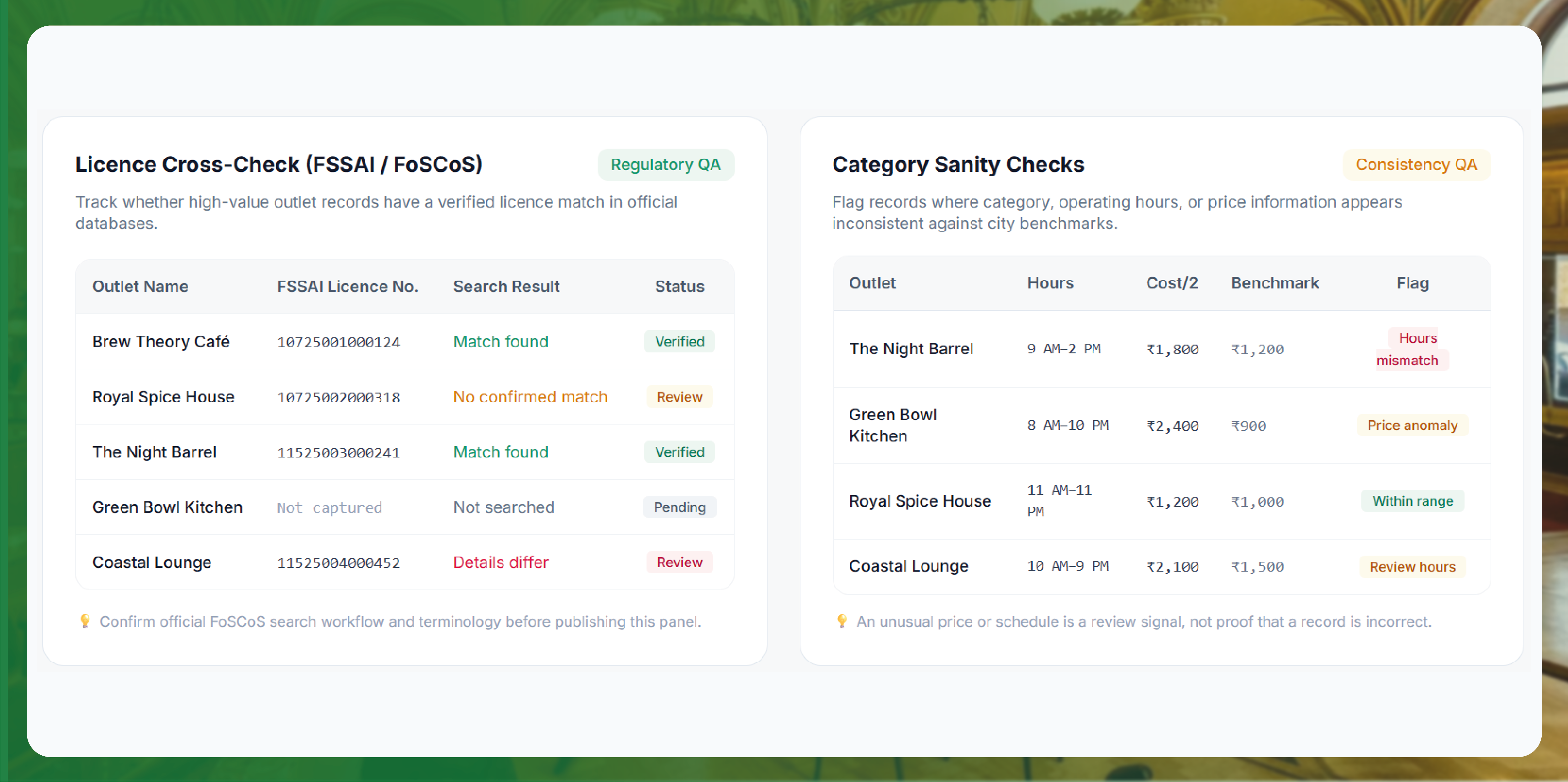
  • Licence cross-check – for high-value accounts, confirm the premises through FoSCoS FBO Search.
  • Category sanity checks – flag "bars" with no evening hours, or "cafés" with a cost-for-two far above the city norm.
  • Count stability – investigate any pincode whose outlet count jumps or drops sharply between refreshes.

Is it legal to build a HoReCa database from public data?

Collecting publicly available business listing data for market analysis is common, but it must be done carefully. Use public business information only, respect each site's terms, and get legal review before you start.

  • Business data only – outlet names, addresses, categories and ratings describe businesses. Do not collect personal phone numbers or emails of owners or staff, reviewer identities, or customer data.
  • India's DPDP Act – the Digital Personal Data Protection Act, 2023 covers personal data. Many small outlets list an owner's mobile on their profile, so treat contact fields with caution and ask counsel.
  • No logins or bypassing – do not log in to collect data, get around access controls or overload sites.
  • Licence data use – use FoSCoS for verification, in line with the portal's terms, not as a bulk mailing source.

Build in-house or buy?

Build your HoReCa database in-house if you need one city once and have engineers who can maintain scrapers and matching logic. Buy a managed feed if you need many cities, several sources and regular refreshes.

Factor Build in-house Managed data provider
Set-up time Weeks to build scrapers, geocoding and matching Sample in days; pipeline already exists
Maintenance Your team fixes breakages when sites change Provider maintains collectors
Matching quality Depends on in-house rules and review Established matching with confidence scores
Refresh Manual or self-scheduled Agreed cadence and delivery format
Cost profile Engineering time and infrastructure Subscription or per-dataset fee

What questions should you ask a HoReCa data vendor?

Ask questions that reveal coverage, method and compliance, not just headline outlet numbers.

  • Which sources do you use, and can you show coverage by city and outlet type?
  • How do you de-duplicate outlets across platforms, and do you share match confidence?
  • How do you define cuisine and outlet-type segments?
  • How often do you refresh, and how do you detect closures?
  • Which fields do you exclude for privacy reasons?
  • Can I get a sample for my own pincodes before I commit?

Actowiz runs managed outlet and menu collection through its Zomato data scraping and Swiggy data scraping services, combined with Google Maps listings where needed.

Frequently Asked Questions

What is a HoReCa database?

It is a list of hotels, restaurants and cafés (and usually bars, pubs, clubs and QSRs), with one record per outlet. A HoReCa database India brands use typically includes address, pincode, outlet type, cuisine and ratings.

How many restaurants are there in India?

There is no single official count of every outlet. Industry reports such as NRAI's estimate market size and growth, while an outlet count for a given area is best built from de-duplicated public listings.

Can I get restaurant counts by pincode?

Yes. After matching listings to unique outlets, you can count by pincode, city and state, and filter by cuisine, such as Indo-Chinese, or by outlet type, such as bars.

Does a HoReCa database include phone numbers and emails?

It can include an outlet's public business website and listed business phone where appropriate. Personal numbers and emails of owners, staff or customers should be excluded, and contact fields should go through legal review.

Can I get restaurant order volumes?

No. Order volumes are not published by delivery apps. Rating counts, review velocity and delivery presence can serve as labelled proxies for popularity.

How often should an outlet list be updated?

Monthly suits most restaurants and QSRs. Cloud kitchens need weekly or fortnightly checks, and hotels can be refreshed quarterly or half-yearly.

Conclusion

A reliable HoReCa database India teams can act on is built, not downloaded once. Combine Google Maps, Zomato, Swiggy and other public listings, match them into unique outlets, segment them with clear rules, refresh them on a schedule and keep personal data out. Start with one city and a sample before you scale.

You can also reach us for all your mobile app scraping, data collection, web scraping, and instant data scraper service requirements!

Tell us your cities, pincodes and outlet types (restaurants, cafés, bars, QSRs or hotels) and we will return a de-duplicated sample with source IDs, cuisine tags and rating counts. Contact Sales to start.
Get a free sample dataset
Social Proof That Converts

Trusted by Global Leaders Across Q-Commerce, Travel, Retail, and FoodTech

Our web scraping expertise is relied on by 4,000+ global enterprises including Zomato, Tata Consumer, Subway, and Expedia — helping them turn web data into growth.

4,000+ Enterprises Worldwide
50+ Countries Served
20+ Industries
Join 4,000+ companies growing with Actowiz →
Real Results from Real Clients

Hear It Directly from Our Clients

Watch how businesses like yours are using Actowiz data to drive growth.

▶
1 min
★★★★★
"Actowiz Solutions offered exceptional support with transparency and guidance throughout. Anna and Saga made the process easy for a non-technical user like me. Great service, fair pricing!"
TG
Thomas Galido
Co-Founder / Head of Product at Upright Data Inc.
▶
2 min
★★★★★
"Actowiz delivered impeccable results for our company. Their team ensured data accuracy and on-time delivery. The competitive intelligence completely transformed our pricing strategy."
II
Iulen Ibanez
CEO / Datacy.es
▶
1:30
★★★★★
"What impressed me most was the speed — we went from requirement to production data in under 48 hours. The API integration was seamless and the support team is always responsive."
FC
Febbin Chacko
-Fin, Small Business Owner
icons 4.8/5 Average Rating
icons 50+ Video Testimonials
icons 92% Client Retention
icons 50+ Countries Served

Join 4,000+ Companies Growing with Actowiz

From Zomato to Expedia — see why global leaders trust us with their data.

Why Global Leaders Trust Actowiz

Backed by automation, data volume, and enterprise-grade scale — we help businesses from startups to Fortune 500s extract competitive insights across the USA, UK, UAE, and beyond.

icons
7+
Years of Experience
Proven track record delivering enterprise-grade web scraping and data intelligence solutions.
icons
4,000+
Projects Delivered
Serving startups to Fortune 500 companies across 50+ countries worldwide.
icons
200+
In-House Experts
Dedicated engineers across scrapers, AI/ML models, APIs, and data quality assurance.
icons
9.2M
Automated Workflows
Running weekly across eCommerce, Quick Commerce, Travel, Real Estate, and Food industries.
icons
270+ TB
Data Transferred
Real-time and batch data scraping at massive scale, across industries globally.
icons
380M+
Pages Crawled Weekly
Scaled infrastructure for comprehensive global data coverage with 99% accuracy.

AI Solutions Engineered
for Your Needs

→
LLM-Powered Attribute Extraction: High-precision product matching using large language models for accurate data classification.
→
Advanced Computer Vision: Fine-grained object detection for precise product classification using text and image embeddings.
→
GPT-Based Analytics Layer: Natural language query-based reporting and visualization for business intelligence.
→
Human-in-the-Loop AI: Continuous feedback loop to improve AI model accuracy over time.
icons Product Matching icons Attribute Tagging icons Content Optimization icons Sentiment Analysis icons Prompt-Based Reporting

Connect the Dots Across
Your Retail Ecosystem

We partner with agencies, system integrators, and technology platforms to deliver end-to-end solutions across the retail and digital shelf ecosystem.

icons
Analytics Services
icons
Ad Tech
icons
Price Optimization
icons
Business Consulting
icons
System Integration
icons
Market Research
Become a Partner →

Popular Datasets — Ready to Download

Browse All Datasets →
icons
Amazon
eCommerce
Free 100 rows
icons
Zillow
Real Estate
Free 100 rows
icons
DoorDash
Food Delivery
Free 100 rows
icons
Walmart
Retail
Free 100 rows
icons
Booking.com
Travel
Free 100 rows
icons
Indeed
Jobs
Free 100 rows

Latest Insights & Resources

View All Resources →
thumb
Blog

Web Data RFP Checklist: How to Write an RFP for Web Data Collection (2026)

Use this web data RFP checklist to define scope, sources, fields, SLA, QA and pricing models, then score vendors fairly.

thumb
Case Study

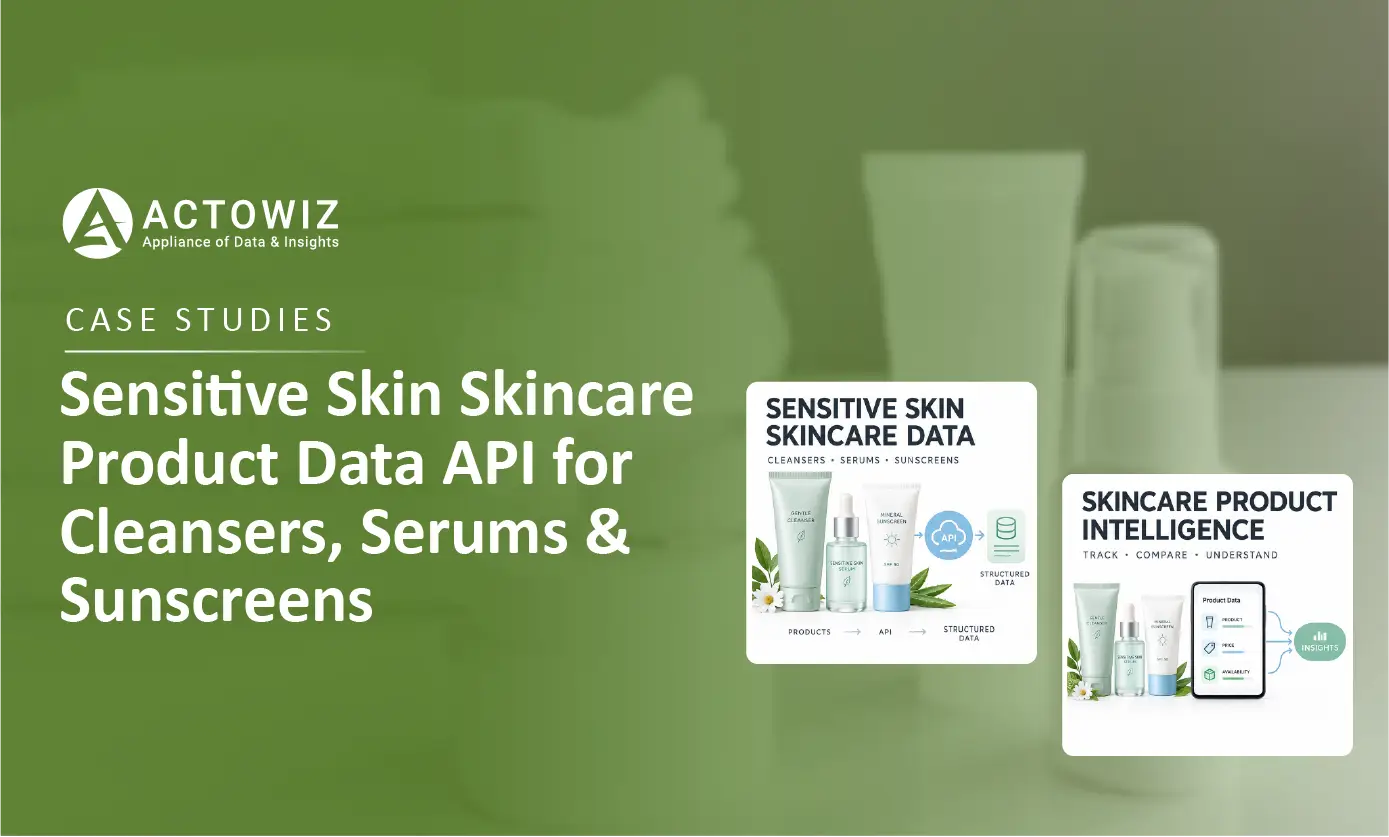
How Sensitive Skin Skincare Product Data API Helps Brands Track Cleansers, Serums, Moisturizers, and Sunscreens

Sensitive Skin Skincare Product Data API helps brands track cleansers, serums, moisturizers, and sunscreens with structured product data.

thumb
Report

Germany Marketplace Market Data Report 2026 for Brand Pricing Intelligence

German marketplace data report 2026: online retail size, Amazon.de, Otto, Kaufland and Zalando price signals, PAngV rules and peak seasons.

Start Where It Makes Sense for You

Whether you're a startup or a Fortune 500 — we have the right plan for your data needs.

icons
Enterprise
Book a Strategy Call
Custom solutions, dedicated support, volume pricing for large-scale needs.
icons
Growing Brand
Get Free Sample Data
Try before you buy — 500 rows of real data, delivered in 2 hours. No strings.
icons
Just Exploring
View Plans & Pricing
Transparent plans from $500/mo. Find the right fit for your budget and scale.
Get in Touch
Let's Talk About
Your Data Needs
Tell us what data you need — we'll scope it for free and share a sample within hours.
  • icons
    Free Sample in 2 HoursShare your requirement, get 500 rows of real data — no commitment.
  • icons
    Plans from $500/monthFlexible pricing for startups, growing brands, and enterprises.
  • icons
    US-Based SupportOffices in New York & California. Aligned with your timezone.
  • icons
    ISO 9001 & 27001 CertifiedEnterprise-grade security and quality standards.
Request Free Sample Data
Fill the form below — our team will reach out within 2 hours.
+1 ▼
✓ Free 500-row sample · No credit card · Response within 2 hours

Request Free Sample Data

Our team will reach out within 2 hours with 500 rows of real data — no credit card required.

+1 ▼
✓ Free 500-row sample · No credit card · Response within 2 hours