Introduction
India RERA Property Registry Data Scraping helps solve property verification and real estate compliance challenges by automating access to verified RERA records, project registrations, builder information, approval statuses, and regulatory updates. It enables developers, investors, proptech companies, financial institutions, legal professionals, and real estate consultants to make faster, data-driven decisions while minimizing manual verification efforts.
Industry Insight: According to industry estimates, India's real estate sector is expected to exceed USD 1 trillion by 2030, while the number of RERA-registered projects continues to grow across multiple states. Automated property intelligence has become increasingly important for ensuring transparency, regulatory compliance, and informed investment decisions.
India's real estate industry is undergoing a digital transformation as regulatory transparency becomes a key priority for developers, investors, lenders, homebuyers, and government authorities. The implementation of the Real Estate (Regulation and Development) Act (RERA) has significantly improved accountability by requiring developers to register projects and disclose verified project information through state-specific RERA portals. However, manually collecting and verifying this information across multiple states is time-consuming, repetitive, and difficult to scale.
This is where India RERA Property Registry Data Scraping delivers significant value. By automating the extraction of publicly available RERA records, organizations gain access to structured information such as project registration numbers, developer profiles, project locations, approval status, completion timelines, litigation updates, and compliance details. Rather than navigating hundreds of individual listings manually, businesses can build centralized datasets that support faster analysis and better operational efficiency.
Combined with Real Estate Data Scraping, organizations can create comprehensive property intelligence platforms that combine RERA records with market listings, pricing trends, transaction history, locality insights, and construction activity. This integrated approach supports property verification, fraud detection, market research, competitive benchmarking, lending risk assessment, due diligence, and investment analysis.
Who Benefits from Automated Property Intelligence?
The solution is valuable for a wide range of organizations, including:
- Real estate developers monitoring competing projects.
- Property listing and PropTech platforms.
- Banks and housing finance companies.
- Investment and private equity firms.
- Legal and compliance consultants.
- Real estate advisory companies.
- Government research organizations.
- Construction and infrastructure analysts.
Challenges Solved Through Automated RERA Data Collection
Organizations implementing automated RERA data extraction can address several business challenges:
- Reduce manual property verification time.
- Improve regulatory compliance monitoring.
- Detect inconsistencies across project records.
- Monitor project registration updates continuously.
- Build reliable property intelligence databases.
- Support investment due diligence.
- Enable data-driven market analysis.
- Improve reporting accuracy across multiple Indian states.
Throughout this blog, we'll explore how automated RERA data extraction improves transparency, accelerates property verification, strengthens compliance workflows, and empowers organizations with reliable real estate intelligence backed by structured data and actionable insights.
How Can Verified Project Records Improve Property Verification?
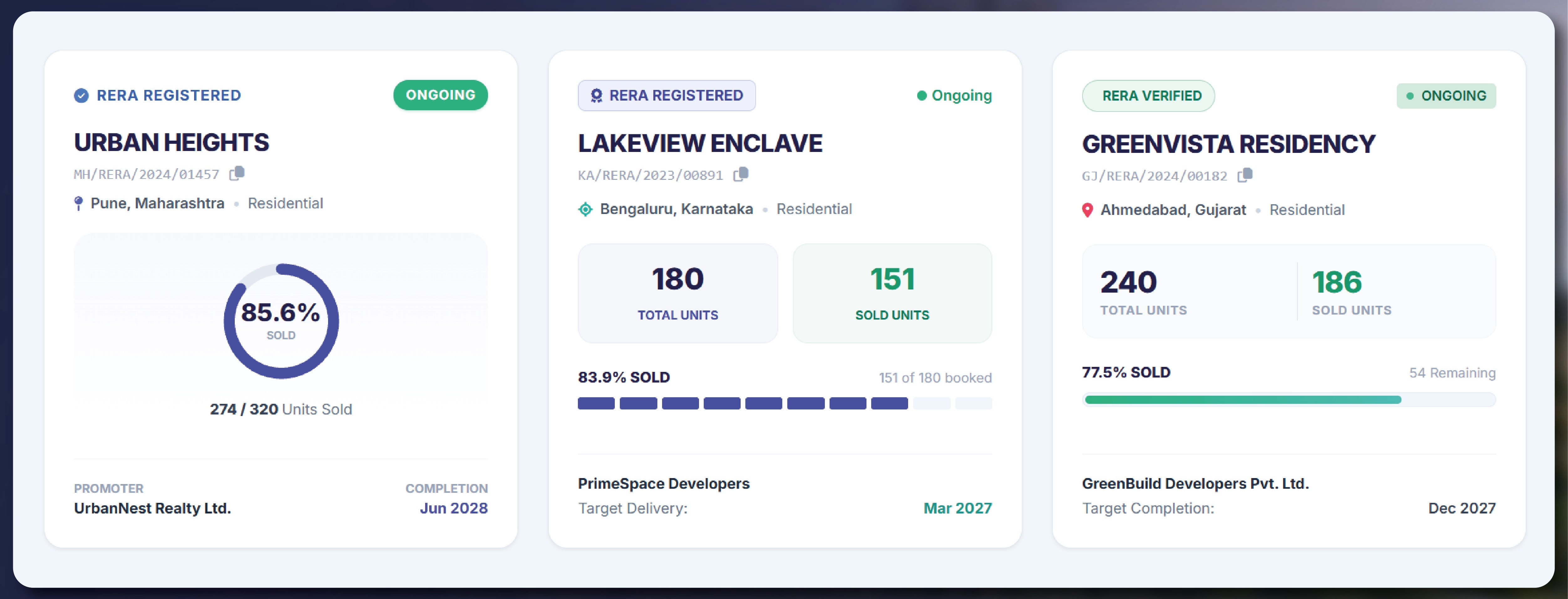
One of the biggest challenges in India's real estate sector is verifying whether a property project is legally registered and compliant with state RERA regulations. Buyers, lenders, investors, and property consultants often spend hours reviewing multiple state portals to validate project information. Manual verification slows business operations and increases the possibility of overlooking important updates.
Businesses can solve this challenge through RERA Project Registration Data Extraction, which automates the collection of publicly available registration records from state RERA portals. Automated extraction provides structured information such as project registration numbers, developer names, project status, approval dates, construction timelines, registered addresses, completion schedules, project categories, and regulatory disclosures. This information helps organizations create centralized databases for faster verification and compliance monitoring.
Real estate platforms use this intelligence to improve listing accuracy, while financial institutions strengthen loan verification processes. Developers monitor competing projects, and legal professionals perform due diligence with greater efficiency. Historical project records also help analysts evaluate construction activity, identify development trends, and assess regional market growth.
RERA Project Registration Trends (2020–2026)
| Year |
Estimated Registered Projects |
States with Active Digital RERA Portals |
Digital Verification Adoption |
| 2020 |
34,500 |
24 |
62% |
| 2021 |
39,800 |
27 |
68% |
| 2022 |
45,900 |
30 |
74% |
| 2023 |
53,700 |
33 |
81% |
| 2024 |
61,800 |
35 |
87% |
| 2025* |
69,500 |
36 |
92% |
| 2026* |
77,400 |
36+ |
95% |
*Projected industry estimates based on digital adoption trends.
Key Business Benefits
- Verify project registration quickly.
- Improve property due diligence.
- Monitor developer compliance.
- Reduce manual verification effort.
- Build centralized project databases.
- Strengthen lending and investment decisions.
- Support regulatory reporting.
- Improve transparency across real estate operations.
As India's property market becomes increasingly data-driven, automated project registration intelligence helps organizations reduce verification time, improve compliance accuracy, and make confident real estate decisions using reliable and structured information.
How Can Property Data Analytics Improve Real Estate Decision-Making?
Real estate organizations generate and process large volumes of property information every day. However, collecting data from multiple state RERA portals and converting it into meaningful business insights can be challenging without automation. Buyers, developers, banks, investors, PropTech companies, and consultants require reliable analytics to understand market trends, evaluate investment opportunities, and monitor regulatory compliance efficiently.
By leveraging India Property Registry Data Analytics, organizations can transform raw property registration records into actionable intelligence. Automated analytics combine project registrations, developer profiles, project status, completion timelines, property locations, approvals, and compliance records into structured dashboards for easier reporting and strategic planning. Historical comparisons also help businesses identify market growth patterns, monitor construction activity, and evaluate regional development trends across different states.
Advanced analytics support multiple business functions, including investment due diligence, project benchmarking, risk assessment, lending decisions, competitive analysis, and market forecasting. Instead of relying on fragmented information, organizations gain a centralized view of India's evolving real estate landscape, enabling faster and more informed decision-making.
Property Registry Analytics Trends (2020–2026)
| Year |
Property Records Analyzed (Millions) |
Organizations Using Analytics |
Decision Accuracy Improvement |
| 2020 |
6.5 |
420 |
68% |
| 2021 |
8.9 |
610 |
73% |
| 2022 |
11.8 |
860 |
79% |
| 2023 |
15.6 |
1,180 |
85% |
| 2024 |
20.4 |
1,620 |
90% |
| 2025* |
25.9 |
2,050 |
94% |
| 2026* |
31.8 |
2,550 |
97% |
*Projected estimates based on increasing adoption of real estate analytics solutions.
Key Benefits of Property Analytics
- Analyze project registration trends.
- Compare regional real estate activity.
- Evaluate developer performance.
- Support investment and lending decisions.
- Improve compliance reporting.
- Identify emerging property markets.
- Build predictive market intelligence.
- Enable data-driven business strategies.
Organizations that invest in automated property analytics gain a competitive advantage by transforming verified registry information into actionable insights. This enables faster property verification, stronger compliance management, improved market forecasting, and smarter real estate decisions in an increasingly transparent and data-driven industry.
How Can Continuous Monitoring Improve Property Compliance and Transparency?
Property records are constantly updated as developers register new projects, modify approvals, revise completion timelines, and submit compliance documents to state RERA authorities. Organizations that depend on outdated information risk making inaccurate investment, lending, or regulatory decisions. Continuous monitoring helps businesses stay informed about these changes and maintain reliable property intelligence.
Using Property Registration Data Monitoring, businesses can automatically track updates across multiple state RERA portals without manually checking each website. Automated monitoring captures newly registered projects, changes in project status, developer profile updates, approval revisions, construction milestones, and compliance notifications. This enables real estate companies, banks, insurance providers, legal firms, and PropTech platforms to maintain accurate databases while improving operational efficiency.
Historical monitoring also allows analysts to identify long-term market trends, evaluate developer consistency, compare regional project growth, and assess regulatory compliance across different states. Continuous access to updated information minimizes business risk and supports faster decision-making throughout the property lifecycle.
Property Monitoring Trends (2020–2026)
| Year |
Projects Monitored |
Monthly Record Updates |
Monitoring Accuracy |
| 2020 |
42,000 |
85,000 |
90% |
| 2021 |
51,500 |
108,000 |
92% |
| 2022 |
63,400 |
136,000 |
94% |
| 2023 |
77,900 |
171,000 |
96% |
| 2024 |
94,300 |
214,000 |
98% |
| 2025* |
112,800 |
258,000 |
99% |
| 2026* |
131,600 |
305,000 |
99% |
*Projected estimates based on increasing adoption of automated real estate intelligence solutions.
Key Advantages of Continuous Monitoring
- Detect new project registrations quickly.
- Track developer and compliance updates.
- Monitor approval and completion status.
- Improve due diligence processes.
- Reduce manual verification efforts.
- Build reliable historical property records.
- Support regulatory reporting.
- Strengthen investment and lending decisions.
Continuous property monitoring enables organizations to maintain accurate, up-to-date real estate intelligence while reducing operational complexity. By automating regulatory tracking, businesses can improve transparency, minimize compliance risks, and make faster, data-driven decisions in India's rapidly evolving property market.
How Can Market Intelligence Help Businesses Stay Ahead in India's Real Estate Sector?
Success in the real estate industry depends on understanding market movements before competitors do. Developers, investors, banks, PropTech companies, and research firms require timely insights into project launches, regional development, developer activity, compliance trends, and investment opportunities. Traditional research methods are often slow and fragmented, making it difficult to respond quickly to changing market conditions.
By leveraging India RERA Market Intelligence, organizations can convert publicly available regulatory information into meaningful business insights. When combined with India RERA Property Registry Data Scraping, businesses gain continuous access to verified project registrations, developer profiles, construction progress, approval status, project completion timelines, and location-based property information. This intelligence enables organizations to benchmark regional growth, evaluate developer performance, identify emerging investment hotspots, and assess market competitiveness with greater confidence.
Comprehensive market intelligence also supports predictive analytics by revealing long-term development trends across different states. Decision-makers can compare project registrations, monitor infrastructure growth, evaluate compliance performance, and identify high-potential investment corridors using centralized and structured datasets.
India RERA Market Intelligence Trends (2020–2026)
| Year |
Projects Analyzed |
States Covered |
Market Intelligence Accuracy |
| 2020 |
38,500 |
24 |
89% |
| 2021 |
46,900 |
27 |
91% |
| 2022 |
57,800 |
30 |
94% |
| 2023 |
70,600 |
33 |
96% |
| 2024 |
85,900 |
35 |
98% |
| 2025* |
101,700 |
36 |
99% |
| 2026* |
118,400 |
36+ |
99% |
*Projected estimates based on continued digital adoption and increasing RERA registrations.
Benefits of Real Estate Market Intelligence
- Compare regional property development trends.
- Evaluate developer performance and compliance.
- Identify high-growth investment locations.
- Monitor new project registrations.
- Support competitive benchmarking.
- Improve investment and lending strategies.
- Build predictive real estate models.
- Strengthen long-term business planning.
Organizations that invest in automated market intelligence gain a comprehensive understanding of India's evolving property landscape. Access to verified regulatory data enables faster analysis, reduces manual research, and supports strategic decision-making, helping businesses stay competitive in an increasingly transparent and data-driven real estate market.
How Can Structured Property Databases Improve Real Estate Research?
Real estate companies often struggle to collect accurate property information from multiple RERA portals because each state platform may have different layouts, search formats, and update schedules. Manual data collection creates delays and makes it difficult to maintain a consistent property database. A structured approach helps organizations access verified information faster and improve research efficiency.
Using Scrape RERA Property Information Database, businesses can automate the collection of project details, developer information, registration numbers, approval records, project locations, completion timelines, and compliance updates. This structured database approach allows PropTech companies, investors, financial institutions, and real estate consultants to analyze thousands of property records without spending significant time on manual research.
A centralized RERA database supports multiple use cases, including property discovery platforms, investment analysis, market forecasting, competitor research, and compliance monitoring. Businesses can also combine registry data with pricing trends, location intelligence, and market demand signals to create deeper real estate insights.
Automated database collection improves accuracy by reducing human errors and ensuring organizations work with consistent and updated property information. It also enables faster reporting and helps decision-makers evaluate opportunities across multiple cities and states.
RERA Database Growth Trends (2020–2026)
| Year |
Property Records Collected (Millions) |
Data Sources Covered |
Database Reliability |
| 2020 |
5.2 |
22 |
88% |
| 2021 |
7.4 |
25 |
91% |
| 2022 |
10.1 |
29 |
94% |
| 2023 |
13.8 |
32 |
96% |
| 2024 |
18.6 |
35 |
98% |
| 2025* |
24.2 |
36 |
99% |
| 2026* |
30.5 |
36+ |
99% |
*Projected estimates based on increased adoption of automated property intelligence.
Key Advantages of Structured RERA Databases
- Access verified property information quickly.
- Reduce manual research efforts.
- Improve property comparison processes.
- Support investment analysis.
- Enhance compliance monitoring.
- Enable scalable real estate platforms.
- Improve reporting and forecasting.
- Create historical property datasets.
A structured property information database gives businesses a reliable foundation for real estate intelligence. By automating data collection and organization, companies can improve research accuracy, identify opportunities faster, and make better decisions in India's competitive property market.
How Does Automated RERA Data Collection Support Real Estate Growth?
India's real estate market generates massive volumes of regulatory and project-related information every year. Developers register new projects, update construction details, submit compliance information, and modify project records regularly. Managing this information manually creates operational challenges for organizations that need accurate and timely insights.
With RERA Data Scraping India, businesses can automate the collection of publicly available RERA records and transform scattered information into structured datasets. Automated scraping solutions help organizations collect project registrations, developer details, approval information, project status updates, and regulatory records from multiple sources.
Real estate companies use this intelligence to monitor competitors, identify market opportunities, and improve project planning. Financial institutions use structured property data for risk assessment and verification. PropTech platforms use it to enhance property search experiences and provide users with reliable information.
Automated RERA data collection also supports large-scale market research by enabling organizations to analyze regional growth patterns, developer activity, and investment trends. Continuous data updates ensure that businesses work with fresh information and reduce the risks associated with outdated property records.
RERA Data Automation Trends (2020–2026)
| Year |
Automated Records Processed (Millions) |
Data Update Frequency |
Processing Efficiency |
| 2020 |
4.8 |
Weekly |
82% |
| 2021 |
6.9 |
Weekly |
86% |
| 2022 |
9.5 |
Daily |
90% |
| 2023 |
13.2 |
Daily |
94% |
| 2024 |
17.9 |
Hourly |
97% |
| 2025* |
23.6 |
Near Real-Time |
98% |
| 2026* |
29.8 |
Real-Time |
99% |
*Projected estimates based on automation adoption.
Business Applications of RERA Data Automation
- Property market research.
- Developer benchmarking.
- Compliance tracking.
- Investment analysis.
- Real estate lead generation.
- Risk assessment.
- Property verification.
- Market trend forecasting.
Automated RERA data collection enables organizations to build reliable property intelligence systems that improve transparency, reduce research time, and support smarter business strategies across India's growing real estate ecosystem.
How Can Actowiz Solutions Help Businesses Build Reliable Real Estate Intelligence?
Actowiz Solutions helps businesses transform complex property information into structured, actionable intelligence. Real estate companies, PropTech platforms, financial institutions, investors, and market researchers need accurate and scalable data solutions to improve verification, compliance monitoring, and market analysis. Manual research across multiple RERA portals can consume significant time and resources. Automated data solutions help organizations overcome these challenges with faster and more reliable insights.
Through advanced India RERA Data Scraping solutions, Actowiz Solutions enables businesses to collect structured property records, project registrations, developer details, approval information, compliance updates, and market intelligence from multiple sources. Our solutions are designed to support organizations that require accurate property datasets for analysis, reporting, and decision-making.
Actowiz Solutions specializes in delivering customized data extraction services that help companies monitor property developments, analyze market trends, and improve operational efficiency. By leveraging India RERA Property Registry Data Scraping, businesses can create centralized property intelligence systems that simplify due diligence, improve transparency, and support strategic growth.
Our solutions include:
- Automated RERA portal data collection.
- Property registry database creation.
- Developer and project monitoring.
- Real estate market intelligence.
- Competitive property analysis.
- Compliance tracking solutions.
- Structured dataset delivery.
- Custom API-based data solutions.
Beyond RERA data extraction, Actowiz Solutions supports complete digital intelligence requirements, including Web Scraping, Mobile App Scraping, and real-time data collection solutions. Businesses can integrate accurate property intelligence into their existing platforms, dashboards, and analytics systems to improve decision-making.
Whether you need property verification data, market research datasets, or large-scale real estate intelligence, Actowiz Solutions provides scalable solutions designed to meet evolving business requirements.
Why Is Data-Driven Property Intelligence the Future of Real Estate?
India's real estate industry is becoming increasingly dependent on accurate, transparent, and updated information. Buyers expect verified property details. Investors require reliable market insights. Businesses need faster ways to evaluate opportunities and manage risks.
Automated property intelligence helps organizations move beyond manual research methods. It enables faster verification, better compliance management, and improved market forecasting. By combining RERA records with additional real estate information sources, businesses can create complete visibility into property ecosystems.
Modern real estate organizations use structured datasets to:
- Identify profitable investment opportunities.
- Analyze regional development trends.
- Monitor competitor activity.
- Improve property discovery platforms.
- Reduce verification risks.
- Enhance customer trust.
- Support smarter financial decisions.
A Real-time dataset approach allows companies to continuously monitor property updates and respond quickly to market changes. Fresh information helps businesses maintain competitive advantages while improving accuracy across their operations.
Conclusion
The Indian real estate market is rapidly becoming more transparent and data-driven. However, accessing, organizing, and analyzing property registry information remains challenging for many organizations. Automated solutions provide a practical way to overcome these challenges by delivering structured, accurate, and scalable property intelligence.
India RERA Property Registry Data Scraping enables businesses to collect verified project information, monitor compliance updates, analyze market trends, and improve property verification workflows. Developers, investors, financial institutions, and PropTech companies can use this intelligence to reduce risks, improve decision-making, and create better customer experiences.
The combination of automated data extraction, advanced analytics, and real-time monitoring is transforming how organizations approach real estate research. Businesses can now evaluate markets faster, track developments more effectively, and build stronger strategies based on reliable information.
Actowiz Solutions delivers customized data solutions that support property intelligence, compliance monitoring, market analysis, and competitive research.
Connect with Actowiz Solutions today to leverage advanced data solutions for your property intelligence needs. Whether you require Web Scraping, Mobile App Scraping, real-time data collection, or a customized instant data scraper service, our experts help you access accurate datasets and unlock powerful real estate insights!
You can also reach us for all your mobile app scraping, data collection, web scraping , and instant data scraper service requirements!

 By industry🏷 By platform🌐 By market
 Pricing & Promotions
MAP Violations Brand Protection Counterfeit Detection Price Intelligence AI HOT Data Intelligence
Pricing & Promotions
MAP Violations Brand Protection Counterfeit Detection Price Intelligence AI HOT Data Intelligence Brand & Intelligence
Share of Search Content Audit & PDP Reviews & Ratings Retail Media Buy Box Monitoring Social Commerce HOT Live Commerce NEW Agentic Commerce NEW
Brand & Intelligence
Share of Search Content Audit & PDP Reviews & Ratings Retail Media Buy Box Monitoring Social Commerce HOT Live Commerce NEW Agentic Commerce NEW Digital Shelf & Search
Assortment Planning Competitive Benchmarking Product Availability Q-Commerce NEW
Digital Shelf & Search
Assortment Planning Competitive Benchmarking Product Availability Q-Commerce NEW AssortmentE-commerce Intelligence Hyperlocal Insights POI & Store Locator DTC Brand Analytics NEW
 For Retailers
 E-Commerce Dashboard
 Flipkart Insights (Live) #1
 Grocery Intelligence
.svg) Grocery Price (U.S.)
Grocery Price (U.S.)
.svg) Quick Commerce (India) HOT
Quick Commerce (India) HOT
 Food & Restaurant
 Fashion Intelligence
 Automotive
 Travel & Hospitality
 Real Estate
 Food Delivery Intelligence NEW
 OTT & Streaming NEW
 Fuel & EV Charging Price Tracker NEW
 By Use Case
 Pricing Intelligence
 Digital Shelf Analytics
 MAP Monitoring HOT
 Cross-Border Price Parity NEW
 Share of Search
 Review Sentiment
 Kitchen Market Gaps NEW
 Dynamic Pricing / AI Repricing NEW
 Promotions & Deals Alerts NEW
 B2B / POI & Lead Data NEW
 AI Search Visibility Dashboard NEW
 Baby Products on Quick Commerce NEW
 Hotel & Flight Rate Parity NEW
 By Region🇮🇳 India 🇺🇸 USA 🇦🇪 Middle East 🇬🇧 UK 🇦🇺 Australia 🌏 SE Asia 🇪🇺 Europe 🌎 LATAMIndia
 Flipkart Real-Time Insights
 Quick Commerce — Zepto · Blinkit
 Pincode Price Tracker
Middle East
Pincode Price Tracker
Middle East GCC Q-Commerce — Talabat · Noon NEW
UK & Australia
GCC Q-Commerce — Talabat · Noon NEW
UK & Australia UK Grocery — Tesco, Sainsbury's, Asda
 AU Grocery — Coles & Woolworths NEW
 Marketplace Scrapers
Amazon API TikTok Shop API HOT Uber Eats API Airbnb API Zepto / Blinkit API Instacart API NEW Talabat API NEW
Marketplace Scrapers
Amazon API TikTok Shop API HOT Uber Eats API Airbnb API Zepto / Blinkit API Instacart API NEW Talabat API NEW Developer APIsWeb Extract API Reviews API SERP API Pricing Webhook NEW
 Universal APIsStreaming Crawl API Scheduler Realtime Alerts Webhook Delivery 🐍 Python SDK 💚 Node.js SDK
 Delivery & SDKs
 Knowledge Center
Digital Shelf Playbook MAP Compliance Guide Pricing Intel Guide Scraping Compliance TikTok Shop Guide NEW Cross-Border Guide NEW
Knowledge Center
Digital Shelf Playbook MAP Compliance Guide Pricing Intel Guide Scraping Compliance TikTok Shop Guide NEW Cross-Border Guide NEW Guides & Playbooks
🎉 Seasonal & event tracking NEWBlack Friday pricing report Festive season, India Ramadan, GCC grocery All seasonal reportsSample Datasets HOT ROI Calculator NEW API Postman Collection Demo Dashboards Free API Playground NEW Press Kit
Guides & Playbooks
🎉 Seasonal & event tracking NEWBlack Friday pricing report Festive season, India Ramadan, GCC grocery All seasonal reportsSample Datasets HOT ROI Calculator NEW API Postman Collection Demo Dashboards Free API Playground NEW Press Kit Downloads & Tools
Trust Center About Us FAQs Careers
Downloads & Tools
Trust Center About Us FAQs Careers Trust & CompanyRetail shelf research NEWRetail shelf research






































 4.8/5 Average Rating
 50+ Video Testimonials
 92% Client Retention
 50+ Countries Served


.webp)