🎃 HALLOWEEN OFF Spooky Savings Event! Get FLAT 20% OFF on all Web Scraping & Data Extraction Plans 20% OFF Web Scraping Plans!
Ends in: 00d : 00h : 00m : 00s
🦇
👻
🎃 Spooktacular Limited Offer

Don’t Let High Data Costs Haunt You! 🎃

Get FLAT 20% OFF

T&C Apply

Scrape competitor prices, monitor MAP, and extract real-time datasets at a spooky discount this Halloween.

Offer Expires In:
00d : 00h : 00m : 00s
⚡ Claim 20% Discount Now
🎃
Promo Code Copied!
SPOOKY30 (20% OFF Applied)
Core services
Enterprise Data Extraction

Scalable web, app and AI-powered collection across 40+ countries.

All 58 services →
New 2026
AI Training Data

Corpus building with provenance and opt-out compliance.

Learn more →
Free pilot
24-hour sample

We run collection on your own sources before you commit.

Get a sample →
58Services
40+Countries
DEVELOPER

Ready-Made Scrapers

Pre-built for top platforms. Self-serve, no setup.

View All →
TRY FREE

API Playground

Test endpoints instantly. No credit card.

Start Free →
28Tools
2SDKs
icons Delivery & SDKs
Streaming Crawl API Scheduler Realtime Alerts Webhook Delivery 🐍 Python SDK 💚 Node.js SDK

Need it managed instead?

Fixed monthly retainer, named engineer, no per-request metering.

Managed Data API →
HOT

Case Studies

How brands use Actowiz, with named outcomes.

Read →
FREE

Sample Datasets

Real output, no signup.

Download →
NEW

ROI Calculator

Model the return on a data engagement.

Calculate →
Texas ZIP-Level Grocery Price Data for Local Price Tracking

Introduction

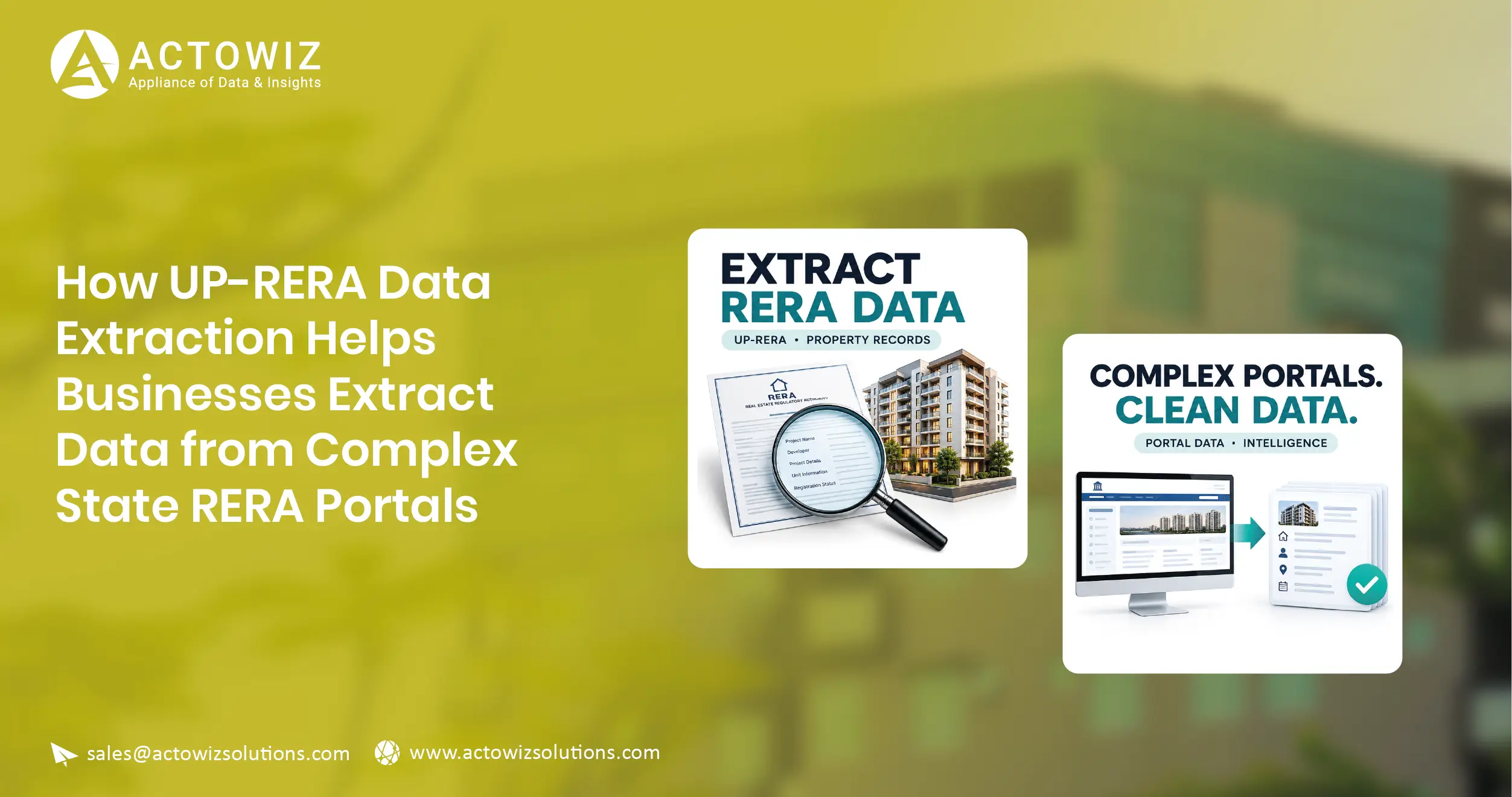
UP-RERA Data Extraction helps real estate companies, property marketplaces, investors, research firms, and developers convert publicly available Uttar Pradesh RERA information into structured datasets for project discovery, promoter analysis, location intelligence, compliance research, and market monitoring. This is especially valuable when teams need to monitor hundreds of projects rather than manually inspect individual records.

The Uttar Pradesh Real Estate Regulatory Authority (UP-RERA) portal provides searchable information covering registered projects, promoters, agents, completed projects, de-registered projects, NCLT projects, abeyance projects, and withdrawn registrations. Its project-search interface supports filters such as district, promoter, registration number, and project name. (UP RERA)

For businesses conducting RERA Data Scraping India, the challenge is not simply finding information. It is creating a reliable, normalized, historical dataset from a portal where information can be distributed across search pages, project profiles, documents, status fields, and location-related records.

The opportunity is significant. According to UP-RERA's January 2026 performance release, the authority registered 308 real estate projects in 2025, compared with 259 in 2024, while approved units increased from 69,365 to 84,976. Capital investment also increased from ₹44,526 crore in 2024 to ₹68,328 crore in 2025. (UP RERA)

This growing volume makes automated extraction useful for stakeholders that need current, comparable, and analysis-ready real estate information.

How can businesses collect project information from the UP-RERA portal?

UP-RERA Data Scraping enables businesses to systematically collect project-level information instead of repeatedly navigating the portal manually. A structured collection process can capture publicly accessible fields and organize them into a consistent database.

The UP-RERA project search currently provides tabular and map views and allows users to search by district, promoter, registration number, and project name. (UP RERA)

A project dataset can include:

Project Dataset Fields
Data Field Business Use
Project Name Project identification
RERA Registration Number Regulatory matching
Promoter Name Developer research
District Geographic segmentation
Project Type Residential/commercial analysis
Registration Date Project timeline
Completion Date Delivery analysis
Project Status Monitoring
Location Market mapping
Units Supply assessment
Project URL Source verification
2020-2026 progression

The period from 2020 to 2021 increased the importance of digital access to real estate information as buyers, developers, and analysts relied more heavily on online sources. During 2022-2023, businesses increasingly needed structured project information for market research and developer comparison. In 2024, UP-RERA registered 259 projects, and in 2025 registrations rose to 308, a 19% increase according to the authority's January 2026 release. Approved units also grew by 22.5%, from 69,365 to 84,976. (UP RERA)

For analysts, the practical implication is straightforward: increasing project activity creates a larger dataset to monitor.

A scalable extraction workflow can help businesses:

  • Build a searchable project database.
  • Identify newly registered developments.
  • Compare developers across districts.
  • Track project registration changes.
  • Monitor project categories.
  • Create historical snapshots.
  • Detect changes in project records.

The quality of the output depends on more than extraction volume. Fields should be normalized so that differences in spelling, formatting, addresses, and developer names do not create misleading duplicates.

How can an API make RERA information easier to integrate?

An UP-RERA Data API can provide a structured route for delivering collected information into business applications, databases, dashboards, research systems, and analytics platforms.

Instead of analysts repeatedly downloading or manually copying information, an API-oriented workflow can make structured records available to downstream systems according to an agreed refresh schedule.

For example:

API Data Layers & Applications
API Data Layer Example Application
Project records Property database
Promoter records Developer intelligence
Registration details Compliance research
Location fields Geographic analytics
Status fields Project monitoring
Historical changes Trend analysis
Document metadata Research workflows
2020-2026 progression

Between 2020 and 2022, many real estate research workflows remained spreadsheet-driven and depended heavily on manual collection. From 2023 onward, larger property datasets created a stronger requirement for repeatable data pipelines. In 2024-2025, increasing project registrations and approved units increased the amount of information businesses needed to monitor. By 2026, API-based delivery can make recurring data consumption easier for organizations that already operate centralized data warehouses or business intelligence systems.

UP-RERA itself describes its portal as an IT-enabled system for registration and related regulatory processes. Its current website provides project, promoter, and agent search functionality along with multiple project-status categories. (UP RERA)

For a property marketplace, for example, API-ready data could feed:

  • A project discovery database.
  • A developer comparison dashboard.
  • A geographic market map.
  • A project-status alert system.
  • An internal research platform.

The API should not be viewed as merely a technical convenience. Its main benefit is reusability. Once structured information is available in a standardized format, multiple business teams can consume the same dataset without repeating the collection process.

What project and developer information can businesses identify?

Businesses can Extract project and developer data from UP-RERA to create a connected view of the state's real estate ecosystem. This is more useful than maintaining separate lists of projects and promoters because the relationship between a developer and its projects provides additional analytical context.

The portal's public interface includes dedicated searches for registered promoters and projects, while its project search supports district and promoter filtering. (UP RERA)

A combined dataset can be structured as follows:

Combined Project & Developer Dataset
Entity Important Attributes
Project Name, registration number, location
Promoter Name, registration details
Development Units, project type, timeline
Location District, city, address
Status Registered, completed, withdrawn, etc.
Timeline Registration and completion dates
Source Portal URL and timestamp
2020-2026 progression

From 2020 through 2022, developer research frequently focused on individual projects and established builders. In 2023-2024, broader portfolio-level analysis became more useful as organizations compared developers across multiple locations. In 2025, UP-RERA reported 308 project registrations and more than 84,000 approved units, demonstrating the scale of new project information entering the regulatory ecosystem. (UP RERA)

A developer-centric dataset can answer questions such as:

  • Which promoters have projects in multiple districts?
  • Which developers have the largest project portfolios?
  • Which locations are attracting new registrations?
  • How many projects are active versus completed?
  • Which developers are entering a particular market?
  • Which projects have changed status?

Historical normalization is especially important here. UP-RERA has previously published examples where promoter-name inconsistencies required correction; in one case, two spellings of the same promoter were consolidated, with 13 complaints transferred to the correctly named promoter record. (UP RERA)

This illustrates why simple text matching is insufficient. A robust dataset needs entity normalization, duplicate detection, and relationship mapping.

How can property intelligence reveal emerging real estate opportunities?

UP-RERA Property Data intelligence can help real estate organizations transform regulatory records into market-level insights. Instead of treating every project as an isolated entry, businesses can analyze projects by geography, developer, status, timeline, and other available attributes.

A geographic intelligence model could include:

Geographic Intelligence Dimensions
Intelligence Dimension Potential Insight
District Market concentration
City Local development activity
Project count Supply pipeline
Promoter count Competitive density
Project status Development maturity
Registration year Market momentum
Unit count Potential supply
Location Geographic clustering
2020-2026 progression

In 2020-2021, location information was increasingly important for remote property research. From 2022-2023, businesses began combining project information with broader market datasets to identify development clusters. During 2024-2025, the rise in registrations and approved units strengthened the value of geographic analysis. UP-RERA reported that 2025 registrations expanded across the state, while its current portal provides both tabular and map-based project discovery. (UP RERA)

This information can help different buyer personas in different ways.

  • Property marketplaces can discover new projects and improve catalogue coverage.
  • Real estate consultants can compare project supply across locations.
  • Investors and research firms can identify development clusters for further due diligence.
  • Developers can study competitor presence before entering a market.

However, RERA records should not be treated as a substitute for investment due diligence. Regulatory data can establish useful factual signals, but investment decisions should incorporate independent verification, legal review, market research, and financial analysis.

The strongest model combines RERA information with other datasets such as property listings, transaction indicators, infrastructure information, and demographic or economic data.

How can a structured dataset simplify large-scale RERA research?

A UP-RERA Project Listings Dataset creates a standardized inventory of projects that can be searched, filtered, compared, and refreshed. Instead of storing information as disconnected pages or screenshots, businesses can create a consistent record for every project.

A sample schema could look like this:

Sample Dataset Schema
Field Category Example Fields
Identity Project name, RERA number
Promoter Promoter name, promoter ID
Geography District, city, address
Project Type, units, development details
Timeline Registration date, completion date
Status Current project status
Source URL, collection timestamp
History Previous values/statuses
2020-2026 progression

During 2020-2021, smaller datasets could often be managed manually. As digital project information expanded during 2022-2024, businesses increasingly required centralized databases. In 2025, the 308 project registrations reported by UP-RERA represented a substantial new flow of project records in one year. (UP RERA) By 2026, recurring collection and historical versioning become increasingly useful for teams that need to identify changes rather than simply capture the current state.

A structured dataset enables analytical operations such as:

  • Filtering projects by district.
  • Sorting developers by portfolio size.
  • Tracking new registrations.
  • Comparing project timelines.
  • Identifying status changes.
  • Creating location-based dashboards.
  • Maintaining historical snapshots.

Data freshness should be determined by the use case. A property research database may need weekly or monthly refreshes, while a project-status monitoring workflow may require more frequent checks.

The key is to maintain a timestamp with every collection cycle. Without timestamps, businesses may know what the portal showed but not when it showed it.

How can businesses monitor project status and location changes?

Businesses can Scrape UP-RERA project status and location data to build recurring monitoring systems that identify changes in project records over time.

The current UP-RERA portal separates projects into categories including registered, completed, de-registered, NCLT, abeyance, withdrawn-registration, and NCLT-related categories. (UP RERA)

A monitoring dataset can track:

Monitoring Fields & Change Detection
Monitoring Field Change to Detect
Project Status Status transition
Registration New/updated record
Completion Completion information
Location Address/location update
Promoter Developer changes
Timeline Date changes
Project Details Updated project information
Source Timestamp When change occurred
2020-2026 progression

Between 2020 and 2022, status monitoring was often conducted through periodic manual checks. From 2023-2024, automated comparison became more practical for organizations managing larger project inventories. In 2025, the growth in project registrations increased the value of systematic monitoring. In 2026, UP-RERA continues to publish regulatory notices, project information, and updates through its digital portal, including recent requirements around quarterly progress reporting. (UP RERA)

The most effective approach is change detection rather than repeatedly storing identical records.

For example:

Snapshot 1: Project status = Registered

↓

Snapshot 2: Project status = Updated

↓

Snapshot 3: Project status = Completed

A system can flag the transition and send it to an internal dashboard.

Location monitoring can similarly identify changes in addresses or geographic metadata. When combined with district-level aggregation, these records can reveal where development activity is accelerating or where particular developers are expanding.

This is particularly valuable for property portals and research firms that need a current project universe rather than a static database.

How Can Actowiz Solutions Help?

Actowiz Solutions helps businesses convert complex public-sector and real estate portals into structured, reusable datasets designed around specific research and analytics requirements.

Our AI-Powered Scraping Services can combine automated extraction, field identification, normalization, validation, and change detection to make large-scale portal data collection more efficient.

Our approach includes:

  • Source and field mapping – We identify relevant project, promoter, location, registration, status, and document-related fields within the agreed scope.
  • Automated collection – Structured collection workflows reduce repetitive manual browsing and support recurring extraction.
  • Data normalization – Names, locations, project identifiers, dates, and other fields can be standardized for cross-record comparison.
  • Entity matching – Developer and project records can be matched to reduce duplicate or inconsistent entries.
  • Historical tracking – Timestamped snapshots allow businesses to identify changes between collection cycles.
  • Quality validation – Records can be checked for missing fields, formatting inconsistencies, duplicate entries, and extraction errors.
  • Custom delivery – Datasets can be prepared for databases, spreadsheets, analytics platforms, dashboards, or other agreed formats.

For real estate marketplaces and research companies, the result is not simply scraped information. It is a structured intelligence layer that can support project discovery, competitive research, geographic analysis, and recurring monitoring.

What Makes RERA Data Useful for Real Estate Buyers and Businesses?

The value of regulatory data depends on how it is organized and combined with business context.

A basic project record tells you that a project exists. A structured historical dataset can reveal:

  • When it appeared in the database.
  • Who the associated promoter is.
  • Where it is located.
  • How its status changed.
  • What project attributes are publicly available.
  • How it compares with other projects.
  • Whether a developer has a broader portfolio in the same region.

This distinction is important for AI-assisted research. Search systems and large language models can answer questions more effectively when underlying information is structured, consistent, timestamped, and attributable to a reliable source.

For organizations building internal AI or analytics applications, well-structured RERA datasets can therefore become a useful foundation for natural-language search, automated summaries, project comparisons, and alerting workflows.

Why Should Businesses Combine RERA Data with Other Real Estate Sources?

RERA information is valuable, but it represents only one layer of the real estate market.

A stronger intelligence environment can combine regulatory information with:

Combining RERA Data with Other Sources
Additional Dataset Combined Use
Property listings Market availability
Pricing data Price benchmarking
Developer websites Project marketing intelligence
Infrastructure data Location analysis
Demographics Demand assessment
Reviews Buyer sentiment
Historical records Trend analysis

For example, a research company could combine project registration data with property-listing prices to study how asking prices vary across newly registered developments. A property marketplace could compare its project coverage against the registered-project universe to identify catalogue gaps.


This is where structured RERA information becomes more than a compliance dataset: it becomes one component of a broader real estate intelligence system.

Conclusion

Data Intelligence Services can turn UP-RERA information into structured, searchable, and historical datasets that support real estate research, project discovery, developer analysis, location intelligence, and competitive monitoring. As Uttar Pradesh's registered-project pipeline continues to evolve, businesses need efficient ways to track new records and changes rather than relying entirely on manual portal searches.

The UP-RERA portal already provides project and promoter search capabilities and multiple project-status categories. (UP RERA) The business opportunity is to organize this information into a consistent dataset that can be refreshed, validated, compared, and connected to other real estate sources.

A scalable Web Scraping workflow can support structured portal collection, while Mobile App Scraping can complement digital-source monitoring where relevant and permitted. For businesses requiring frequent updates, a Real-time dataset approach can provide fresher signals for project and market monitoring.

The right solution should prioritize accuracy, historical context, field normalization, source traceability, and responsible collection rather than simply maximizing the number of records.

Ready to build a scalable UP-RERA intelligence pipeline? Contact Actowiz Solutions to discuss your project, data fields, refresh frequency, and delivery requirements!

You can also reach us for all your mobile app scraping, data collection, web scraping , and instant data scraper service requirements!

Social Proof That Converts

Trusted by Global Leaders Across Q-Commerce, Travel, Retail, and FoodTech

Our web scraping expertise is relied on by 4,000+ global enterprises including Zomato, Tata Consumer, Subway, and Expedia — helping them turn web data into growth.

4,000+ Enterprises Worldwide
50+ Countries Served
20+ Industries
Join 4,000+ companies growing with Actowiz →
Real Results from Real Clients

Hear It Directly from Our Clients

Watch how businesses like yours are using Actowiz data to drive growth.

▶
1 min
★★★★★
"Actowiz Solutions offered exceptional support with transparency and guidance throughout. Anna and Saga made the process easy for a non-technical user like me. Great service, fair pricing!"
TG
Thomas Galido
Co-Founder / Head of Product at Upright Data Inc.
▶
2 min
★★★★★
"Actowiz delivered impeccable results for our company. Their team ensured data accuracy and on-time delivery. The competitive intelligence completely transformed our pricing strategy."
II
Iulen Ibanez
CEO / Datacy.es
▶
1:30
★★★★★
"What impressed me most was the speed — we went from requirement to production data in under 48 hours. The API integration was seamless and the support team is always responsive."
FC
Febbin Chacko
-Fin, Small Business Owner
icons 4.8/5 Average Rating
icons 50+ Video Testimonials
icons 92% Client Retention
icons 50+ Countries Served

Join 4,000+ Companies Growing with Actowiz

From Zomato to Expedia — see why global leaders trust us with their data.

Why Global Leaders Trust Actowiz

Backed by automation, data volume, and enterprise-grade scale — we help businesses from startups to Fortune 500s extract competitive insights across the USA, UK, UAE, and beyond.

icons
7+
Years of Experience
Proven track record delivering enterprise-grade web scraping and data intelligence solutions.
icons
4,000+
Projects Delivered
Serving startups to Fortune 500 companies across 50+ countries worldwide.
icons
200+
In-House Experts
Dedicated engineers across scrapers, AI/ML models, APIs, and data quality assurance.
icons
9.2M
Automated Workflows
Running weekly across eCommerce, Quick Commerce, Travel, Real Estate, and Food industries.
icons
270+ TB
Data Transferred
Real-time and batch data scraping at massive scale, across industries globally.
icons
380M+
Pages Crawled Weekly
Scaled infrastructure for comprehensive global data coverage with 99% accuracy.

AI Solutions Engineered
for Your Needs

→
LLM-Powered Attribute Extraction: High-precision product matching using large language models for accurate data classification.
→
Advanced Computer Vision: Fine-grained object detection for precise product classification using text and image embeddings.
→
GPT-Based Analytics Layer: Natural language query-based reporting and visualization for business intelligence.
→
Human-in-the-Loop AI: Continuous feedback loop to improve AI model accuracy over time.
icons Product Matching icons Attribute Tagging icons Content Optimization icons Sentiment Analysis icons Prompt-Based Reporting

Connect the Dots Across
Your Retail Ecosystem

We partner with agencies, system integrators, and technology platforms to deliver end-to-end solutions across the retail and digital shelf ecosystem.

icons
Analytics Services
icons
Ad Tech
icons
Price Optimization
icons
Business Consulting
icons
System Integration
icons
Market Research
Become a Partner →

Popular Datasets — Ready to Download

Browse All Datasets →
icons
Amazon
eCommerce
Free 100 rows
icons
Zillow
Real Estate
Free 100 rows
icons
DoorDash
Food Delivery
Free 100 rows
icons
Walmart
Retail
Free 100 rows
icons
Booking.com
Travel
Free 100 rows
icons
Indeed
Jobs
Free 100 rows

Latest Insights & Resources

View All Resources →
thumb
Blog

Inventory Optimization AI Agent 2026 - How AI-Powered Stock Planning Improves Demand Forecasting

Inventory Optimization AI Agent 2026 helps businesses improve stock planning, forecast demand, reduce inventory waste, and make smarter replenishment decisions.

thumb
Case Study

How We Helped a Travel Brand Use Travel Price Comparison Data Scraping to Improve Airline Fare Intelligence

Explore how Travel Price Comparison Data Scraping helps travel brands monitor fares, compare rates, and gain real-time competitive pricing insights.

thumb
Report

Daily News and Article Data Collection - Real-Time News Monitoring, Content Trends, and Media Intelligence

Discover Daily News and Article Data Collection for real-time news monitoring, content analysis, trend tracking, and actionable media intelligence insights.

Start Where It Makes Sense for You

Whether you're a startup or a Fortune 500 — we have the right plan for your data needs.

icons
Enterprise
Book a Strategy Call
Custom solutions, dedicated support, volume pricing for large-scale needs.
icons
Growing Brand
Get Free Sample Data
Try before you buy — 500 rows of real data, delivered in 2 hours. No strings.
icons
Just Exploring
View Plans & Pricing
Transparent plans from $500/mo. Find the right fit for your budget and scale.
Get in Touch
Let's Talk About
Your Data Needs
Tell us what data you need — we'll scope it for free and share a sample within hours.
  • icons
    Free Sample in 2 HoursShare your requirement, get 500 rows of real data — no commitment.
  • icons
    Plans from $500/monthFlexible pricing for startups, growing brands, and enterprises.
  • icons
    US-Based SupportOffices in New York & California. Aligned with your timezone.
  • icons
    ISO 9001 & 27001 CertifiedEnterprise-grade security and quality standards.
Request Free Sample Data
Fill the form below — our team will reach out within 2 hours.
+1 ▼
✓ Free 500-row sample · No credit card · Response within 2 hours

Request Free Sample Data

Our team will reach out within 2 hours with 500 rows of real data — no credit card required.

+1 ▼
✓ Free 500-row sample · No credit card · Response within 2 hours